
Landspitali - University Hospital
Priority 3: Improving the safety of the use of high-risk drugs
The reform is led by the Landspitali Hospital and the Akureyri Hospital (SAK) with the involvement of the health care system.
The safe use of high-risk medicines associated with the English abbreviation ‘APINCHS’ is given priority:
(A) antibiotics
(P) Potassium and other salt solutions
(I) Insulin
(N) Drugs with a risk of dependence (opioids) and other sedatives
(C) cancer medicines
(H) Heparin and other anticoagulant medicines
(S) Safe systems
Experimental projects have begun in the pharmaceutical departments of Landspítali, SAK and in the health care center.
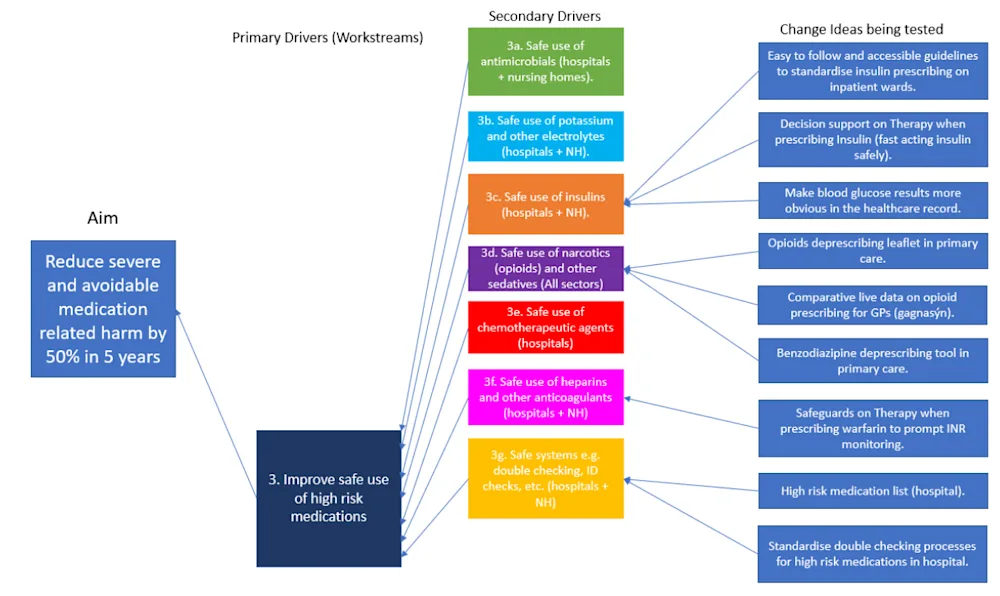
Insulin is a risky drug. Inappropriate or incorrect treatment of patients with diabetes in hospital leads to poor control of glucose and can lead to post-operative ulcer infections, longer hospital stays, re-hospitalisations and deaths that could have been prevented. A large proportion of medication incidents reported at Landspítali involves insulin and many are related to lack of procedures and training of staff in the correct use of insulin.
Interventions to improve insulin safety is a pilot project at one of the pharmaceutical departments at Landspítali. Solutions include:
Available instructions for prescribing insulin, especially for hyperglycaemia.
Employees are reminded to regularly measure blood sugar.
Training and education of employees on the safe use of insulin.
Clinical teams were made easier to respond to blood glucose tests that were outside the limit.
The task force is currently evaluating the impact of these interventions. Solutions that work will be made available to other departments at Landspítali and Akureyri.
1. Understanding Opioid Prescription Patterns in Iceland
An analysis of opioid prescription patterns in Iceland is currently underway. The purpose of this study is to assess which patient groups receive renewed opioid prescriptions, what types of opioids they are prescribed, and which medical specialties are most involved in these prescriptions.
The findings will enable the Steering Committee on High-Risk Medications to determine the root causes behind Iceland having the highest opioid sales among the Nordic countries (NOMESCO Health Statistics Editorial, 2020).
Additionally, the study aims to understand why research consistently shows that 10% of post-surgical patients who were previously opioid-naïve become long-term users (Steen T, Lirk PB & Sigurdsson MI, 2019; Ingason AB et al., 2022)). The results of this study are expected to be presented in spring 2022, with an improvement initiative launched in autumn 2022.
2. Opioid Tapering in Primary Healthcare
Addressing opioid prescriptions in primary healthcare is one of the priority projects of the Icelandic Primary Healthcare Development Center. Direct prescription data will be made accessible to all primary healthcare centers and general practitioners in Iceland to increase awareness of prescribing patterns (via the Gagnasýn system).
Additionally, a patient information leaflet on opioid tapering (from www.deprescribing.org) is being translated into Icelandic. This resource aims to improve communication between patients, caregivers, and physicians regarding the tapering process. The information is presented in plain language and aligns with evidence-based tapering guidelines.
3. Rational Prescribing of Habit-Forming Medications
A new initiative by the Icelandic Primary Healthcare Development Center (ÞÍH) is being prepared to promote the responsible prescribing of these medications. Meetings will be held with physicians from all primary healthcare centers, prescription patterns will be reviewed via Gagnasýn in the Sögu system, and measures will be encouraged to promote safer prescribing practices.
Key aspects of the initiative include:
Standardizing the renewal process for prescriptions
Developing tools to support medication tapering
Exploring alternative non-pharmacological treatments for patients’ conditions
An educational booklet, "You May Be at Risk" (.pdf)(in icelandic), which focuses on sedatives and sleeping pills, will help patients assess, in collaboration with healthcare professionals, whether they can take steps toward better health by tapering off these medications.
Several primary healthcare centers in Iceland have already implemented measures to promote rational prescribing of habit-forming drugs. For example, the Efra-Breiðholt Primary Healthcare Center presented its project and results at the Icelandic Medical Days conference in March 2022, see summary (.pdf)(in icelandic).
At Landspítali, efforts are underway to improve the prescribing and management of warfarin. Currently, different clinical teams use various methods to monitor hospitalized patients receiving warfarin. A recent incident analysis identified several root causes related to warfarin management, including:
A lack of safety mechanisms in the hospital’s electronic prescribing system (Therapy) to ensure that patients on warfarin are monitored at appropriate intervals.
Inconsistent management of warfarin-treated patients across different hospital departments.
To address these issues, new rules have been programmed into the Therapy prescribing system at Landspítali. Under these rules, warfarin can only be prescribed for three days at a time, with a reminder prompting dose reassessment before further prescriptions are issued. This intervention was successfully tested in the cardiology department, where it proved effective. It is now being piloted in geriatric wards, and once its effectiveness is confirmed, it will be implemented in other hospital departments and institutions.
Further research is ongoing regarding accessibility of warfarin prescription information. Currently, warfarin dosing information is not universally accessible to all healthcare professionals across different institutions. If a patient is managed by an anticoagulation team outside Landspítali, hospital staff do not have access to this information upon patient admission. Likewise, when patients are discharged from the hospital and require follow-up care in primary healthcare settings, access to warfarin dosing information is often limited.
Warfarin dosing data is stored in multiple, non-integrated systems across healthcare institutions, increasing the risk of medication errors when patients transition between care settings. Efforts are now being made to improve information-sharing and ensure safer continuity of care for patients on warfarin.
A standardized high-risk drug registry is currently being developed in cooperation between Landspítali and Akureyri Hospital, based on the APINCHS abbreviation. The purpose is to improve medication handling, preparation and administration in the inpatient wards.
Nurses in selected wards are now being asked to determine how this list can be used to add 6Rs (6Rs to a specific medication, administration and registration).