
Landspitali - University Hospital
Consequences, stages and classification
A pressure injury can range from a reddened area on intact skin to a deep wound reaching the bone. The severity of tissue damage determines the staging of pressure injuries.
Stage 1 Pressure Injury
A stage 1 pressure injury appears as a non-blanchable red area on the skin. This means that when pressure is applied with a finger, the redness does not fade, indicating tissue damage at the skin's surface.
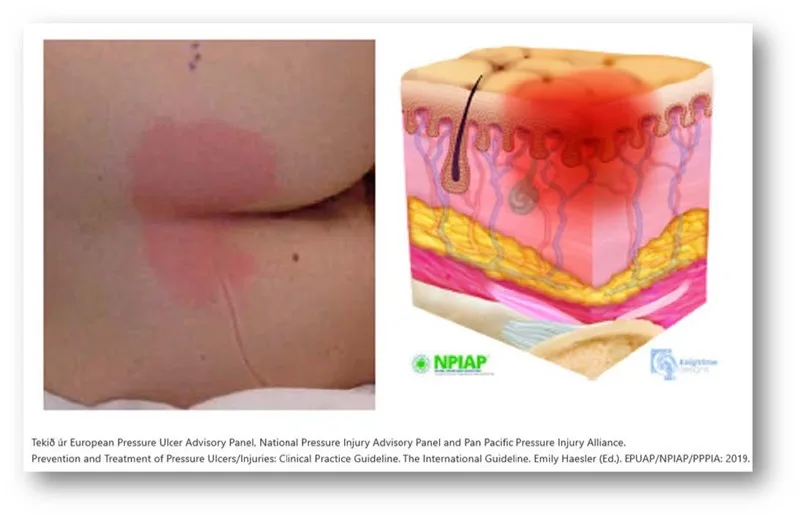
To perform the blanching test, a finger is pressed against the reddened area for a short moment and then quickly released. If the redness disappears (blanches), it suggests a normal response to temporary pressure. However, if the redness persists, it indicates tissue damage and is classified as a stage 1 pressure injury.
For individuals with darker skin tones, identifying redness can be challenging. Other signs of a stage 1 pressure injury may include warmth, firmness, or tenderness in the affected area.
Stage 2 Pressure Injury
A stage 2 pressure injury involves tissue damage extending into or up to the dermis (the second layer of the skin). It may appear as an intact or ruptured blister or as a shallow wound with skin loss.

Stage 3 Pressure Injury
A stage 3 pressure injury extends into the subcutaneous tissue but does not penetrate through the fascia (the connective tissue layer beneath the skin).
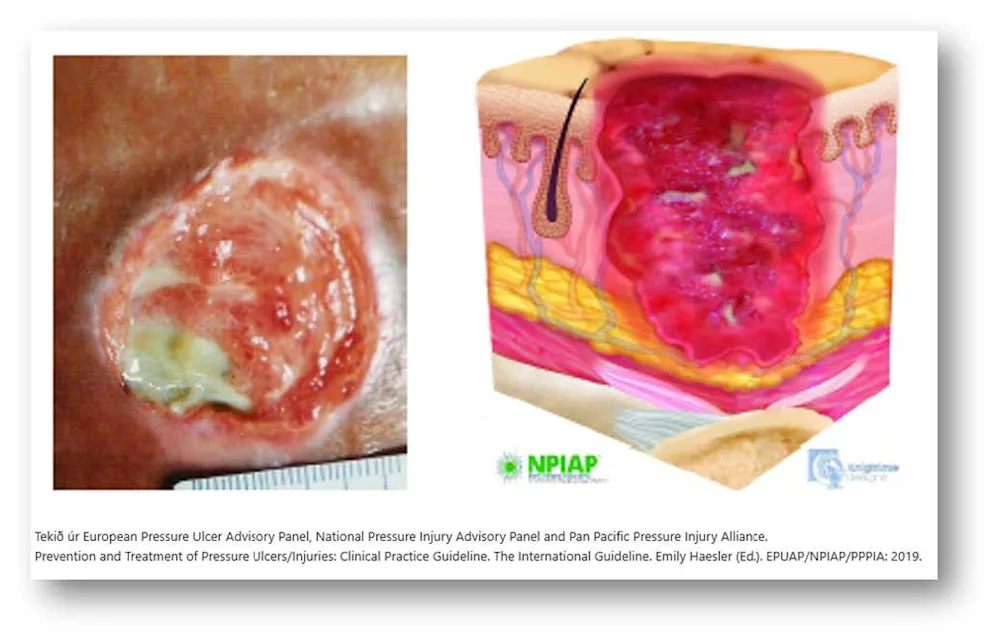
The depth of the injury varies depending on its location. For example, on the heel, where the bone is close to the skin, a stage 3 injury may not be very deep.
Stage 4 Pressure Injury
A stage 4 pressure injury is the most severe and costly type.
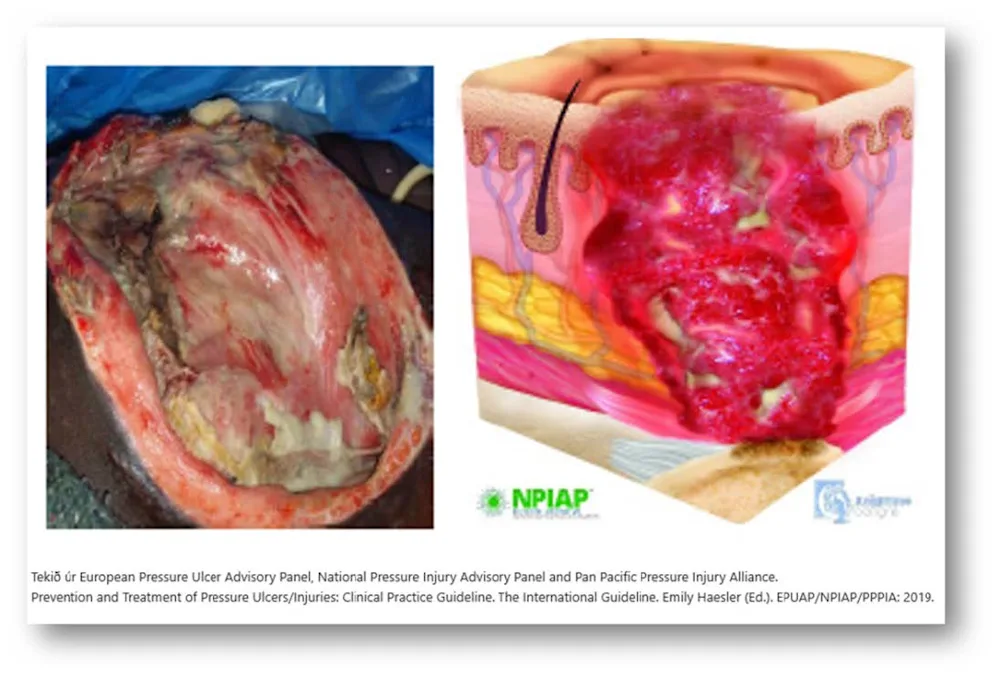
The damage extends through the fascia and reaches underlying muscles, tendons, or bones.
Unstageable Pressure Injury – Suspected Deep Tissue Injury
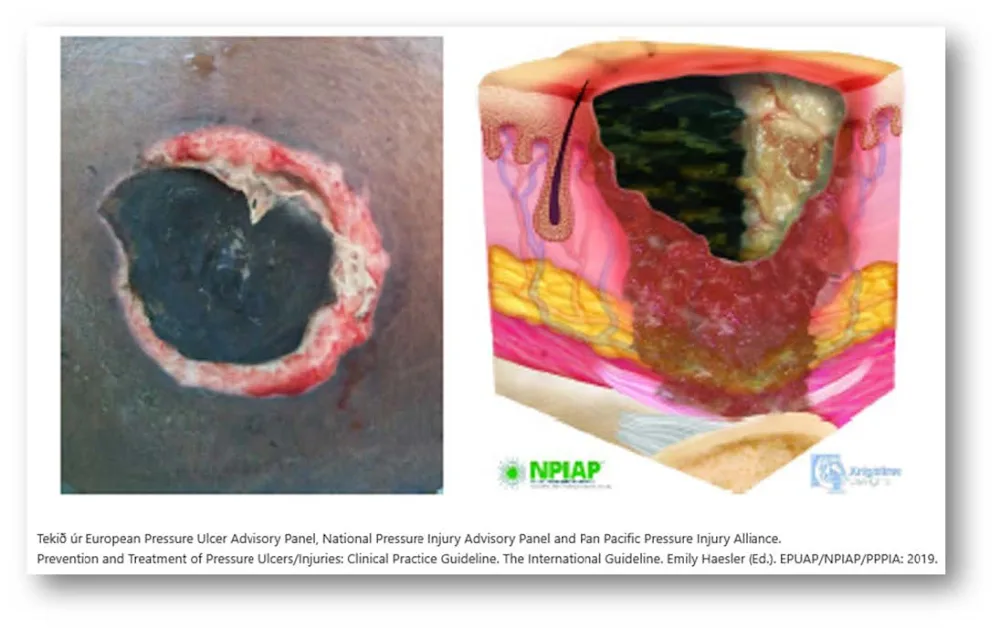
An unstageable or suspected deep tissue injury occurs when the wound base is not visible. The skin may be intact or broken, but significant underlying tissue damage is often present.

Differentiating Pressure Injuries from Incontinence-Associated Dermatitis (IAD)
It is important to distinguish pressure injuries from skin irritation caused by urine and/or fecal incontinence, known as incontinence-associated dermatitis (IAD). Consider the following factors:
Cause: IAD results from exposure to urine and/or feces. If a patient does not experience incontinence, any redness or wound is more likely a pressure injury.
Symptoms: IAD often causes burning, itching, and stinging, whereas pressure injuries typically cause localized pain.
Location: IAD commonly occurs in areas not exposed to pressure, such as the inner thighs and genital region, often affecting large skin surfaces with indistinct borders. Pressure injuries, on the other hand, typically develop over bony prominences (e.g., sacrum, ischial tuberosities) or due to pressure from medical devices, with well-defined edges.
Blanching Test: Redness from IAD blanches with pressure, whereas a stage 1 pressure injury does not.
Symmetry:IAD may present symmetrically, such as "butterfly-shaped" lesions on the buttocks or areas where skin contacts skin.
By accurately identifying and classifying pressure injuries, healthcare professionals can implement appropriate preventive and treatment strategies.