Landspitali - University Hospital
Common Sites of Pressure Injuries
Sacrum
The vast majority of pressure injuries develop on the sacrum or the heel.
When lying on the back, the weight of the pelvic region—one of the heaviest parts of the body—rests on the sacrum. The bony prominences of the sacrum are superficial, and their shallow depth can be easily felt through palpation.
Individuals with limited mobility often struggle to lift the sacral area when repositioning in bed. As a result, friction and shear forces occur on the sacral skin, contributing to the development of pressure injuries.
Ischial Tuberosities
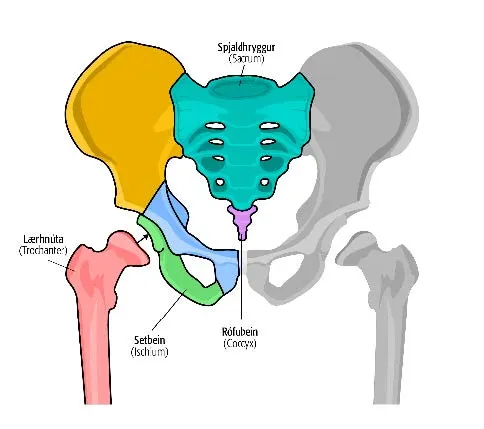
When seated in a chair or bed, the body's weight is concentrated on the ischial tuberosities. This creates significant pressure on the skin and underlying soft tissues. In patients who have difficulty repositioning, shear forces may occur as they slide down in bed or a chair, increasing the risk of tissue damage.
Hip (Trochanter Major)
When lying on the side at a 90° angle, the body’s weight rests on the greater trochanter, leading to pressure on the surrounding skin and soft tissues.
Heel
In the supine position, a large amount of weight is concentrated on the small surface area of the heel, where the bone is close to the skin. This creates pressure that often results in severe pressure injuries. Additionally, friction can cause blistering in patients with limited mobility or involuntary movements. These blisters may contain fluid or blood, and even if the skin remains intact, deep tissue damage may occur.
Ankle
The ankle bones are prominent and easily palpable. When lying on the side, pressure may be exerted on the skin and soft tissue over the medial or lateral malleoli. In some cases, friction can also weaken the skin in these areas.
Occiput (Back of the Head)
The occiput, like other areas of the skull, has very little soft tissue covering the bone. When lying on the back, the weight of the head creates pressure on the occipital skin, increasing the risk of injury.
Ear
The ear has minimal soft tissue covering its cartilage. When lying on the side or stomach, pressure can develop on the ear’s skin, potentially leading to injury.
Spine
The scapulae and the entire spinal column are bony areas, especially in individuals with low body fat. When lying on the back, significant pressure and shear forces can occur over these regions. Pressure can also develop when sitting in a chair.
Elbow
The elbows are bony prominences. When sitting in bed or a chair with armrests, or when using high walkers, the body's weight may rest on the elbows, leading to friction and skin breakdown.
Skin Under Medical Devices and Equipment
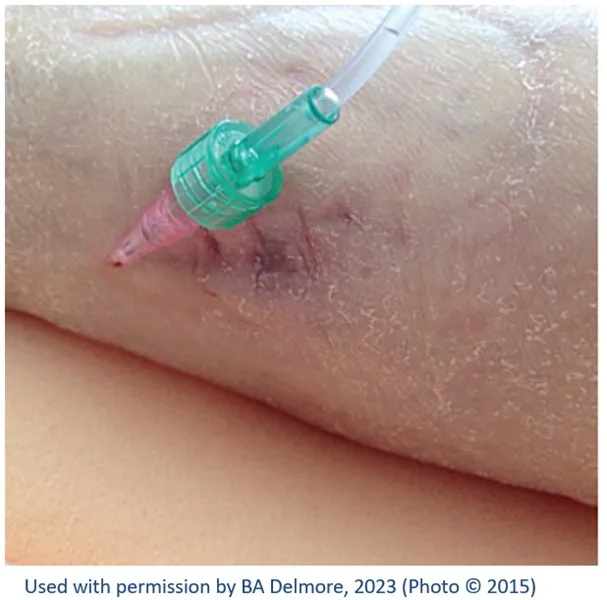
Pressure injuries that do not form over bony prominences are often caused by prolonged pressure from medical devices, equipment, or external objects pressing against the skin. Examples of objects that can cause these types of pressure injuries include:
Pulse oximeters
Oxygen tubing
Urinary catheters
Clothing such as socks and underwear
Small objects inadvertently trapped in the patient’s bed or chair, such as syringe caps, plugs, or cutlery.