Health and safety plan
In Short
All employers are responsible for ensuring that a workplace health and safety plan is in place, regardless of the size of the business. The plan includes risk assessment and a health protection and risk prevention plan.
The plan serves as the foundation for effective occupational health and safety practices. Its purpose is to promote the safety and well-being of employees.
The plan must be written. Its presentation should be clear and accessible to both management and employees.
The plan provides a good overview of hazards in the workplace and how they have been prevented or mitigated through preventive measures. When improvements are needed in the workplace, they should be scheduled and included in the plan.
The plan is a living document that must be reviewed regularly and whenever circumstances change. The effectiveness of the measures taken must also be evaluated.
The employer must ensure that the plan is implemented in daily operations so that occupational safety and health become an integral part of the business. This is the key to promoting employee safety and well-being in the workplace.
Safety and well-being at work is a daily task
Every day, we manage risks in our personal lives to prevent accidents and mishaps. We place knives facing down in the dishwasher and switch to winter tires when the season changes.
The same mindset should apply in the workplace—as shown in the video.
The Administration of Occupational Health and Safety encourages both managers and employees to start a conversation about safety and well-being at work, no matter the nature of the job.
Let’s go over the risks, write them down, and decide together how we’re going to prevent them.
Roles and Responsibilities
The employer is responsible for ensuring that the plan is created and properly followed. Employees must be prepared to participate in its development if requested. It is recommended that the creation and implementation of the plan be a collaborative effort between employers, managers, and employees.
Workplaces need to foster a culture that emphasizes the well-being and safety of employees, with occupational health and safety being an integral part of daily operations. This requires the involvement of everyone at the workplace, with managers leading by example.
When conducting a risk assessment, the employer must identify the risks in the workplace. It is recommended to consult with employees, as they know their jobs well and can provide valuable suggestions for reducing risk.
Employees are obligated to inform the employer, the safety officer, or the safety representative if they notice anything at the workplace that may pose a threat to safety or health. They are also responsible for minimizing risk in their work environment during daily tasks.
If the preparation of the workplace health and safety plan requires expertise that the employer, managers, or employees do not possess, the employer must seek assistance from (only avilable in icelandic).
Even if the employer uses the services of an approved provider, they remain responsible for ensuring that the plan is prepared and implemented.
Safety representatives, safety guards and members of safety committees
The organization of occupational safety efforts depends on the size of the workplace. The Act on Working Environment, Health and Safety in the Workplace, and the Regulation on the Organization and Implementation of Occupational Safety Work, make varying demands on workplaces based on the number of employees per year.
When the number of employees fluctuates, the average number from the previous year is used as a reference, but changes in the scale of operations are also taken into account.
Election of safety representatives and appointment of safety officers
Employees elect safety representatives; all employees except managers are eligible for election.
All employees, regardless of employment type, duration, or percentage of full-time work, have the right to vote, except for managers.
The term of office for safety representatives is generally two years.
Union representatives or representatives of relevant trade unions are responsible for organizing and conducting the election of safety representatives.
Elections can take place through written ballots or during staff meetings. Employee meetings for this purpose must be announced at least two days in advance, and all employees must be given the opportunity to participate.
You must notify the Administration of Occupational Safety and Health about the election of a safety representative and the appointment of a safety officer or the establishment of a safety committee.
Access to the Plan
The plan must be introduced to all employees and should always be accessible to both management and employees. It is recommended that workplaces assess whether it needs to be made available in languages other than Icelandic to ensure that everyone at the workplace can understand it. The Administration of Occupational Safety and Health (AOSH) may request to see the plan during site visits or through digital communication.
How is the plan created?
First, the risks in the work environment need to be identified and assessed, and a written risk assessment must be prepared outlining the specific risks present at the workplace. Employers must take a comprehensive view of all aspects of their operations and work environment. It is helpful to use the five key elements of occupational health and safety, along with specific risks where applicable. It is recommended that the employer consult with employees, as they know their jobs well and can offer valuable suggestions on how to reduce the risks. Next, a time-bound health protection and risk prevention plan should be created — a written document outlining how to prevent or, if not possible, minimize the identified risks as much as possible.
The Process of Creating a Health and Safety Plan
Below is an overview diagram of the process that supports employers in creating a health and safety plan for their workplace. It helps to structure the two main components of the plan — the risk assessment and the health protection and risk prevention plan — in accordance with the regulation on the organization and implementation of occupational health and safety at workplaces (only avilable in Icelandic)
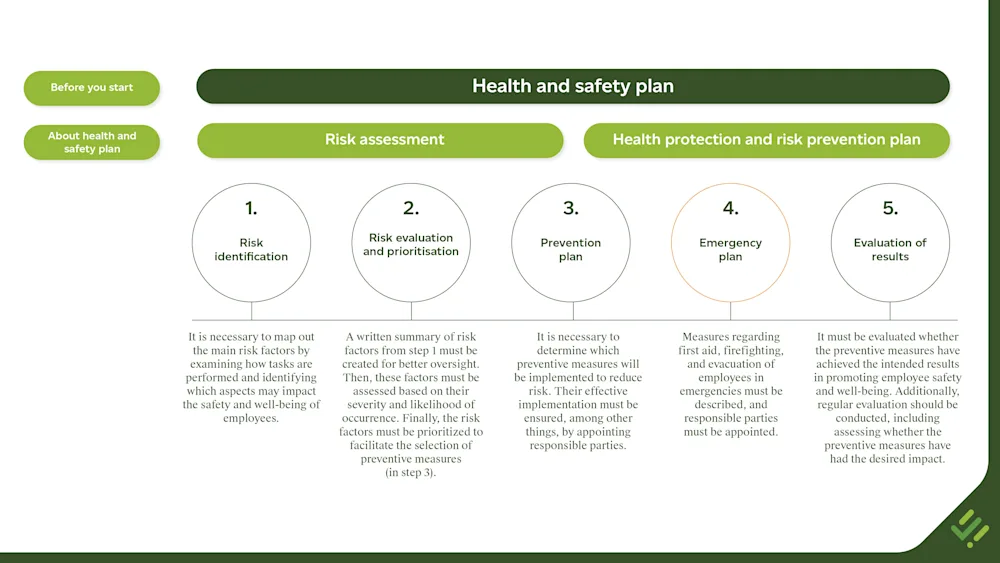
The Administration of Occupational Safety and Health encourages employers to familiarize themselves with the process that supports the development of a health and safety plan.
Educational video on creating a safety and health plan
This video simply explains what a health and safety plan is and what is involved in creating one.
Review of the Plan
The plan must be reviewed regularly in cooperation between the employer, management, and employees. For example, when incidents, accidents, near-misses, or changes in working conditions occur. It is then necessary to assess whether the preventive measures that have been implemented are still effective in mitigating the risks they are intended to address. It’s important to keep in mind that preventive actions may evolve or become outdated over time.
Additional material
Let's work together: Everyone home safe
Every day, we manage risks in our personal lives to prevent accidents and mishaps. We place knives facing down in the dishwasher and switch to winter tires when the season changes. The same mindset should apply in the workplace—as shown in the video above.

Service provider
Administration of Occupational Safety and Health