
Landspitali - University Hospital
Hyperbaric and Dive Medicine Department
Frequently Asked Questions
General questions
Hyperbaric oxygen therapy is a medical treatment provided only for specific, approved indications.
To access this service, a referral from your physician is required and must include relevant medical information.
All referrals are reviewed by a physician in our department, who determines whether the medical criteria for treatment are met.
Hyperbaric oxygen therapy (HBOT) is approved only for specific medical indications.
If your condition does not meet these criteria, the referral may be rejected. All referrals are reviewed individually by our medical team.
Common reasons for rejection include:
The condition does not qualify for hyperbaric oxygen therapy
A contraindication to HBOT is present
Insufficient medical information in the referral
If you believe there is still a valid indication for treatment, we recommend discussing this with your referring physician, who may provide further guidance or submit a more detailed referral if appropriate.
Unfortunately, it is not possible to change individual treatment times.
Treatments are organized into fixed pressure groups, each with a specific time slot and treatment protocol.
Because protocols differ between groups, switching times is not possible.
In certain situations, schedules may be adjusted for entire groups, for example due to emergency or high-priority cases. The department operates 24 hours a day, year-round, and non-emergency treatments follow predefined schedules.
Example:
Group 1: 09:00
Group 2: 11:30
If you are assigned to Group 1 at 09:00, it is not possible to move to another group during the same day.
Our department responds to medical emergencies and operates under various alert levels.
As a result, scheduled treatments or doctor appointments may occasionally need to be postponed.
If you receive an SMS, please follow the instructions provided.
Doctor appointments will be rescheduled at the next available time. You will be contacted with updated details.
Treatments will be moved to the next available time.
In most cases, cancellations occur because the hyperbaric chamber is required for complex emergency cases, which may involve prolonged or continuous use. Patients are notified by SMS when this happens.
In rare cases, cancellations may also occur due to safety, weather, or environmental conditions.
The treatment is not deducted from your total number of sessions; it is simply postponed.
If you are unable to attend the new time, our staff will assist with rescheduling.
No. Silver (amalgam) and plastic (composite/resin) fillings are not a problem for hyperbaric oxygen therapy and do not need to be replaced beforehand.
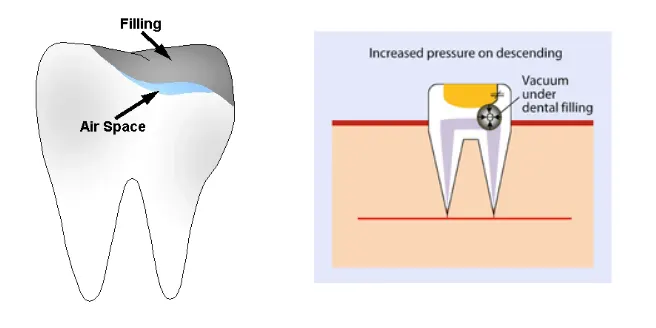
Older amalgam fillings may be associated with mild discomfort during the first treatment session. This can occur if a filling is loose, allowing air to become trapped under pressure.
If you experience any pain or discomfort in your teeth, ears, or facial bones, inform the doctor or nurse immediately. Treatment can be paused, and you may be advised to see a dentist before continuing.
Untreated cavities must be repaired before starting treatment. A dental X-ray after repair is recommended to ensure no air is trapped beneath the filling.
Unfortunately, no.
Hyperbaric oxygen therapy (HBOT) is not an approved or effective treatment for Myalgic Encephalomyelitis / Chronic Fatigue Syndrome (ME/CFS).
Although some symptoms of ME/CFS may overlap with those of Long Covid, these are considered two distinct medical conditions. HBOT has shown benefit in selected patients with Long Covid, but not in patients with ME/CFS.
For referral to HBOT for Long Covid, a formal diagnosis from a physician is required, meeting the World Health Organization (WHO) definition of Long Covid.
Unfortunately, no.
Postural Orthostatic Tachycardia Syndrome (POTS) is not an approved indication for hyperbaric oxygen therapy (HBOT).
Some patients referred for HBOT for another approved condition may also have POTS, but POTS alone does not qualify for treatment.
Only patients who meet the approved medical criteria are eligible for HBOT. For further information, please consult your physician.
The treatment
Yes. The hyperbaric chamber can be configured with chairs, beds, or a combination of both, depending on patient needs.
Beds are reserved for patients who are hospitalized, unable to move independently, arrive by ambulance, require emergency treatment, or are in intensive care.
A specialized bed is also available for neonatal patients.
You do not need to bring anything specific, but strict safety rules apply.
Allowed:
Plastic water bottle without a label
Book, Sudoku or crossword puzzle with a pencil
Reading glasses
Not allowed:
Phones, tablets, laptops, or other electronic devices
Watches, jewelry, or accessories
Pens, markers, or highlighters (special safe pens are provided if needed)
Metal or glass bottles
Makeup, hair products, or perfume (nail polish is allowed)
Newspapers or newspaper-type paper
Plastic-coated books or magazines
Hyperbaric oxygen therapy (HBOT) is considered a very safe medical treatment with a low risk of complications.
Most potential side effects are mild and are prevented through strict safety procedures and staff guidance.
The most common minor issues include:
Difficulty equalizing ear pressure
This is the most frequent issue. Staff will instruct you in simple techniques to prevent discomfort.Mild discomfort in enclosed spaces (claustrophobia)
The chamber is spacious, well-lit, and designed for comfort. You may bring reading material or similar distractions, and in some cases a movie is available during treatment.
Emergency Treatment
Unfortunately, no. Emergency hyperbaric treatments are medical procedures that require full attention from staff and unrestricted use of the department. Family members or companions are not allowed to stay inside the department during treatment.
You may wait in the seating area outside or in the cafeteria.
It is recommended to provide contact information and ask about the expected duration of treatment. In some cases, it may be possible to bring approved food or drinks for the patient.
The department can be reached via the hospital telephone center at +354 543 1000 (24 hours) by requesting connection to the Diving Control Center.
During long emergency treatments, eating inside the chamber may be allowed.
Do not consume:
Carbonated or gas-producing drinks (e.g. sparkling water, cola, orange soda, malt drinks)
Gas-producing foods (e.g. beans, corn)
Fried or greasy foods
Energy drinks, caffeine, or coffee
Alcohol
Hard candy, chewing gum, nicotine pouches
Ice cubes or chewing ice
Popcorn
Food containers not allowed:
Foam containers or cups
Metal flasks or thermoses
Glass containers
Metal cutlery
Self-heating containers
Military MRE packs
All food and containers are inspected by the safety officer before entering the chamber.