
Icelandic Medicines Agency
Information on interchangeable medicines for pharmacy staff
For many years, one of the roles of pharmacies in Iceland has been to offer patients a cheaper alternative when they are prescribed a medicine that can be substituted with an equivalent medicine. Medicines have been grouped into reference price categories for nearly three decades. Pharmacy staff therefore play a key role in providing this information to patients, not only to save patients and society money, but also to improve patient safety during treatment with medicines.
Reference prices in the Icelandic Medicine Price Catalogue
The Icelandic Medicines Agency (IMA) places comparable medicinal products (originator medicinal products, generic medicines and parallel imported medicinal products) together in reference price groups. In some cases a doctor has prescribed an originator medicinal product, and in others a generic medicine. Pharmacy staff can then check which medicinal product in the reference price group is the cheapest for the patient and offer the patient a switch.
The reference price in each group is based on the lowest unit price in the group. If a package with a higher price per unit than the cheapest one is dispensed, the patient must pay the price difference.
Example: Medicine D is the cheapest in reference price group V1500, and medicine C the second cheapest:
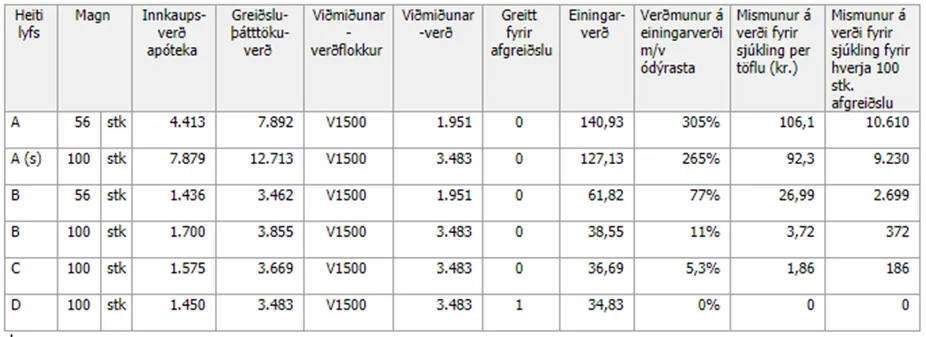
The reference price groups are the equivalent of what is known as the list of interchangeable medicines and are published in the Icelandic Medicine Price Catalogue issued by IMA; information can also be found in the Medicinal Product Information (Sérlyfjaskrá). The list of reference price groups is updated monthly. The medicinal products in each group must have the same active substance, the same strength and the same pharmaceutical form, as well as confirmation that they have been shown to be equivalent.
Pharmacist's conversation with the patient
The pharmacist's conversation with the patient about interchangeable medicines is an important part of successful treatment, as it can affect adherence, prevent misunderstandings and avoid concern and possible uncertainty for the patient. For the vast majority of patients, switching works well with the information provided by doctors and pharmacists.
In addition to their duty to provide information on the correct use and storage of medicines, pharmacists in pharmacies must inform patients of a comparable, cheaper alternative and offer a switch where possible, in accordance with the reference price groups in the Icelandic Medicine Price Catalogue in force at the time. At the same time, the pharmacist shall inform the patient of the change and ensure that the patient knows how to use and store the medicines. As a rule, patients should be shown their medicines when the above advice is given.
There has been some discussion of how best to conduct such a conversation and what wording has so far proved most suitable. Examples of wording:
"May I offer you a cheaper medicine? It is the same medicine but from a different manufacturer."
"May I offer you a cheaper generic medicine?"
"Pharmacies are obliged to offer customers cheaper medicines where possible. I can therefore offer you a medicine from a different manufacturer; it has the same active substance in the same amount."
"You have been prescribed a generic medicine, but I have another, cheaper generic medicine; it has the same active substance but is from a different manufacturer."
In the conversation, it is also important to explain that:
The medicines have different names because they come from different manufacturers
The medicines often look different
The medicines contain the same active substance, and to show the patient how to read it on the package
What happens if a patient declines the offer of the cheapest option?
Reference price groups are used for cost control, as reimbursement by Icelandic Health Insurance (SÍ) is based on the cheapest medicine in each group. Reference price groups include both medicines that Icelandic Health Insurance helps pay for, to the benefit of patients, and others without reimbursement. If an individual chooses a more expensive medicine in the group concerned, that individual pays the difference.
Is it permitted to dispense an excess quantity?
Following the introduction of total-quantity prescriptions, questions have arisen as to whether it is permitted to dispense an excess quantity. For treatment lasting 100 days or less, pharmacists may offer the patient a more economical package within the reference price group. Example: a 120-unit package dispensed when 100 units have been prescribed and the medicine is taken twice a day.
Special restrictions have been placed on narcotic and habit-forming medicines with regard to rounding that may occur when different dispensings are combined. Thus, no more than a 10% excess quantity of a package can be dispensed in the final dispensing of a total-quantity prescription.
Payments to pharmacies for dispensing the cheapest medicines in reference price groups
About half of retail sales of general medicines in Iceland are medicines belonging to reference price groups. IMA's analyses have shown that the share of generic medicines in total sales was 49% by volume and 35% by value in 2021. The share has remained virtually unchanged in recent years. For medicines in reference price groups, the cheapest medicine was chosen in 26% of cases in 2021, and in 50% of cases the medicine chosen was within 5% of the cheapest price in the reference price group concerned.
The measure is intended as an incentive for pharmacies to offer cheaper medicines where available. The aim is to achieve savings for patients and in total reimbursement expenditure in the long term. If successful, this will create an incentive for pharmaceutical companies to bring cheaper medicines to market, keep them on the market and compete on price.
Generic medicines and reference medicines
The terms samheitalyf (generic medicine) and frumlyf (reference medicine) are in many ways unclear, and their use has even become controversial among professionals. A generic medicine is developed to be equivalent to a reference medicine that has been granted a marketing authorisation.
Generic medicines are equivalent to reference medicines, as the following factors have been assessed:
The active substance is the same and is present in the same amount as in the reference medicine
The pharmaceutical form is the same (e.g. tablets, oral solution, eye drops)
A bioequivalence study has been carried out confirming that the generic medicine is absorbed by the body at the same rate and to the same extent as the reference medicine, and therefore has the same intended effect as the reference medicine
For a generic medicine to be granted a marketing authorisation, it must be shown that it is manufactured to the same quality as the reference medicine. Various tests are also carried out to ensure the properties of the medicines, such as their dissolution, hardness, distribution of the active substance and shelf life.
Why is there a price difference between generic medicines and reference medicines?
The shorter development process for generic medicines and the lower costs of studies and registration mean that the price of generic medicines is in most cases lower than that of reference medicines. The use of generic medicines therefore saves individuals and society considerable sums of money.
When a pharmaceutical company develops a new medicine (reference medicine), it is the result of extensive research and a long development process in which the efficacy and safety of the medicine must be demonstrated. The pharmaceutical company is granted a patent for the medicine for more than a decade. This gives the company the opportunity to earn revenue to offset the costs of developing and registering the medicine. When the patent expires, other companies are permitted to develop, register and manufacture equivalent medicines with the same active substance, for the same symptoms and diseases. In Icelandic, these medicines have been called samheitalyf. Because of the competition that arises when generic medicines enter the market, the price of the medicines falls.
Various things have already been demonstrated when a reference medicine is registered that do not need to be repeated for a generic medicine. For example, when a reference medicine is registered, both toxicological studies in animals and clinical trials in humans must be carried out, showing that the medicine is tolerated and has the intended effect on a particular disease. When a generic medicine is to be registered, it is possible to refer to the results of the reference medicine manufacturer's studies on the medicine concerned, as they are considered to establish how the substance works.
Adverse reactions
All medicines can have unintended effects, but in the vast majority of cases adverse reactions are caused by the active substance, and medicines containing the same active substance usually cause the same or similar adverse reactions. Known adverse reactions are described in section 4 of the package leaflet in the package. If you notice an adverse reaction to a medicine or a change in the effect of a medicine, seek advice from a doctor or a pharmacist at a pharmacy. If a healthcare professional suspects a serious, new or unexpected adverse reaction to the use of a medicine in the course of their work, they are obliged to report it to IMA.
Legal basis
The interchangeability of medicines and the list of interchangeable medicines are covered in, among others, Articles 40, 52 and 69 of the Medicinal Products Act and Articles 14 and 16 of Reglugerð um lyfjaávísanir og afhendingu lyfja.
Last reviewed: 15th October 2026