Landspitali - University Hospital
Quality Improvement Training for Post-graduate Clinical Education
Learning objectives and structure
Quality improvement training is an essential pre-requisite of post-graduate education for doctors, clinical nurse specialists and clinical pharmacists in Iceland. The training programme was developed in 2018 at Landspítali based on Learning to Make a Difference curriculum by the Royal College of Physicians.
The learning objectives are:
To develop necessary knowledge, skills and attitudes to make focused small-scale change through a simple structured framework.
To provide a real means for trainees to respond to the theme of learned helplessness and not accept mediocrity in their clinical practice.
Debate on the Importance of Quality Improvement Projects for Specialized Residents
Structure of QI training
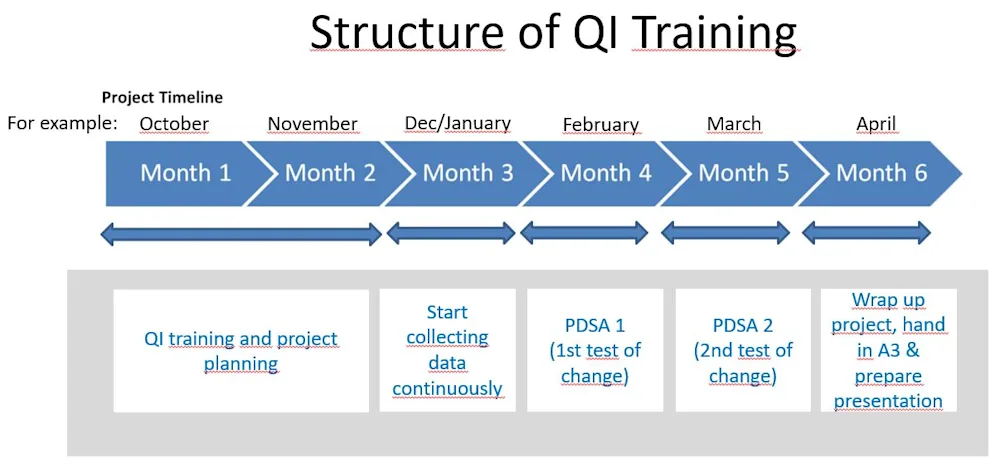
Quality improvement training is a 4-6 month programme comprising of face-to-face teaching and implementation of a small project. Trainees will be taught to use a methodology called Model for Improvement, which will enable them to achieve their learning objectives. Teaching is interactive and delivered in two half-day small group face-to-face sessions.
Trainees are expected to have a topic in mind before starting training and work through the idea during the teaching sessions. The teaching sessions are held one month apart and trainees should continue to plan their projects in-between sessions. By the time the teaching has been completed, the trainee should have a draft project plan developed and be ready to start executing their project over approximately 4 months.
Trainees are expected to work through some pre-training preparation (read articles and watch a short video), which will enable them to develop a basic understanding of the methodology to assist them in choosing a suitable topic.
Trainees are encouraged to participate in quality improvement training during their 2nd or 3rd year of post-graduate studies. To help prepare trainees for QI training, they will attend an introductory presentation at their first year induction.
The QI methadology
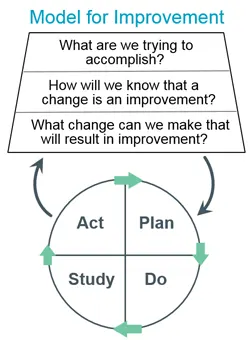
Model for Improvement
There are many quality improvement methodologies. These include Lean, Six Sigma, Total Quality Management (TQM) and clinical audit. The Model for Improvement was developed based on the work of W. Edwards Deming who is an American engineer, statistician and management consultant. It is a continuous improvement methodology where changes are tested in small cycles, which involves planning, doing, studying and acting (PDSA), before returning to planning and so on. Each cycle starts with hunches, theories and ideas and helps them evolve into knowledge that can inform action and, ultimately, produce positive outcomes.
This QI methodology is based on approaching change through four lenses, in accordance with Deming‘s „System of Profound Knowledge“:
Psychology
All improvement ultimately involves the change in behaviour of people. To be successful, it is essential to understand how people think and act.
Systems
The work that people do is part of a process, and each process is connected to other processes. This network of processes forms a system. Different people participate in making systems work. Changing part of one process affects another and disrupts the wider system. One needs to understand how systems work to be able to make sustainable improvements.
Variation
Understanding variation in how people work within a system and reducing it as much as possible is necessary for improvement. Therefore, data for improvement needs to be informative about variation.
Theory
One cannot fully learn about the psychology of people, how systems work and variation without testing changes. Testing enables the formation of theories by investigation into how people behave and complex systems are affected by changes. Forming and testing theories in cycles enables sustainable solutions to be found and is underpinned by the approach of „learning by doing“.