
The Supreme Court of Iceland
Building of the Supreme Court
About the building
Supreme Court of Iceland
The minister of justice turned the first sod for the new Supreme Court of Iceland building on 15 July 1994, laid the cornerstone on the 75th anniversary of the establishment of the court on 16 February 1995, and handed over the key to the president of the court on 5 September 1996.
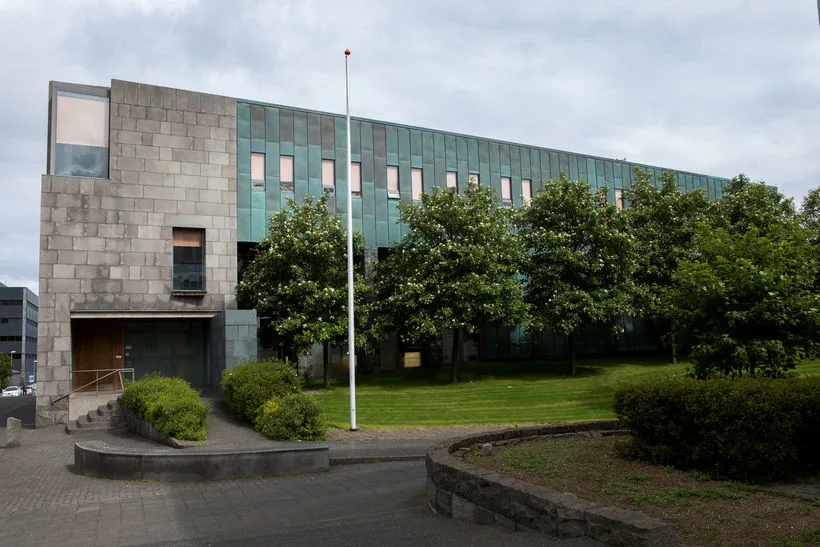
The design of the building, by Studio Granda, was selected from 40 entries submitted in a competition held in 1993. The architects, Margrét Harðardóttir and Steve Christer, are also known for designing the Reykjavík City Hall and the new offices for Iceland’s parliament, the Althingi.
The building’s plinth is of hewn basalt with a superstructure of sawn basalt and green patinated copper. Highlighting is achieved through the use of gabbró, an Icelandic metamorphic rock, and it is no coincidence that the overall colour palette strongly resembles that of Mount Esja on the far side of the Faxaflói Bay. On the south façade the copper is shaped to meet a gently sloping lawn under the shade of silver rowans. A taut trawler cable marks the edge of the grass and serves as a reminder of the mainstay of the nation’s economy. Internally, the forms and finishes, including concrete, terrazzo and oak, and colour scheme have been selected to subtly frame and support the spaces and functions within.
History and Location selection
Reception desk
The reception desk of the Supreme Court is in the spacious entrance lobby, where the painting Drekkingarhylur (‘the Drowning Pool’) by Sigtryggur Bjarni Baldvinsson is displayed. The subject of this work is the execution site at Þingvellir, the location of Iceland’s parliament and court of justice in ancient times. The guest chairs were designed specially for the building, initially as part of an exhibition instigated by the Alvar Aalto Museum in Jyväskylä, and later approved by the court for inclusion in the building itself.
A ramp leads beneath a canted wall from the lobby to the courtrooms and upper levels. Some see the route as a representation of the geological rift at Þingvellir through which those attending the Althingi would have walked. Others may interpret it as a reference to the spatial restrictions of imprisonment.
Courtrooms
There are two courtrooms which are accessed from the ramp, one large and one small. Between their doors hang portraits of the first justices of the Supreme Court.
The larger of the two rooms hosts a stained-glass work by Leifur Breiðfjörð that fills the room with multi-coloured light. This incorporates citations on the duties of judges from the lawcode Jónsbók, written in 1281, and from Njáls Saga on the oaths of advocates, both in prosecution and defence: “It is not in breach of settlement”, said Njáll, “for each to pursue the law against the other, for with law shall our land be built but with lawlessness destroyed.”
In counterpoint, the text “It will prove true that if we sunder the law in twain, we will also sunder the peace” is etched into the glass window to the ramp. These were the trenchant words of Þorgeir Ljósvetningagoði on the occasion of the conversion of Iceland to Christianity at the Althingi in 1000, as recorded in Ari the Learned’s Book of the Icelanders.
These quotations are a poignant reminder that the rule of law has been a foundation of Icelandic society since ancient times.
The speaker’s lectern in the smaller courtroom is bathed in daylight from a conical shaft that penetrates through the upper floor, tangibly linking the court to the heavens. In a similar vein, Svava Björnsdóttir’s sculpture on the flanking wall appears to listen to the proceedings of the court. The piece was commissioned by the Icelandic Bar Association in celebration of the 75th anniversary of the court’s establishment and was incorporated as an integral part of the building during its construction.
Adjacent to the larger courtroom are facilities for court attorneys that include two private offices for client consultations. At the other, top, end of the ramp, the bronze sculpture Mind, by Helgi Gíslason, is poised next to the president’s office. This was a gift from the Icelandic Bar Association on the 100th anniversary of the establishment of the court.
Lawyers facilities
President of the Supreme Court
The ceremonial office of the president of the court is primarily used to receive guests and hold meetings as, like the other court justices, the president has a working office on the third floor. This room holds many valuable given to the court, including the actual key that was presented to the president of the court by the minister of justice at the building’s inauguration ceremony.
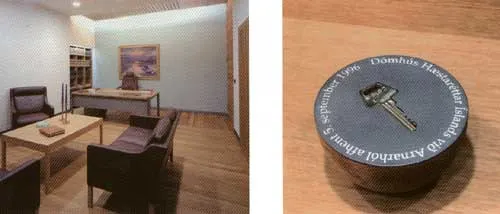
This key to the courthouse was presented to the President of the Supreme Court by the Minister of Justice on the day of the building's inauguration on 5 September 1996.
Conference chamber
Connected to the president’s office is the conference chamber. Here the Supreme Court justices may meet to discuss and decide on matters other than the disposition of court cases. The room is furnished with a heavily carved table and chairs that date from the founding of the court in 1920 as well as three surviving chairs from the earlier National High Court.
Lounge
Adjacent to the conference chamber is the justices’ lounge with a panoramic view over the city and the bay. Here the justices gather before oral presentations and don their robes.
Meeting room
The third floor of the building contains the offices of the justice and their assistants and also that of the secretary-general of the court. Two meeting rooms command views of the city centre. The court’s library, considered one of the best law libraries in the country, is also located on this floor. This cluster of rooms is bound together about a common space that encircles the cone above the smaller courtroom below.
At the east end of the top floor an imposing gargoyle directs rainwater from the roof onto the lava-strewn roof garden below. This gentle stream changes dramatically in scale and character when, in winter, it freezes.
Statistics on the number of cases handled by the Court and their disposition can be found on the home page, along with information about the current and former Supreme Court justices, the employees of the Supreme Court and the Courthouse itself.
As soon as an oral case presentation is finished, the justices retire for a closed meeting to confer and vote on the disposition of the case. One justice will be responsible for introducing the matter and proposing a solution of the case, a duty shared among the justices according to an objective rule, and he will usually write the opinion of the Court.
At the meeting, this reporting justice will review the main aspects of the case and set forth his opinions on the specific points in issue, the legal arguments involved and the conclusion of the case. The other justices then will explain their views, one after the other, the President winding up the round.
If the views of the reporting justice do not have the support of a majority of the justices, the President will ask another justice to write the Court’s opinion, and the minority justices decide who will write a separate dissenting or concurring opinion.
The draft opinions are then reviewed and read over jointly at meetings of the justices, where they will attempt to harmonise their views and proposals, which sometimes requires several meetings.
Finally, a judgement will be ready, and the justices sign a single copy which is filed in the book of opinions of the Court.
There are two meeting rooms at the third floor of the Courthouse.
Both rooms have a view over the Reykjavik City Centre.