
Landspitali - University Hospital
This news article is more than a year old
Two posters awarded at the Science Fair in the spring of 2023
26th April 2023
Two best posters for a scientific project at the Landspítali Science Festival, Science in the Spring, in Hringsalur, on April 26, 2023, were awarded in kind. The writers of the awards are medical student Þórður Björgvin Þórðarson and PhD student Kirstine Nolling Jensen.
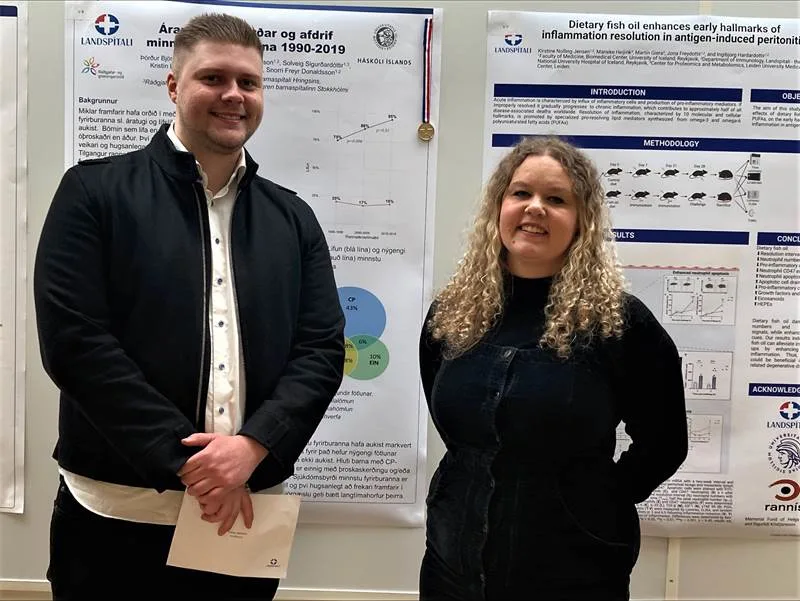
The poster award is a grant in the form of a refund of costs for the promotion/travel of their projects, up to ISK 150,000. The winners were presented by the meeting leader and presented their posters to the guests and the marchers at the poster exhibition at Vísindavefurinn in the spring of 2023 and received the award documents.
The award posters were selected from 29 submitted science posters in 2023. The National University Hospital’s Scientific Council had a lot of problems in evaluating the submitted reviews and selecting the winners.
Þórður Björgvin Þórðarson - Treatment outcomes and fate of the smallest premature infants in Iceland 1990-2019
The purpose of this study is to examine survival, treatment effectiveness and long-term prognosis of the smallest premature infants in Iceland in the period of 30 years (1990-2019). The population includes all premature infants born after <28 weeks of pregnancy and/or ≤ 1000 g at birth, a total of 508 children. The survival increased significantly from 75% during the first 10 years to 95% during the last 10 years. 29% of the children had cerebral haemorrhage and 39% had chronic lung disease, which was defined as requiring oxygen therapy at 36 weeks of pregnancy. Of the children who were released alive, 18% were later diagnosed with disabilities (CP-mental inability, developmental impairment and/or autism). There was no significant change in the incidence of disabilities during the period. Of those diagnosed with disabilities, 72% had CP-mental inability, 41% had developmental impairment and 32% had autism. Some of the children had more than one type of disabilities. Thus, the study demonstrates improvement in the life expectancy of the smallest premature infants in the past three decades and it is gratifying that the incidence of disabilities among them has not increased. The burden of disease for the smallest premature infants is still high and therefore it is possible that further improvement in neonatal intensive care can improve their long-term prognosis.
The research team includes Þórður Björgvin Þórðarson, medical student at HÍ, Snorri F. Donaldsson and Kristín Leifsdóttir, neonatal surgeon at the neonatal intensive care unit at the Children’s Hospital of the Ring, Þórður Þórkelsson, superintendent of the neonatal intensive care unit, Solveig Sigurðardóttir, pediatrician and specialist in children’s disabilities at the Counseling and diagnostic centre, and Olga Sigurðardóttir, special education doctor in pediatrics at the Astrid Children’s Hospital in Stockholm.
Kirstine Nolling Jensen - Dietary fish oil enhances early signs of resolution of inflammation in antigen induced peritonitis
Kirstine Nolling Jensen is a doctoral student at the University of Iceland’s School of Medicine and has been working on her project at the Department of Immunology at Landspítali University Hospital under the supervision of Professors Jóna Freysdóttir and Ingibjargar Harðardóttir. Kirstine has been interested in the molecular biological processes that drive long-term inflammation and autoimmune responses in diseases since her research career began. She completed her master’s degree from the University of South Denmark in Óðinsvéar, where she studied the protective role of CD11c+ microglia in the mouse model of spinal cord disease under the guidance of Professor Trevor Owens. In her PhD project she then studied the effects of omega-3 polyunsaturated fatty acids on inflammation control and the role of natural killer cells in inflammation control. In the project she worked with fluid-mediated inflammation in mice as a model for disease attacks in autoimmune diseases and also with natural killer cells in culture. Her main findings show that fish oil in food increases many of the signs of inflammation control, including controlled cell death of neutrophils, their consumption and entry into lymph nodes. In addition, they showed that the omega-3 fatty acid docosahexane acid (DHA) affects how natural killer cells interact with neutrophils in culture. Finally, the findings showed that natural killer cells express lipoxygenases and can produce lipid-derived inflammation-modifying signals that encourage inflammation control. The findings are shown on the poster “Fisco oil in food in mice increases early signs of inflammation control in fluid-mediated inflammation”. The findings will be published in three scientific papers, Kirstine is the first author. In addition to these, Kirstine is co-author of five scientific papers.
During her studies Kirstine has guided a number of masters students along with her instructors. She has also handled services at the Cell Flow Irons and Cell Isolation Core of the Bioscience Center. She also helped with service research on immune cells and their role in the Department of Immunology at Landspítali during the Covid-19 pandemic.