
The Healthcare Institution of North Iceland
Less Paperwork for Doctors – More Time With Each Patient
9th March 2026
The AI tool Skríban converts a doctor’s speech into a clinical note, allowing doctors to spend more time with each patient. Testing of Skríban is now underway at HSN in Akureyri.
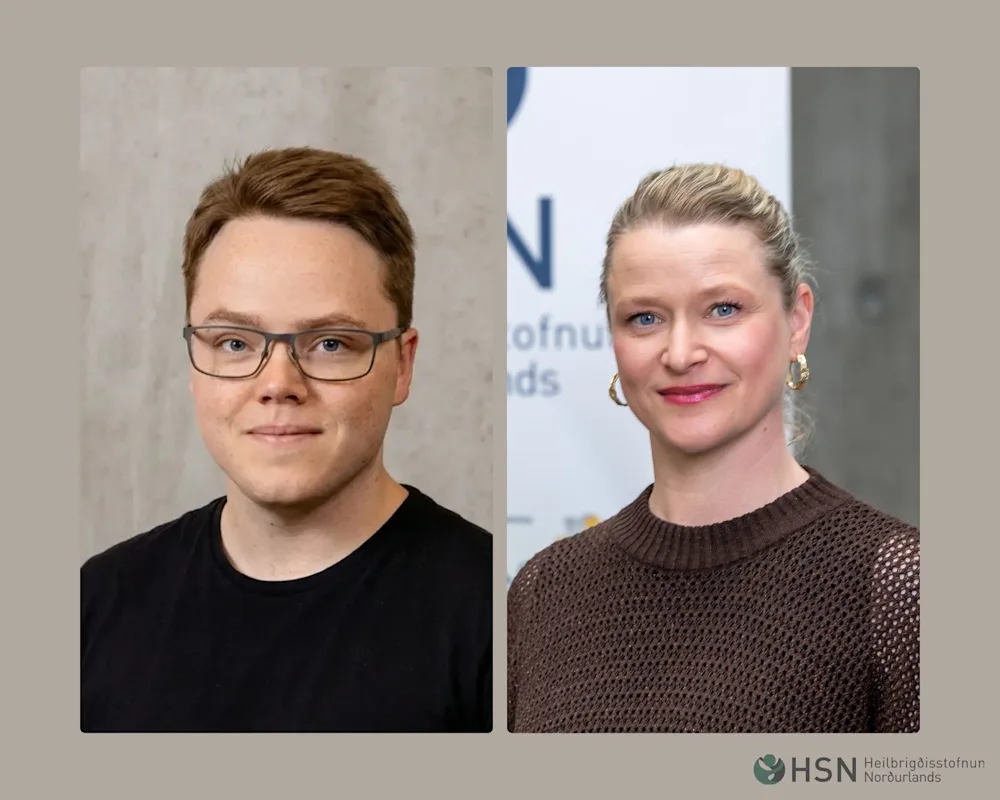
Jón Halldór Hjartarson general practicioner and Guðrún Dóra Clarke Chief Medical Officer at HSN.
There is strong ambition within HSN to make use of digital solutions to enhance efficiency and improve access to information, fully in line with the Ministry of Health’s goals for digital health. This February, a new and exciting pilot project began at HSN in Akureyri involving the use of artificial intelligence to reduce the time and burden associated with administrative work and documentation for doctors—tasks that often divert attention from what truly matters: the patient.
The project involves testing the AI tool Skríban, which converts a doctor’s speech (hereafter referred to as “dictation”) into a clinical note in real time and can even record an entire conversation between doctor and patient and generate a ready-made note from it. Guðrún Dóra Clarke, Chief Medical Officer at HSN, is implementing the project in collaboration with Jón Halldór Hjartarson, a general practitioner at the Capital Area Health Service who also works at HSN, and with the innovation company Careflux. Jón Halldór was introduced to the possibilities that AI can offer through a quality improvement project completed during his specialty training in general practice, carried out in cooperation with Careflux, a company specializing in the development of AI solutions for the healthcare system.
Developed by Doctors for Doctors – and for Patients Too
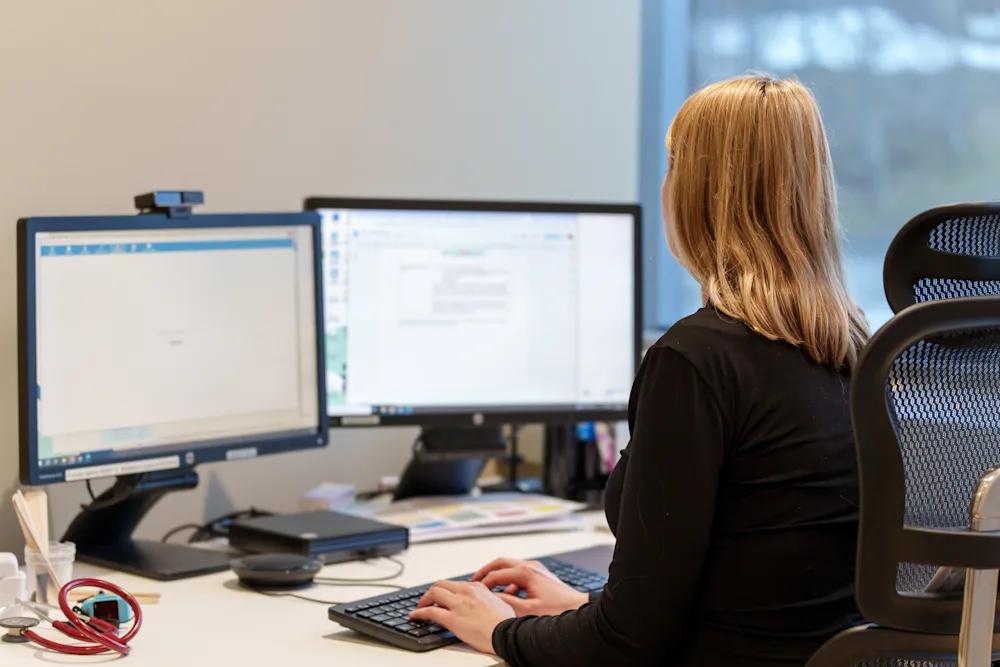
In the first phase, Skríban will be used to transform a doctor’s dictation into a finalized note. Instead of typing, the doctor speaks the information after the consultation, and Skríban generates a note based on predefined instructions, which the doctor then only needs to review and approve.
Guðrún Dóra explains that Skríban is designed by doctors who understand the strain that documentation places on clinical encounters.
“Standard consultation time for a doctor is twenty minutes, which is extremely valuable and must cover everything: gathering information, examination, assessment, documentation of the consultation, and even preparing referrals or ordering blood tests and other necessary investigations. Documenting the consultation can take a considerable amount of time, but Skríban gives us more time with each patient and significantly reduces our workload—especially the mental load. It always takes energy to type word for word, to translate thought into a well-written clinical note.”
Testing Shows Strong Results – Up to 50% Time Savings
In larger language markets, such as English-speaking regions, the technology and use of comparable solutions are more advanced, largely due to the vast amount of English-language data available to train AI systems. In Iceland, however, the Icelandic version of Skríban is already in use at the Kirkjusandur Health Clinic in Reykjavík and in selected departments of Landspítali University Hospital. A significant portion of Careflux’s development work has focused on training the AI with Icelandic audio data, and today the solution can be considered fully ready for use in clinical environments.
Jón Halldór says that informal measurements suggest that the time savings for doctors when writing notes may reach up to 50%, and could be even greater with the conversation-based solution. In that version, Skríban listens to the entire consultation—with the patient’s consent—distinguishes between speakers, and then generates a tailored clinical note that the doctor can review and approve before it is entered into the medical record. Preparations for implementing the conversation-based solution have not yet begun within HSN.
“Future development could even include drafting referrals, certificates, or suggestions for blood tests. But it is important to emphasize that Skríban is not intended to make decisions for the doctor; it is not a medical device but a tool to help us manage the ever-growing administrative workload that has increased in recent years and has become a major stress factor for doctors and other healthcare professionals. The job must not shift into becoming an overly burdensome office role where documentation and paperwork overshadow caring for sick patients who increasingly rely on our services. This is where AI can help us.”
Preparatory work related to data protection and security for Skríban’s dictation solution was completed before the end of the year at HSN in Akureyri. A three- to four-month pilot phase is now underway with four participating HSN doctors. After that, it will be assessed whether the technology should be adopted permanently across HSN facilities, and if so, longer-term planning may begin for implementing the conversation-based solution as well.