22nd September 2026
22nd September 2026
Nordic study: Six in ten young people consume energy drinks every week
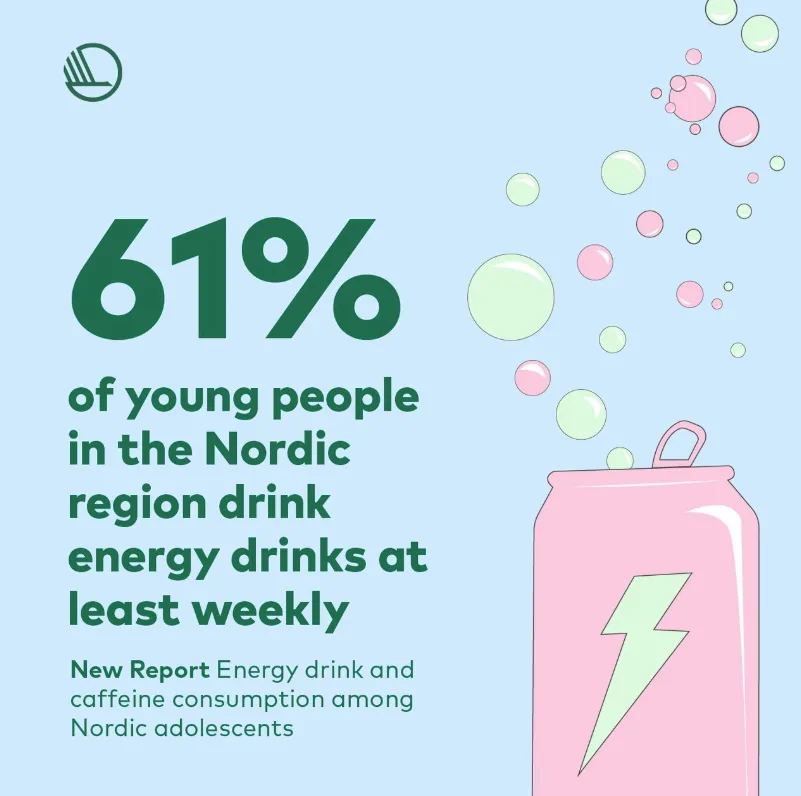
Just over one in five young people in the Nordic countries consume energy drinks at least once a day, and three in five do so at least once a week. Almost half say that, at least occasionally, they can’t get through a day without an energy drink. These are the findings of a new Nordic report.
In the report, 30 percent of 15 to 19 year olds say they have experienced negative health effects from energy drinks, including heart palpitations, sleep problems, and dizziness. Fifteen percent say they experience discomfort when they do not consume energy drinks, while one in three young people would like to reduce their intake.
A relatively large proportion, 39 percent, say they began consuming energy drinks at the age of 13 or younger, while 16 percent never consume energy drinks.
Taste – the most common reason
The most common reason young people give for drinking energy drinks is the taste, cited by 73 percent. Other common reasons include getting more energy, cited by 51 percent, and staying awake, cited by 34 percent. The study also shows that boys consume energy drinks more frequently than girls.
The report was funded by the Nordic Council of Ministers. The Swedish Food Agency was responsible for the survey on which the findings are based. A total of 4,916 young people took part in the study.
“The study sends a strong warning signal that far too many young people are dependent on energy drinks to get through day-to-day life. This could have serious consequences for young people’s mental health and education. This is a shared challenge for the Nordic countries, and we need to work together to break this pattern,” says Karen Ellemann, Secretary General of the Nordic Council of Ministers.
Consumption highest in Sweden
Energy drinks are a natural part of day-to-day life for young people in the Nordic countries, but consumption differs between countries.
Sweden has the highest frequency of consumption, where 28 percent of young people drink energy drinks at least once a day and as many as 75 percent do so at least once a week.
In Sweden, young people are more likely to say that they consume energy drinks to help them perform better at school. Swedish young people are also more likely to report regularly drinking cola drinks and taking caffeine-fortified dietary supplements.
Social aspect important in Denmark
Denmark has the lowest frequency of consumption in the Nordic Region, where 14 percent drink energy drinks daily, and 43 percent drink them weekly.
In Denmark, energy drinks have a more pronounced social function. Young people are more likely to say that they consume energy drinks because their friends do. Danish young people are also more likely to report drinking tea and iced tea.
Young people in Norway also drink energy drinks less frequently than the Nordic average. Eighteen percent consume energy drinks daily and just over half do so weekly. Taste and the need for energy are the main factors driving consumption there.
Finnish young people start earlier
Finland differs from the other Nordic countries in that many young people start drinking energy drinks at a younger age. One in four say they started before the age of 12, while one in three say they started when they were 12 or 13. Young people in Finland are also more likely to drink coffee and iced coffee.
The results from Iceland should be interpreted with caution because the number of respondents was relatively low. The study shows that Iceland is below the Nordic average: 46 percent of young people there drink energy drinks every week.
“What concerns me most is that so many young people describe a level of consumption that they themselves feel they have difficulty controlling. When a habit starts to affect sleep, wellbeing or day-to-day life, there’s reason to act. We now need to better understand what can help young people change their habits and which measures actually work for them. That’s why, in the second part of the project, we will listen directly to young people,” says Sabina Litens Karlsson, toxicologist and nutritionist at the Swedish Food Administration and project manager for the study.
Facts
The study Energy drink and caffeine consumption among Nordic adolescents is the first part of a follow-up project to NORMO 2025, a Nordic survey of adults’ dietary and lifestyle habits.
The aim is to develop feasible policy recommendations for reducing energy drink consumption among young people in the Nordic Region.
The study was published on 22 September 2026 and was conducted under the leadership of the Swedish Food Administration, in collaboration with Origo Group and partners from public authorities in the other Nordic countries.
The study is based on responses from young people in Sweden, Denmark, Finland, Norway, and Iceland, and examines consumption patterns, attitudes, and the use of energy drinks and other caffeinated products.
In the second part of the project, beginning in autumn 2026, young people will be involved through youth panels. The aim is to develop measures that work for young people themselves. The project’s policy recommendations are due to be presented in summer 2027.
Contact
Jonathan Eng, Senior Advisor, Nordic Council of Ministers
+45 2710 9467, joneng@norden.org