21st September 2026
21st September 2026
An ever-increasing focus on rehabilitation
A new interview with Huld Magnúsdóttir, Director General of TR, about the 90th anniversary of social insurance and the activities of TR was published in Morgunblaðið today.
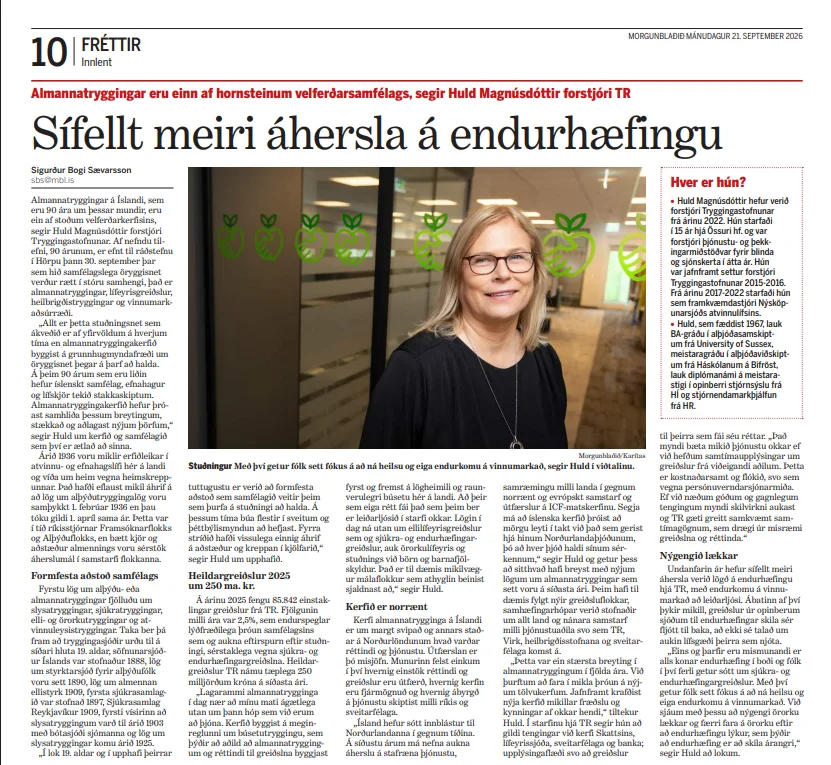
The interview reveals, among other things, that the social insurance anniversary conference will be held in Harpa on 30 September, that social insurance is based on the fundamental ideology of a safety net for when it is needed, and that there is an ever-increasing emphasis on rehabilitation so that people can focus on regaining their health and returning to the labour market.
You can read the full interview with Huld below.
Social insurance in Iceland, which is celebrating its 90th anniversary, is one of the pillars of the welfare system, says Huld Magnúsdóttir, Director of the Social Insurance Administration. To mark the occasion of the 90th anniversary, a conference will be held in Harpa on 30 September where the social safety net will be discussed in a broad context, including social insurance, pension payments, health insurance and labour market measures.
“This is all a support network determined by the authorities at any given time, but the social insurance system is based on the fundamental ideology of a safety net for when it is needed. In the 90 years that have passed, Icelandic society, its economy and living standards have undergone a complete transformation. The social insurance system has evolved alongside these changes, expanding and adapting to new needs,” says Huld about the system and the society it is intended to serve.
In 1936, there were great difficulties in the labour market and economy here in Iceland and widely around the world due to the Great Depression. This undoubtedly had a major impact on the passing of the National Insurance Act on 1 February 1936, which came into force on 1 April of the same year. This was during the time of the coalition government of the Progressive Party and the Social Democratic Party, and improving the terms and conditions of the general public was a particular priority in the parties' cooperation.
Formalising community assistance
The first laws on national or social insurance covered accident insurance, health insurance, old-age and disability insurance, and unemployment insurance. It should be noted that insurance funds were established in the latter half of the 19th century. The Iceland Collection Fund was founded in 1888, a law on a support fund for the common people was passed in 1890, a law on general old-age support in 1909, the first health insurance fund was established in 1897, the Reykjavík Health Insurance Fund in 1909, the first precursor to accident insurance was created in 1903 with a compensation fund for fishermen, and a law on accident insurance was passed in 1925. “At the end of the 19th century and the beginning of the twentieth, the assistance provided by society to those in need of support was being formalised. At this time, most people lived in rural areas and urbanisation was just beginning. The First World War certainly also had an impact on conditions, as did the subsequent depression,” says Huld about the beginnings.
Total allowance in 2025 around ISK 250 billion
In 2025, 85,842 individuals received an allowance from the SIA. The year-on-year increase was 2.5%, reflecting the demographic development of society as well as increased demand for support, especially for medical and rehabilitation allowance. The SIA's total allowance amounted to almost ISK 250 billion last year. “In my opinion, the current legal framework for social insurance adequately covers the group we are serving. The system is based on the main principle of residence-based insurance, which means that membership of the social insurance system and the right to an allowance are primarily based on legal domicile and actual residence in this country. Our guiding principle is that those who are entitled receive what they are due.
The current laws cover old-age pension payments as well as medical and rehabilitation allowance, in addition to disability pension and support for children and families. This, for example, is an important category that rarely receives attention,” says Huld.
The system is Nordic
The social insurance system in Iceland is in many ways similar to those elsewhere in the Nordic countries in terms of rights and services. However, the implementation differs. The difference lies mainly in how individual rights and allowances are implemented, how the systems are financed, and how responsibility for services is divided between the state and municipalities.
“Iceland has drawn inspiration from the Nordic countries throughout the years. In recent years, one can mention an increased emphasis on digital services, coordination between countries through Nordic and European cooperation, and the implementation of the ICF assessment system. It can be said that the Icelandic system is, in many respects, developing in line with what is happening in the other Nordic nations, although each nation retains its own characteristics,” says Huld, noting that several things have changed with the new Social Insurance Act passed last year. For example, it introduced new allowance categories, established coordination groups throughout the country, and fostered closer cooperation between service providers such as the SIA, Virk, healthcare institutions and municipalities.
“This was one of the biggest changes in social insurance in many years. We had to undertake significant development of new computer systems. At the same time, the new system required a great deal of education and promotion on our part,” Huld points out. In her work at the SIA, she says that the value of connections to the systems of the Tax Authority, pension funds, municipalities and banks is crucial; the flow of information to ensure that the allowance paid to recipients is correct.. “It would greatly improve our service if we had real-time information about allowances from the relevant parties. This is costly and complicated, for reasons such as data protection. If we could establish good and useful connections, efficiency would increase and TR could pay out according to real-time data, which would reduce discrepancies in allowances and rights.”
Incidence is decreasing
In recent years, TR has placed an ever-increasing emphasis on rehabilitation, with the guiding principle of returning to the labour market. The benefits of this are considered significant; allowances from public funds for rehabilitation are quickly recouped, not to mention the increased quality of life for those who benefit.
“Just as needs vary, all kinds of rehabilitation are available, and people in that process can apply for a medical and rehabilitation allowance. This allows people to focus on regaining their health and returning to the labour market. We are seeing that the incidence of disability is decreasing and fewer people go on disability after their rehabilitation ends, which means that rehabilitation is yielding results,” Huld concludes.