
National Archives of Iceland
The Reykholt inventory listed on the national Memory of the World register
5th May 2026
The Reykholt inventory has been inscribed on the national Memory of the World register. The inventory will be discussed in particular on UNESCO Day, to be held on Thursday, 7 May, at Edda.
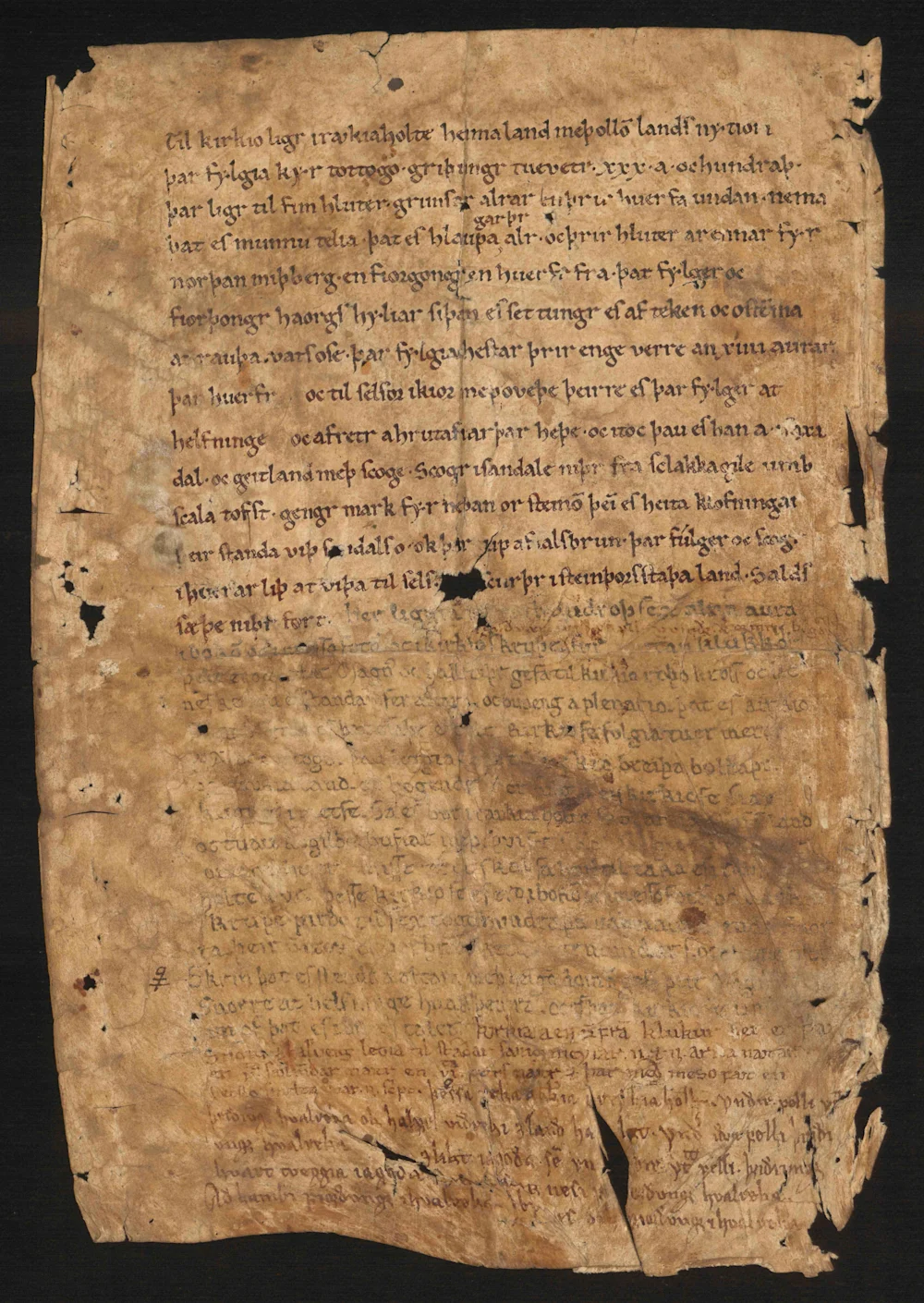
The Reykholt Inventory is unique in many respects. The inventory is written on vellum and is the oldest document in Icelandic preserved in its original form. It is also one of the oldest surviving documents written in a Nordic language. The inventory has been preserved in the National Archives of Iceland since the institution’s founding in 1882. Its contents remain legally relevant today and were cited in a Supreme Court judgment in 2021.
Memory of the World is a register whose aim is to preserve and draw attention to significant documentary and manuscript heritage. The Reykholt Inventory has now been entered on the Icelandic national register, which can be accessed at: https://unesco.is/landsskra-islands-um-minni-heimsins/
The Reykholt Inventory will be discussed on UNESCO Day at Edda on Thursday, 7 May 2026, at 1:00 p.m. The programme is open to all.
Further information: UNESCO Day 2026 | Facebook
More about the Reykholt Inventory
The Reykholt Inventory is a vellum document and the oldest document written in Icelandic that survives in its original form. It is also among the oldest surviving documents written in a Nordic language. Furthermore, it is the oldest document preserved in the National Archives of Iceland and has been held there since the institution’s establishment in 1882.
The oldest part of the inventory was written in the latter half of the 12th century, and there are grounds to argue that it was originally written closer to the middle of the century than to the year 1200. Seven distinct hands can be identified in the document, and information concerning the assets of Reykholt Church was added to it over a period of more than a century. Relatively few original documents from the 12th century and the early 13th century have survived in Iceland; most texts from this period are preserved only in later copies. This fact alone makes the Reykholt Inventory exceptional of its kind.
The Reykholt Inventory is a record of the property, holdings, and rights of Reykholt Church in Borgarfjörður. It sheds clear light on the development of the Reykholt site and how its importance steadily increased during the Sturlung Era. At the same time, the document is an important source on the development of handwriting and orthography at the time of its composition. The document retains both legal and historical significance and was used as a legal source in a case before the Supreme Court of Iceland in 2021 (case no. 41/2020), concerning whether a tract of land in Borgarfjörður constituted public land or private property.
The Reykholt Inventory is likely written on calfskin. It measures approximately 29–30 cm in length and 21 cm in width. The document consists of a single leaf, densely written on one side and almost blank on the other. Originally, the leaf appears to have been part of a larger manuscript—possibly a missal, a homiliary, or a gradual—and the inventory was entered on a blank leaf either at the beginning or the end of the manuscript. The fate of the manuscript itself is unknown, though it is not unlikely that it was lost during the upheavals of the Reformation in the mid-16th century.
The preservation history of the Reykholt Inventory is remarkable. The document has always been preserved in Iceland, apart from being loaned twice to Copenhagen. It was not taken abroad, as was the fate of many other documents and manuscripts during the 17th, 18th, and 19th centuries. It was most likely kept at Reykholt Church from the outset. The earliest recorded mention of the document dates to 1562, when it was presented at a tylftardómur (a court of twelve jurors) at the Öxará Assembly in a dispute between representatives of Reykholt Church and Kirkjuból Church in Langadalur regarding ownership of two farms in the Strandir region. The Reykholt Inventory was subsequently transferred to the National Archives (then the State Archives) at its founding in 1882, along with other records from Reykholt Church.
In the article series Document of the Month (Heimild mánaðarins) on the National Archives of Iceland’s website, Benedikt Eyþórsson, Head of Professional Practices, has written about the Reykholt Inventory.