
Land and Forest Iceland
Increased Early Thinning in Farm Forests
28th January 2026
Early thinning in farm forests increased over the past year, and thinning work is continuing this January due to favourable weather conditions across the country. At the same time, Icelandic forest farmers planted more than two million trees during the year.
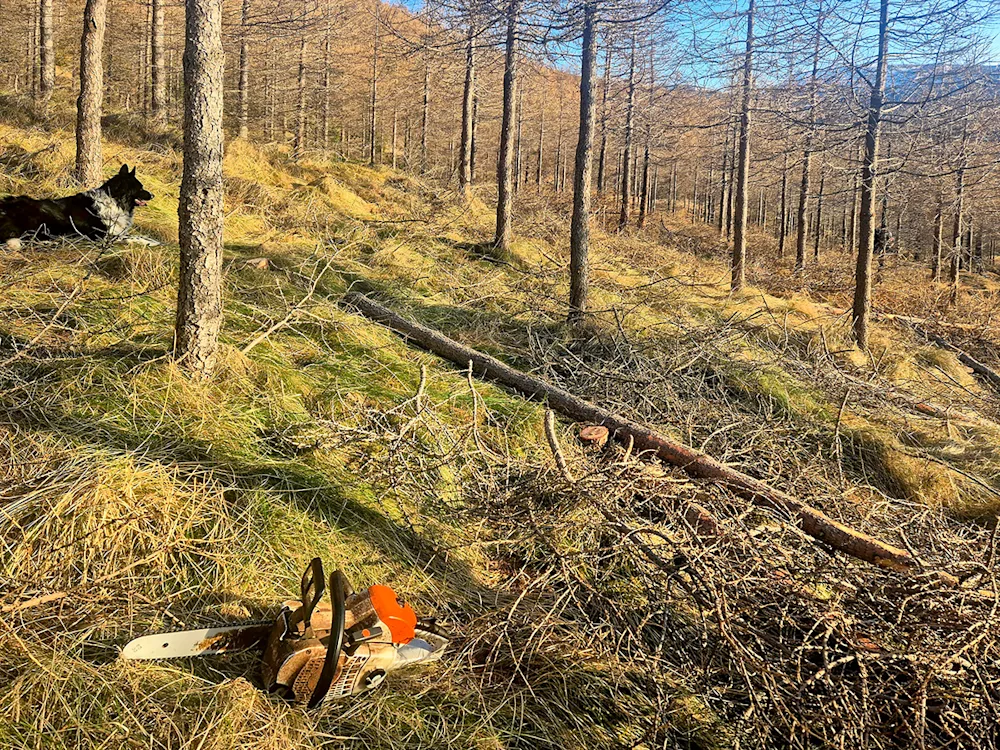
Larch forest after early thinning. Photo credits: Johan Holst
This is reported in an overview of the Forestry on Farmland programme compiled by forestry adviser Guðríður Baldvinsdóttir. The programme was established in 2016 following the merger of the regional forestry projects with the Icelandic Forest Service and is now part of the activities of Land and Forest Iceland. Over the years, it has become an important component of land use in Iceland.
In 2025, forest seedlings were planted on 249 farms throughout the country. In addition, shelterbelts or small shelter woodlands were established on 87 farms. The need for forest management—primarily early thinning—continues to grow as forests established during the early years of the regional forestry projects reach what is often referred to as their “adolescent” stage. Early thinning was carried out on 47 farms last year, representing a notable increase compared to previous years. Owing to mild weather, thinning work is continuing this January and will proceed into spring as conditions allow.
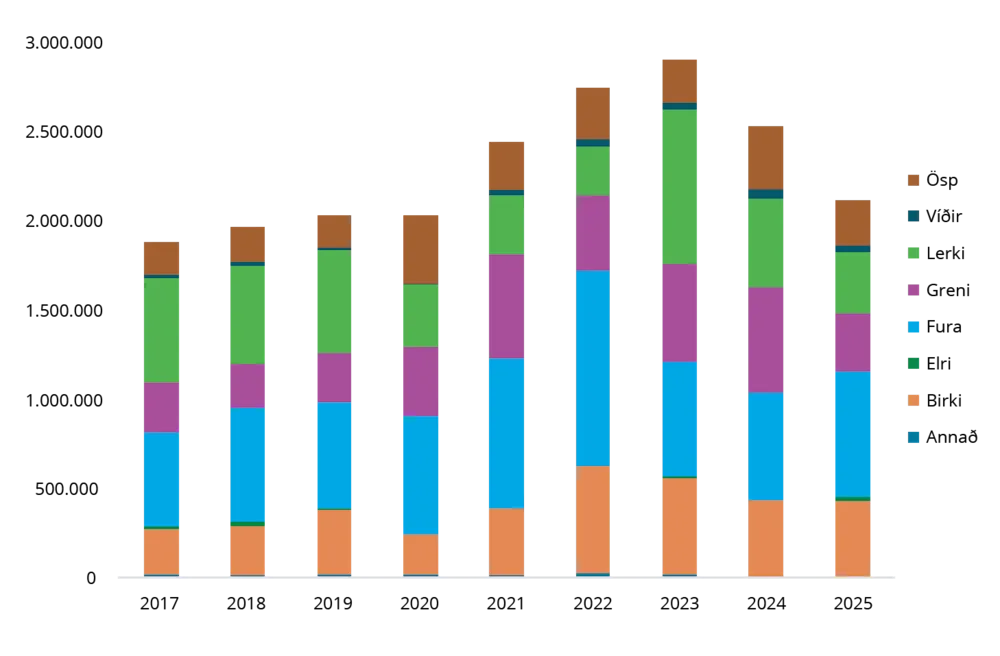
The chart above shows the number of planted seedlings by species Forestry on Farmland projects 2017–2025. The total number of planted trees last year amounted to just over 2.1 million. Of these, approximately 1.9 million were forest trees, with an additional around 210,000 trees planted in shelterbelts and shelter woodlands. On average, just over 7,600 forest trees were planted per farm in 2025.
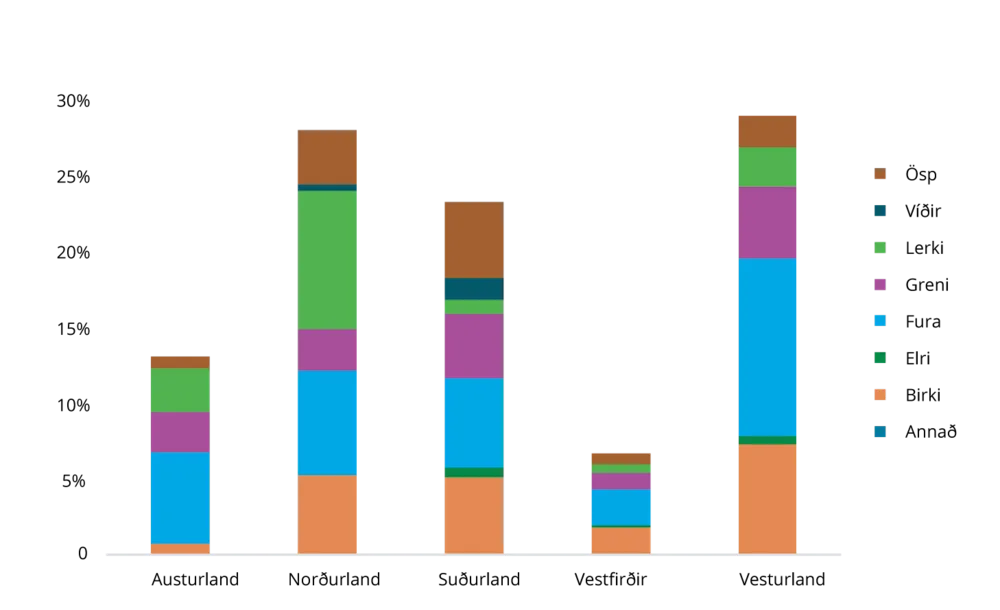
According to the overview, planting activity varied between regions. The largest number of trees were planted in West Iceland and North Iceland, together accounting for more than half of all plantings, followed by South Iceland. The bar chart below shows the distribution of tree species by region in forest farmers' plantations 2025.
Weather and Other Factors Behind the Decline
There is no single explanation for why fewer tree seedlings were planted in projects on agricultural holdings supported by Land and Forest Iceland in 2025 compared with previous years. Several factors influence these figures from year to year, and such fluctuations are to be expected.
Firstly, fewer requests for planting stock were received from farmers. Weather conditions also had a considerable impact on last year’s outcome. A cold summer in 2024 caused losses in nursery production and adversely affected the quality of forest seedlings. As a result, fewer seedlings suitable for planting were available in the following year. Farmers therefore did not receive the species or quantities they had requested. In addition, a cold spell in spring 2025 disrupted both seedling distribution and planting operations. Furthermore, seed availability for certain species has not kept pace with demand.
Several other factors can also influence the success of afforestation on agricultural land. In recent months, obtaining permits for new afforestation projects from municipalities has proven more time-consuming than before. At the same time, landowners are increasingly seeing opportunities in carbon sequestration projects, and public debate on forestry can also affect developments in this area.
Forest Management an Increasing Focus
As forests mature, the need for active management increases. Support for early thinning among forest farmers has grown under the auspices of Land and Forest Iceland, and demand for such measures is now rising rapidly. Consequently, a growing share of allocated funding for farm forestry is directed towards forest management, and the lower level of planting in 2025 created scope to increase contributions to management activities that year.
Alongside the increasing need for management, methods and practices must continue to be developed, and work on this is ongoing. Good experience has been gained from thinning in larch forests, and substantial expertise in planning such operations has already been established. By contrast, more experience and improved knowledge are needed with regard to the management of pine forests, for example. With appropriate management, lodgepole pine forests can become open and accessible and, over time, produce high-quality and valuable yields. A dedicated working group within Land and Forest Iceland is developing these methods. This work will be of particular benefit to forest farmers in southern and western Iceland, where thinning of pine forests is now approaching a significant scale.
Increase Expected in the Coming Summer
Advisors at Land and Forest Iceland received implementation requests from forest farmers in January, and the outlook for the coming summer is currently becoming clearer. Indications suggest that the number of seedlings planted on agricultural holdings under forestry agreements with Land and Forest Iceland will be higher this summer than it was last summer.
Accompanying photos were taken by forestry adviser Johan Holst. The image below shows unloading work at a plant distribution centre.