
Land and Forest Iceland
Improvements in Iceland’s Greenhouse Gas Inventory
30th March 2026
Iceland’s national greenhouse gas inventory for 2024 has now been submitted. Continuous efforts are undertaken to improve the completeness and accuracy of the land use, land-use change and forestry part of the inventory. In addition, a range of research activities across Iceland contributes to strengthening the scientific basis of the estimates. The main improvements in the latest submission relate to wetlands, grazing land on mineral soils and cultivated land. The main improvements in the latest submission relate to the Wetlands, grazing land on mineral soils, and Cropland categories.
By Lake Hraunsvatn in Öxnadalur. Photo credits: Pétur Halldórsson
Iceland’s national greenhouse gas inventory for 2024 is submitted in cooperation with the Icelandic Environment and Energy Agency. Land and Forest Iceland is responsible for the land use, land-use change and forestry (LULUCF) sector.
Total emissions from the LULUCF sector are estimated at 6.2 million tonnes of CO₂ equivalents in the 2024 inventory year. Emissions have decreased slightly since 2008, with a minor increase observed over the past three years. The majority of emissions from the sector originate from drained wetlands. Emissions by land-use category are presented in Figure 1.
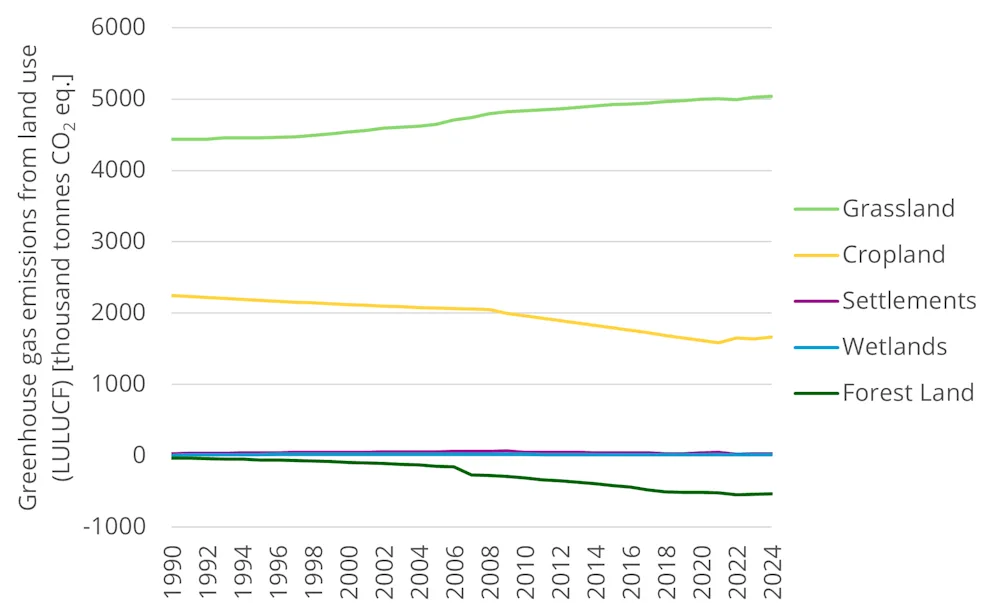
Figure 1. Emissions and removals in each land use category from 1990 to 2024.
Improvements in the estimation of emissions and removals
During 2025 and early 2026, several improvements were implemented in the estimation of emissions and removals from the LULUCF sector. When improvements are implemented, the entire time series from is recalculated from the latest inventory year back to 1990 to ensure consistency.
Several ongoing studies and projects aim to further improve the underlying data and emission factors. Figure 2 presents net emissions from the LULUCF sector as reported in the March 2026 submission, compared with the preliminary submission from July 2025 and the previous final submission (March 2025). Three key improvements had the most significant impact and are described below.
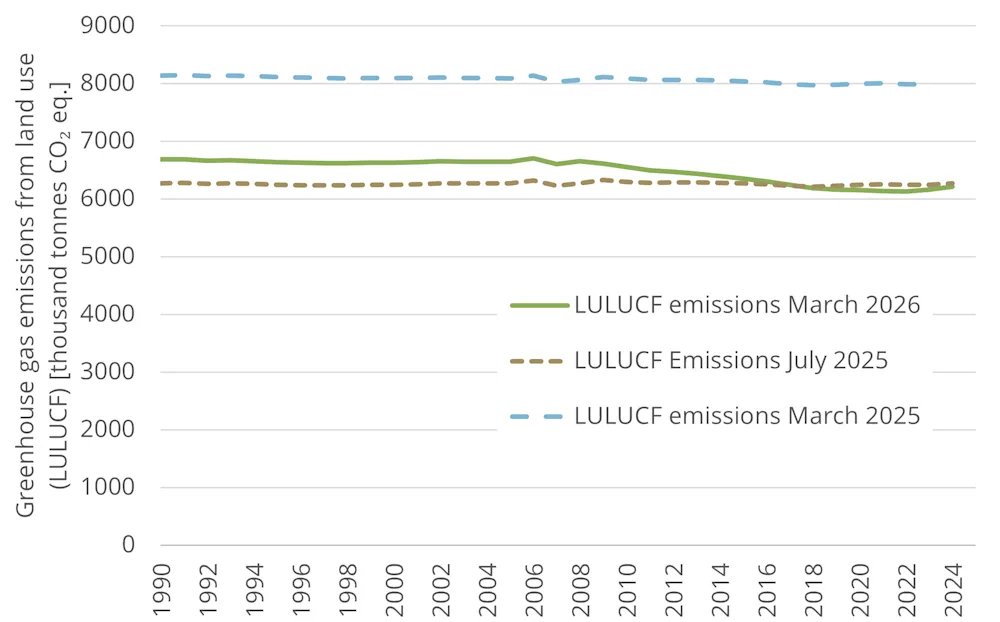
Figure 2. Comparison in the total net emissions from LULUCF between submissions in March 2026, July 2025 and March 2025.
Emissions and removals from undisturbed wetlands no longer reported
Emissions and removals are now reported only for wetlands where the groundwater level has been altered due to human activities (e.g. drainage or inundation for reservoirs). In previous submissions (up to 2025), emissions and removals were also estimated for undisturbed wetlands below 200 m elevation that may be affected by grazing.
This revision was implemented in consultation with the inventory reviewers. The impact of land-use activities other than changes in groundwater level, such as grazing, is considered minor for overall emissions and removals from wetlands.
As a result of this change, total estimated emissions decrease by approximately 700 kt CO₂ eq. across the entire time series.
Estimation of emissions and removals from mineral soils in grazing areas within the Grassland land-use category, by land condition
Prior to the 2025 submission, emissions and removals from mineral soils in grazing areas within the Grassland land-use category were not estimated due to insufficient data. In the current submission, grazing areas and pastures are stratified by land condition. Emissions are estimated for degraded areas, while removals are estimated for well vegetated areas. No emissions or removals are estimated for areas without vegetation or soil cover.
This improvement applies only to mineral soils in grazing areas and does not affect grazing areas on drained organic soils, which remain a significant source of emissions.
As a result, total estimated emissions decrease by approximately 1,050 kt CO₂ eq.uivalents uniformly across the time series.
Revision of area in the cropland land-use category
The area of the Cropland land-use category has been revised based on updated data and improved data processing methods, including a clearer distinction between cropland in use and cropland that has been abandoned.
The revised estimates indicate that cropland area in use remained relatively stable over the period 2021–2024 but has declined since 1990, consistent with a decreasing trend in hay harvest. The updated area affects emission estimates in both the Cropland and Grassland land-use categories, as cropland no longer in use is reclassified as grassland.
As a result of this improvement, net emissions from the Cropland land-use category decrease from 1990 to 2021, whereas in previous submissions (up to 2025) net emissions increased over the entire inventory period. The overall impact of this improvement is an increase of emissions of 420 kt CO₂ eq. in at the beginning of the inventory period (1990) and a decrease of 85 kt CO₂ eq. at the end of the inventory period (2023), compared with the preliminary submission from July 2025 (see Figure 2).
The improvements described above represent further steps in the continuous development of the inventory. Ongoing research efforts across Iceland are expected to provide improved data in future submissions, including for emissions from drained wetlands.