
Land and Forest Iceland
Honored for contributions to birch genetics
22nd September 2025
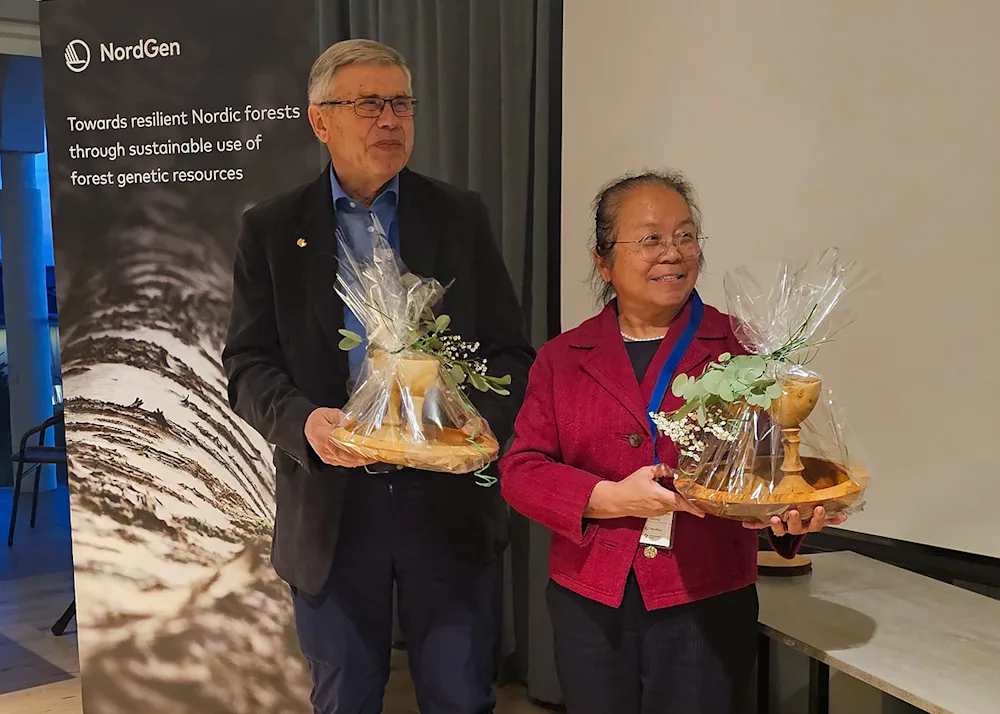
At the NordGen Forest conference on birch, held in Hella on 17–18 September, two Icelandic scientists were honored for their work in birch genetics: Kesara Margrét Anamthawat-Jónsson and Þorsteinn Tómasson.
The first day of the conference covered a wide range of topics relating to the genetics and resources of birch species found in the Nordic countries, both in natural forests and in cultivation. In addition to Icelandic contributions, speakers came from Sweden, Norway, and Denmark. On the second day, participants went on an excursion to Þórsmörk, where they were introduced to the long-standing efforts in birch woodland restoration and to research on soils, methods for stimulating birch colonisation, and related fields.
The conference made it clear that there is growing emphasis on the use of birch in Nordic forestry, both to expand its share in natural forests and to increase its role in planted forests, adding diversity and improving timber quality. Birch breeding shows great promise, particularly in developing straight-stemmed trees suitable for veneer and other wood products. Finland has led birch breeding efforts for decades, and Sweden and Norway now have active breeding programs as well. Denmark and Iceland are also moving forward in this field. Two Icelanders stand out as pioneers in birch research and breeding: Dr. Kesara Margrét Anamthawat-Jónsson and Dr. Þorsteinn Tómasson.
Dr. Kesara Margrét Anamthawat-Jónsson has had a very successful and fruitful scientific career, as a professor of botany and plant genetics at the Faculty of Life and Environmental Sciences, part of the School of Engineering and Natural Sciences at the University of Iceland. She has been in charge of teaching plant physiology, plant genetics and biotechnology, molecular and cellular genetics of plants, and tropical biology and has supervised a large number of PhD- and MSc-students at the University of Iceland and universities abroad.
Kesara's research over the past four decades has focused on the genetics of Icelandic plant species, and she has made various discoveries in this field, in collaboration with students and partners both in Iceland and abroad. Among other things, Kesara has researched the genetic characteristics of Icelandic birch. Icelandic downy birch (Betula pubescens) is often crooked, which is due to introgression with dwarf birch (Betula nana). Gene flow between downy birch and dwarf birch, which also occurs elsewhere in Northern Europe, is considered an evolutionary advantage for the species to survive environmental changes, especially those that have occurred during human history.
Molecular genetic studies supervised by Kesara have revealed that Icelandic birch has different characteristics. In fact, most of what is known scientifically about molecular, cytological and phenotypic variation found in Icelandic birch can be attributed to the work of Kesara and her collaborators. Land and Forest Iceland expresses its gratitude to Kesara for her great contribution to genetic research on birch and other tree species.
Mr. Þorsteinn Tómasson has worked for decades on plant breeding in the fields of agriculture, forestry, and horticulture. Þorsteinn began his career as a plant geneticist, working on barley and grass-breeding. Þorsteinn then had a long and successful career, first as the director of the Icelandic Agricultural Research Institute and later as a head of office in the Ministry of Agriculture and Fisheries. In parallel, he contributed a major share of his free time as a volunteer, from the 1980s to date, on genetic improvement of Icelandic downy birch. His work led to several genetically improved birch strains, under the variety names such as Embla and Kofoed. He has also crossed these strains with other birch species and red-leaved cultivar from other countries and developed both fast-growing varieties and red-leaved coloured varieities, including those named Hekla and Dumba.
Owing to his work, Þorsteinn has been awarded honorary membership of the Icelandic Forestry Association and has received the Icelandic Order of the Falcon from the president of Iceland. Þorsteinn's breeding work has been crucial in strengthening birch breeding in forestry and beautifying urban environments with beautiful trees and increasing interest in forest tree improvement in Iceland. We thank him for his selfless work in birch breeding, and especially for having given the Embla variety to the Icelandic Forest Service (now Land and Forest Iceland), for use in Icelandic forestry. For all his painstaking efforts, Land and Forest Iceland owes Þorsteinn a depth of gratitude.
At the evening ceremony on the first day of the conference, Ágúst Sigurðsson, Director General of Land and Forest Iceland, presented Kesara and Þorsteinn with honorary awards in recognition of their contributions. He thanked Þorsteinn in particular for having donated Embla to Land and Forest Iceland for use in forestry. The awards, crafted from Icelandic wood by artisan Jón Guðmundsson, were presented to the honorees in the presence of conference organisers and colleagues. The above image shows the honorees along with Dr. Ágúst Sigurðsson, Director of Land and Forest Iceland to the right, and Dr. Brynjar Skúlason, head of research and development at Land and Forest Iceland, to the left.

From the Þórsmörk excursion. Professor Ása Aradóttir educates conference attendees about suitable conditions for the spread of birch. Photo credits: Pétur Halldórsson

From the Þórsmörk excursion. Professor Ása Aradóttir educates conference attendees about suitable conditions for the spread of birch. Photo credits: Pétur Halldórsson