
Land and Forest Iceland
First-Ever Quantified Target for Reducing Land-Based Emissions
22nd September 2026
A total of 225 hectares of wetlands will be restored this autumn on state-owned land in Iceland. Under a new regulation on support schemes for soil conservation and forestry, work is now under way to develop financial incentives for nature-based solutions on privately owned land. For the first time, the Icelandic Government has established a quantified target for reducing land-based emissions.

This was among the points highlighted by Jóhann Páll Jóhannsson, Minister for the Environment, Energy and Climate, during a presentation this morning on newly released emissions figures for Iceland and the status of the country’s climate actions. The Minister reported that provisional figures from the Environment and Energy Agency indicate that Iceland remains well behind schedule in meeting its climate objectives and that efforts will need to be accelerated significantly if national targets are to be achieved.
According to the provisional figures, greenhouse gas emissions fell by only 3.9% in 2025 compared with the previous year. Further information on the main sources of emissions can be found in a news item on the Government of Iceland website, which also includes a link to the Minister’s presentation.
Concerning land use, the Minister noted that implementation of the ongoing priority programme on ecosystem and wetland restoration is progressing well. He stated:
“This autumn, a total of 225 hectares of wetlands will be restored on five state-owned farms. This corresponds to 315 full-size football pitches. We will fill in 23 kilometres of drainage ditches, roughly the same distance as from Hveragerði to Þorlákshöfn.”
Preparatory work for these projects has been under way over the past year. In addition, the Minister signed a new regulation last January establishing a broader system of incentives and support for soil conservation and forestry. Based on this framework, financial incentives are now being developed for nature-based actions on privately owned land. According to the Minister, it is essential that farmers and other landowners become active participants in these efforts, enabling them to protect and restore ecosystems alongside the sustainable use of their land.
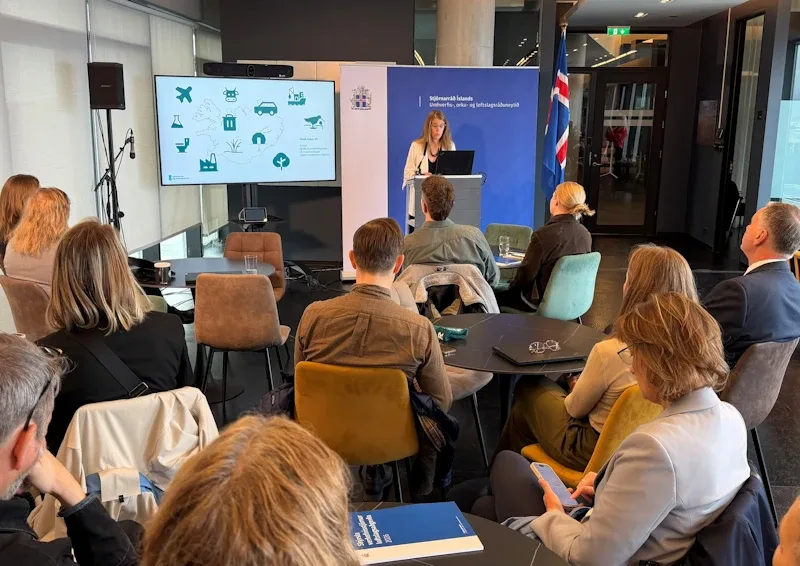
Land and Forest Iceland is responsible for compiling and calculating the land-use and forestry emission figures that form part of Iceland’s greenhouse gas inventory. At the meeting, Nicole S. Keller, specialist at the Environment and Energy Agency, outlined the latest figures for human-induced emissions within Iceland’s borders. Emissions from land use, arising primarily from drained soils, amounted to approximately 6.1 million tonnes in 2025, representing a decrease of 2.2% from the previous year. Increased carbon sequestration through forestry and the restoration of both dryland and wetland ecosystems is helping to reduce overall emissions from land use.
A report by the Climate Action Steering Group states that, for the first time, a quantified target has been established for reducing emissions from land. Iceland’s nationally determined contribution (NDC) for 2035 includes a 50-55% reduction in societal greenhouse gas emissions compared with 2005 levels, as well as a reduction in land-based emissions of 400,000-500,000 tonnes of carbon dioxide equivalent over the same period.
The report emphasises that achieving these goals is not solely the responsibility of public authorities. Participation by individuals, non-governmental organisations, businesses and public institutions in both the preparation and implementation of soil conservation and forestry measures is considered essential for meeting climate objectives as well as biodiversity goals related to land use. The report therefore stresses the importance of reviewing and strengthening government support mechanisms so that funding for actions on privately owned land becomes even more effective. It also calls for a clearer and more proactive approach by Land and Forest Iceland in engaging with society through outreach, advisory services and encouragement of public participation in restoration initiatives.
With regard to land use and climate action, the Minister also noted that the Climate and Energy Fund supported 42 agricultural projects in March this year, including initiatives aimed at improving fertiliser application efficiency and, in other words, making better use of mineral fertilisers.
A formal announcement on the commencement of wetland restoration projects on state-owned land is soon to be expected. It is hoped that the Minister himself will place the first spadeful of soil into a drainage ditch to mark the occasion. At that point, details will also emerge regarding the locations of the 23 kilometres of drainage ditches scheduled to be filled in during the autumn months.
The news item on the Government's website
The Climate action steering group report
Watch the minister's presentation
Photos are from the Government's website