
Land and Forest Iceland
Doctoral thesis on soil formation in birch woodlands
13th October 2025
Sólveig Sanchez recently defended her PhD thesis in Natural and Environmental Sciences at the Agricultural University of Iceland, focusing on soils in Icelandic birch woodlands, particularly their carbon and water balance. Her results show that soils in old birch forests are carbon-rich, well-developed, and retain water effectively—signaling their very healthy state.
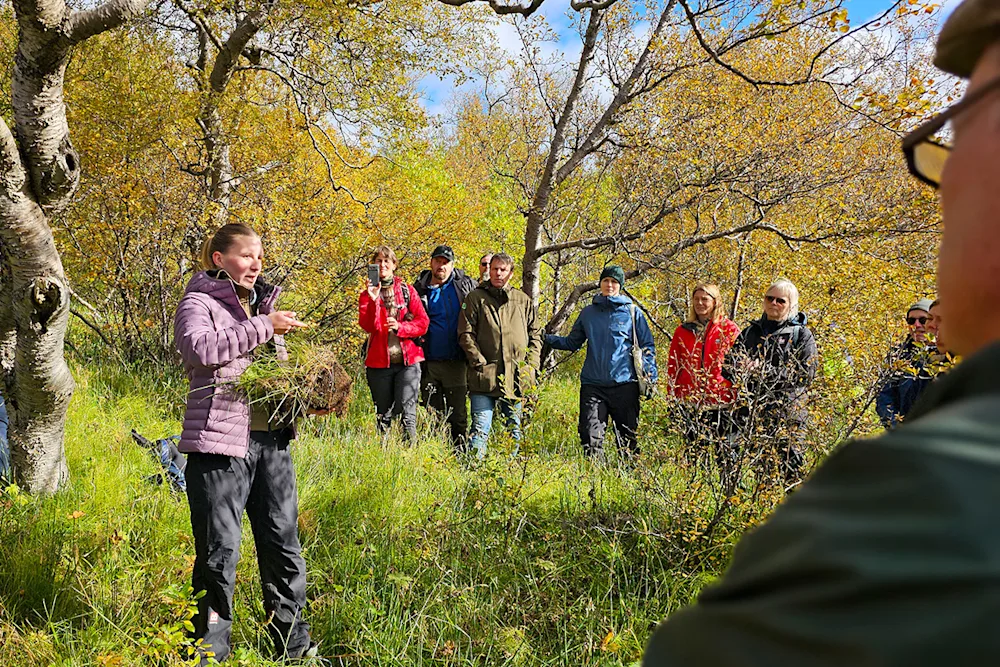
Sólveig teaches about the soil of a mature forest during an excursion in connection with the NordGen birch conference in September 2025. Photo: Pétur Halldórsson
The thesis, titled Soil dynamics within Icelandic birch woodland chronosequences, explores how soil properties develop as treeless land gradually becomes birch woodland. The aim was to fill important knowledge gaps concerning birch forest soils in Iceland, especially regarding the restoration of natural woodlands. Ten study areas were examined, each including treeless land, young woodland, and birch stands older than sixty years.
Significant carbon storage in soil
The results revealed substantial carbon accumulation in the upper 30 cm of soil in the old birch stands—around 7.4 kilograms per square metre, compared with 5 kilograms in treeless areas. Annual carbon accumulation was found to be 0.04–0.07 kilograms per square metre, equivalent to 400–700 kilograms per hectare per year. This carbon storage was largely attributed to andic soil properties and the presence of metal-humus complexes, both of which enhance soil carbon stability.
According to these findings, soil carbon storage in Icelandic birch woodlands could potentially offset about 7% of the country’s current greenhouse gas emissions if the government’s target—to reclaim birch cover on 5% of Iceland’s land area—is achieved. The research also showed that old birch forest soils retain water much better than those of young forests or open land. Water infiltration during summer was rapid due to high soil porosity and dense vegetation cover, which promotes infiltration and prevents runoff. Dust deposition was also found to have a major influence on soil characteristics, helping to bury organic carbon and contribute to its accumulation in the soil. Overall, the study demonstrates that Icelandic birch woodlands foster carbon-rich, fertile soils with excellent hydrological properties.
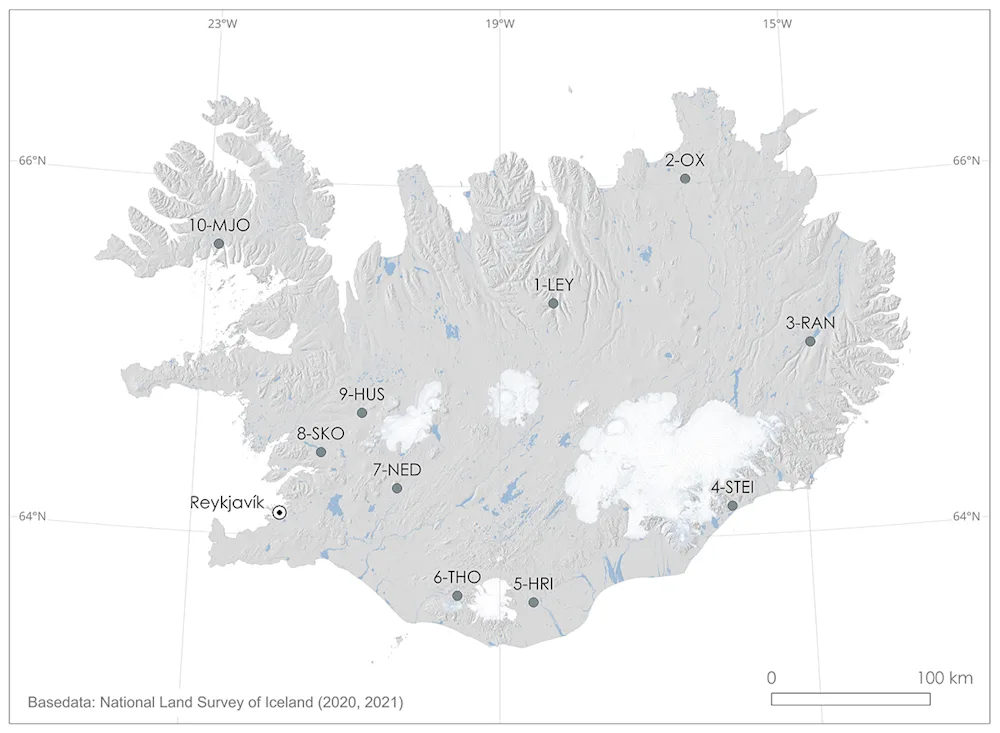
The study locations demonstrated effective distribution across Iceland.
Future research directions
Asked what we can learn from the project, Sólveig explains that her work highlights the crucial role of birch for soil health. It also provides valuable insight into the composition of Iceland’s volcanic soils, including the behaviour of allophane and metal-humus complexes. The research sheds new light on the effects of dust deposition on birch forest soils. Looking ahead, she is eager to continue exploring—especially to study deeper soil layers (beyond 30 cm) in dust-affected areas to determine whether large carbon stores exist there. She also hopes to investigate metal-humus complexes and soil hydrology further, including ways to improve methods for estimating plant-available water.
Specialist at Land and Forest Iceland
Sólveig has recently joined Land and Forest Iceland as a specialist in carbon dynamics of dryland ecosystems. Her role includes analysing data collected in the Moli and CO2lur research projects and publishing results in scientific papers. The findings will contribute to Iceland’s national greenhouse gas inventory.
And how does she feel about her new position?
“I really enjoy the work. I’m surrounded by people I know well from my studies, and I feel great here. It’s an honour to be able to work as a researcher and to contribute directly to the nation’s climate accounting. I’m very much looking forward to the years ahead!”
Landogskogur.is warmly welcomes Sólveig Sanchez to the team and congratulates her on earning her doctorate.
Sólveig’s PhD supervisors were Ólafur Arnalds, Professor at the Agricultural University of Iceland; Jóhann Þórsson, Specialist at Land and Forest Iceland; Randy Dahlgren, Professor at the University of California, Davis; and Ása L. Aradóttir, Professor at the Agricultural University of Iceland. The external examiners were Paul A. McDaniel, Professor at the University of Idaho, and Graeme I. Paton, Professor at the University of Aberdeen.
Link to the PhD thesis:
Soil dynamics within Icelandic birch woodland chronosequences
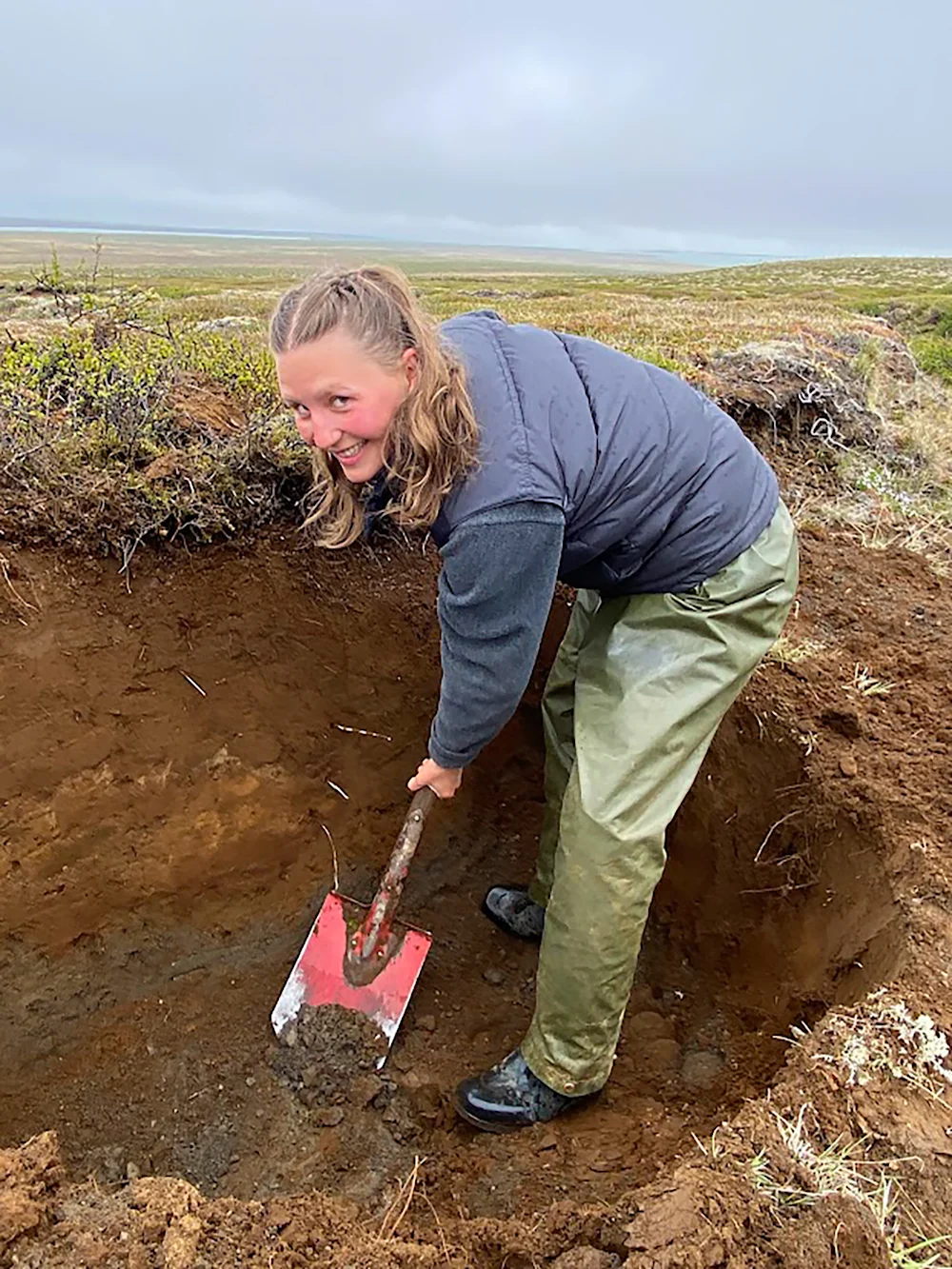
Sólveig performing fieldwork.