Land and Forest Iceland
Birch spreading in Sandvatnshlíð
16th October 2025
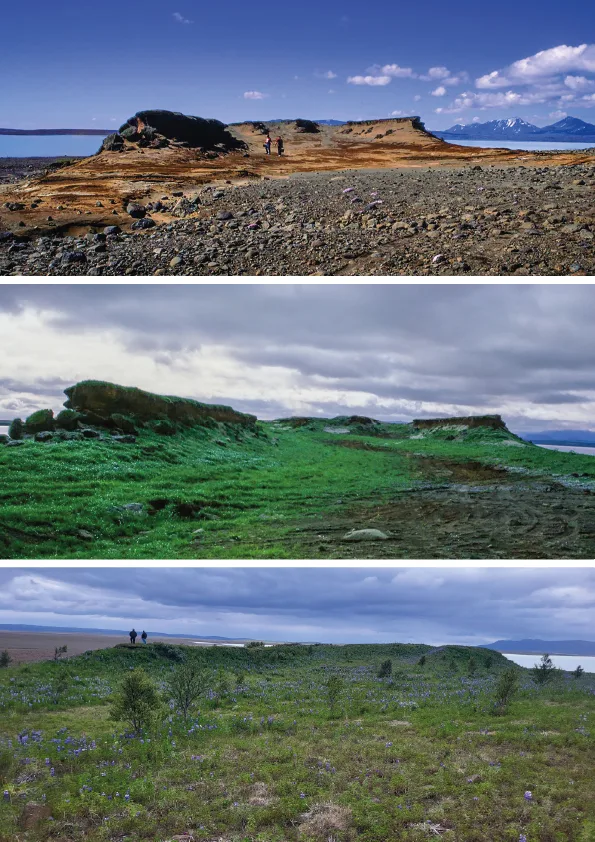
The recovery of birch woodland in Sandvatnshlíð demonstrates the long-term impact of protection and targeted restoration measures on eroded land in Iceland. After a quarter of a century of care and monitoring, birch is now spreading, and the tallest trees have reached nearly four metres in height.
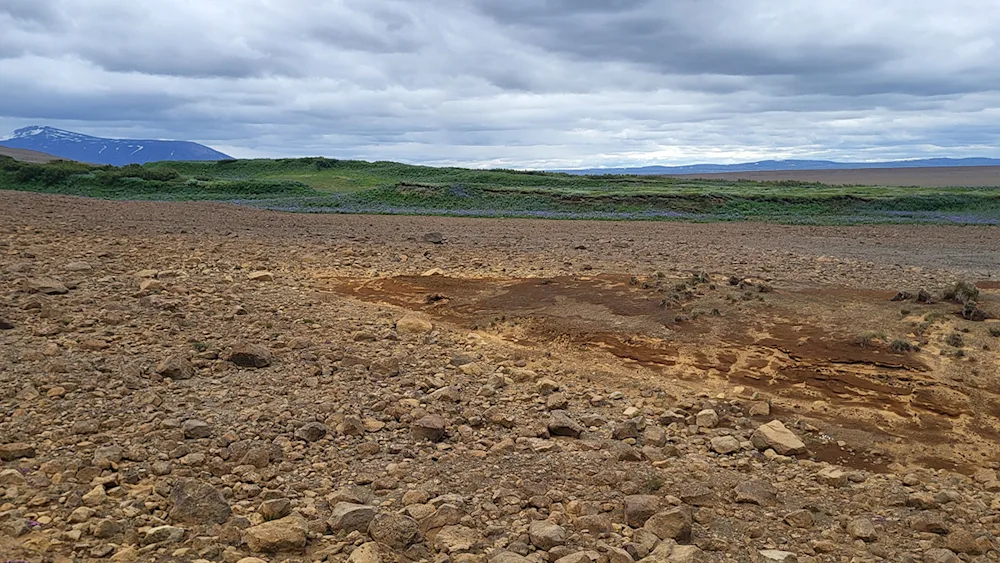
Image demonstrating the contrast between the enclosed area and the landscape beyond where no land reclamation measures have been applied. Photo credit: Garðar Þorfinnsson.
The results of protection and land restoration measures in Sandvatnshlíð, located on the uplands of Biskupstungur in South Iceland, are now clearly visible: birch is spreading, and the tallest trees have reached nearly four metres in height. Outside the nine-hectare fenced area, however, there is no sign of natural birch regeneration.
The area in question lies on the slopes just north of Sandvatn, at an elevation of about 300 metres above sea level. The road to Hagavatn runs through the site. The land had been largely eroded, though small patches of vegetation could still be found around the turn of the century. In 2000, members of the Biskupstungur Land Reclamation Association fenced off nine hectares to protect the main remaining vegetation patches in Sandvatnshlíð.
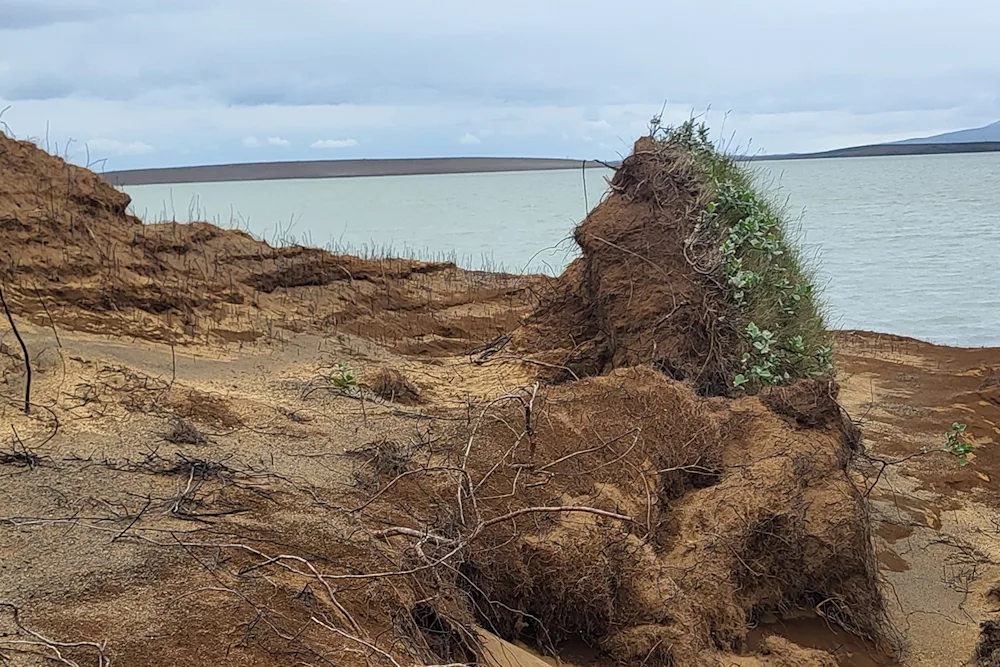
An eroding turf mound beyond the fenced area on the shores of Lake Sandvatn. Photo credits: Garðar Þorfinnsson
The main reason for this initiative was the presence of birch in these patches, considered valuable for preservation. They offer an indication of what the area might once have looked like, before extensive soil erosion transformed much of the vegetated land. Some believed that the last remnants of vegetation would eventually disappear if no protective action was taken. Following the fencing, members of the Land Reclamation Association carried out several land improvement measures. According to Garðar Þorfinnsson, specialist and regional officer at Land and Forest Iceland, the institution’s data show that the last restoration work was conducted there in 2009.
Land restoration measures
The main actions taken to restore vegetation in Sandvatnshlíð included:
• Spreading of fertiliser and grass seed, both mechanically and by hand.
• Distribution of hay bales over erosion scars and closing them off.
• Planting of lupine.
• Planting of birch.
• Levelling of eroded surfaces using a small crawler excavator.
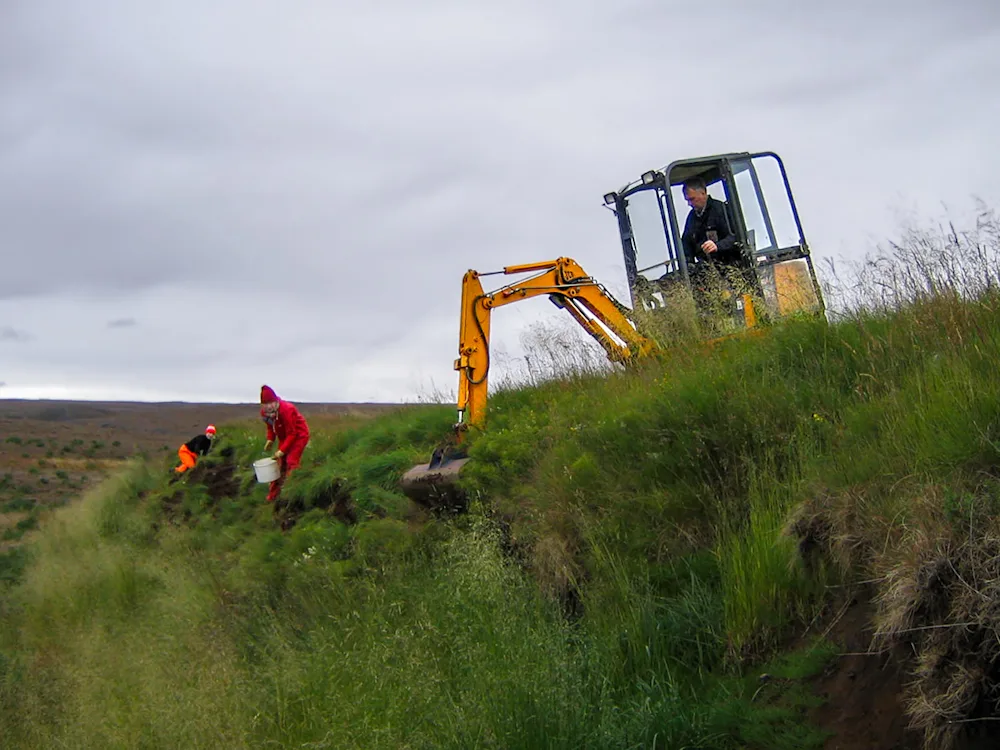
Edges of an eroding turf mound being reduced with a small excavator. Photo credits: Elínborg Guðmundsdóttir
Garðar explains that birch is now naturally regenerating within the fenced area, which covers only about nine hectares. Outside the fence, no self-sown birch has been observed, although lupine is gradually spreading beyond the enclosure, despite the fact of sheep grazing in the area.
The tallest birch trees have now reached almost four metres, and Garðar describes the results as highly successful. No further land restoration work has been carried out in recent years, and future plans are uncertain. However, members of the Land Reclamation Association have also worked outside the fence, where they managed to halt erosion in some vegetation patches by blowing hay into the bare soil.
According to Garðar, fencing alone is far from sufficient to trigger vegetation recovery in such severely degraded areas. Nevertheless, the contrast between the thriving vegetation inside the fence and the barren land outside is striking.
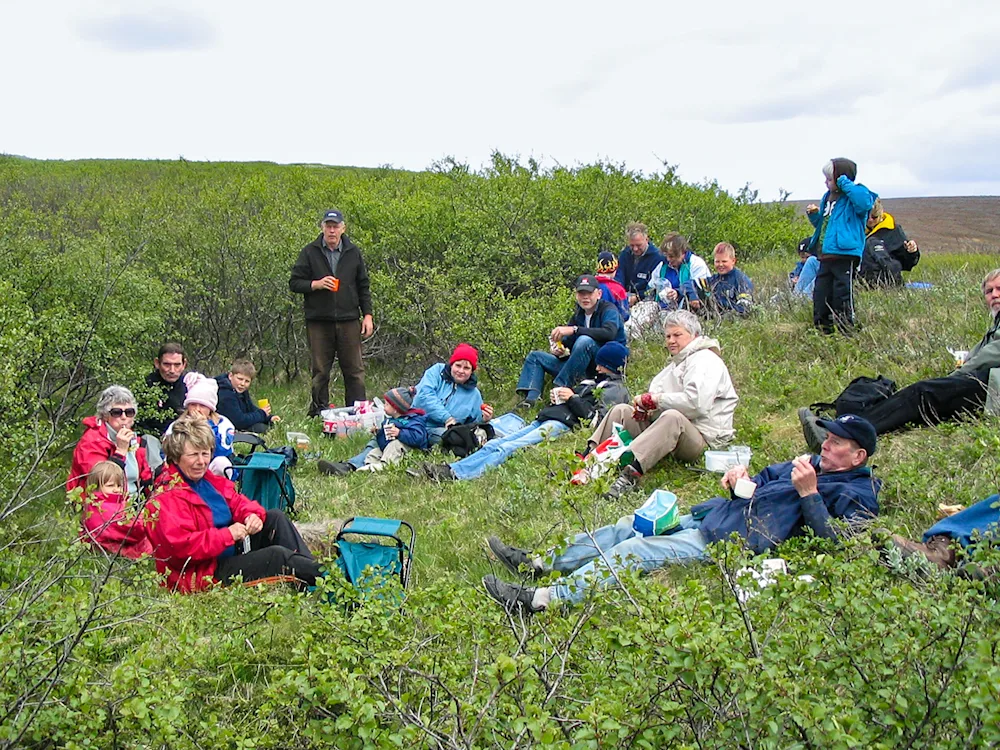
A well-deserved pause during a land reclamation effort funded by Pokasjóður Fund. Photo credits. Garðar Þorfinnsson
Vanished forests
In the 1999 issue of Skógræktarritið (The Icelandic Forestry Journal), Sturla Friðriksson and Grétar Guðbergsson published an article on "Ancient Forests in Sandvatnshlíð". They described the area as mostly barren gravel slopes, scree and exposed rock, though occasional patches of soil and vegetation remained on high turf mounds. Evidence showed that forests once grew on the slopes near Brunnalækur, a few kilometres eastward, where remains of charred wood and charcoal pits were found. Ancient records and later sources indicate that woodland in this area was used for timber and fuel but had largely disappeared by the mid-nineteenth century.
Sturla and Grétar suggested that, in earlier centuries, a continuous stretch of vegetation may well have extended from Sandvatn all the way east to the river Hvítá, even if usable forest was found only in the most sheltered sites. Based on charcoal remains, they concluded that the trees were slow-growing and probably not more than two metres tall.
Today, the tallest birch trees in Sandvatnshlíð have surpassed that height, reaching nearly four metres after a quarter-century of protection from grazing and other disturbance.
Source: Fornir skógar í Sandvatnshlíð (Ancient Forests in Sandvatnshlíð), Skógræktarritið 1–1999, p. 79
Read the article (in Icelandic) on timarit.is.