5th June 2026
5th June 2026
Experience with electronic submission and preservation of digital records
The National Archives of Iceland’s spring conference was held on Wednesday, June 3, for the eighth time under the title “Electronic Submission and Preservation of Digital Records – Lessons Learned, Challenges, and the Way Forward.” As in previous years, the conference was very well attended, with well over one hundred participants taking part both on-site and via livestream.
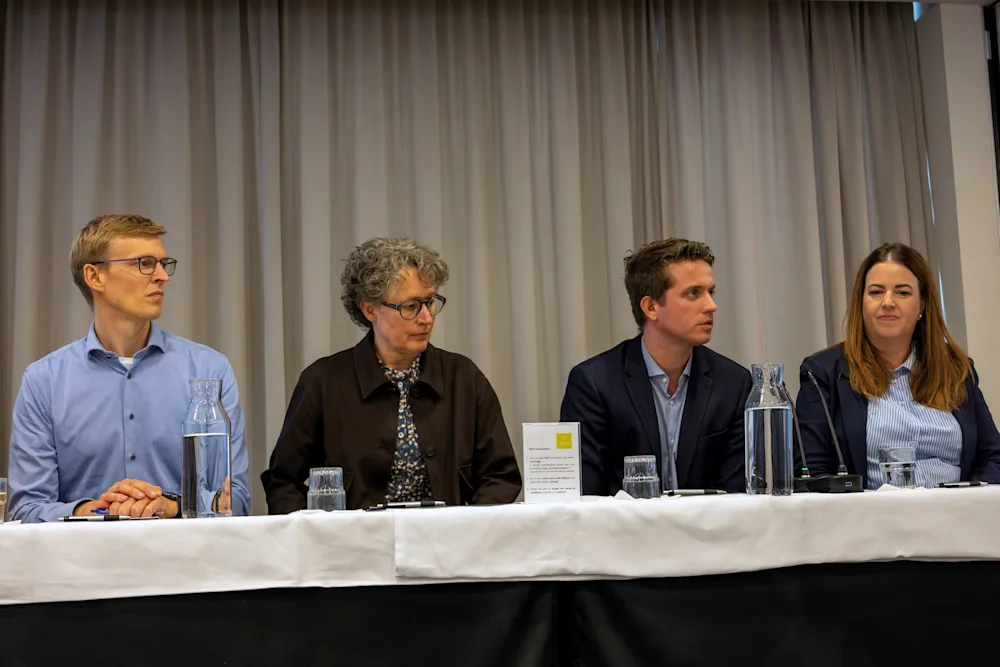
Frá vinstri: Bjørn Ehrenreich Riis Thorup and Jette Holmstrøm Kjellberg from Rigsarkivet, Heiðar Lind Hansson, National Archives and Bergrún Lilja Sigurjónsdóttir from AOSH
Four presentations were delivered, focusing on the creation, registration, transfer, and preservation of digital records, with emphasis on the lessons learned in addressing these tasks. Two presentations were given by specialists from the Danish National Archives (Rigsarkivet), who discussed their experience, implementation approaches, and future vision for the project in Denmark. The framework for electronic records transfer in Iceland to public archives is based on methods developed by the Danish National Archives over several decades and is grounded in an agreement between the National Archives of Iceland and Rigsarkivet from 2005.
The presentations were delivered by Jette Holmstrøm Kjellberg and Bjørn Ehrenreich Riis Thorup from the Danish National Archives (Rigsarkivet). Jette emphasized the importance of quality control in records management at the point of creation and reviewed the methods that have proven most effective in Denmark. In his presentation, Bjørn outlined the value of the Danish methodology for preserving digital records, its advantages and challenges, and provided insight into the current state of electronic records transfer in Denmark as well as future prospects.
The latter part of the program featured Heiðar Lind Hansson from the National Archives of Iceland and Bergrún Lilja Sigurjónsdóttir from the Administration of Occupational Safety and Health. Their presentations addressed both human resources issues and competencies in electronic records management. Heiðar highlighted a new government human resources policy, which, among other things, aims to define core competencies across the public sector. He noted that it would be natural to define electronic records management as a core competency, thereby promoting good practices across government. Bergrún Lilja shared practical experiences of electronic records management at the Administration of Occupational Safety and Health and stressed the importance of fostering a positive and supportive culture in this work. She also emphasized the crucial role of leadership in setting a good example and the importance of recognizing and praising good performance.
The session was chaired by Helga Margrét Höskuldsdóttir, a television and sports news reporter at RÚV.
Further information about the speakers, presentation titles, and the program can be found here.