Akureyri Hospital
European Trauma Course (ETC) Held in Iceland for the First Time — at Akureyri Hospital
10th November 2025
This week, the European Trauma Course (ETC) took place for the first time in Iceland. The Icelandic Resuscitation Council (EÍ) is responsible for introducing these courses to Iceland, and the inaugural session was hosted at Akureyri Hospital (SAk). The aim of the course is to train healthcare professionals in the coordinated reception and management of severely injured trauma patients, with a strong emphasis on teamwork, communication, leadership, and decision-making. In addition to hands-on clinical procedures, 85% of the course is based on practical scenario training. Organizers from ETC, EÍ, and SAk were all highly satisfied with the outcome.
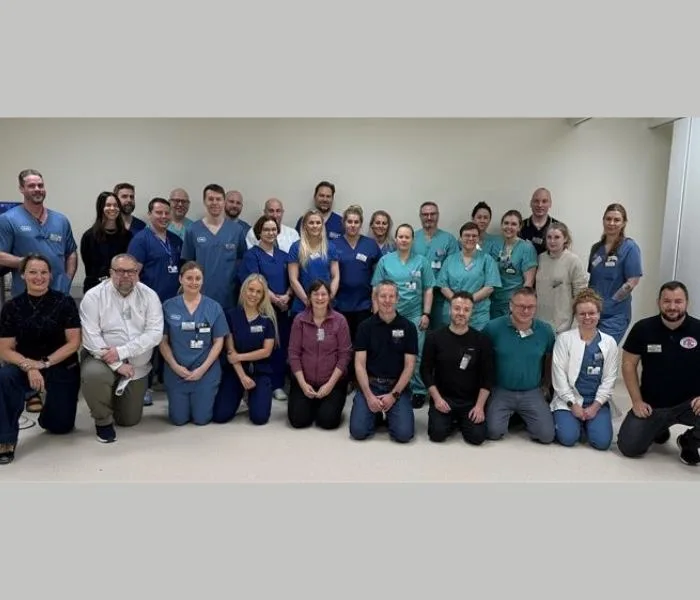
Hrafnhildur Lilja Jónsdóttir, SAk’s Education Director and EÍ project manager, says the process leading up to the course has been long. “This is a standardized course, and Iceland has been on the waiting list alongside other countries since 2021 to bring it here. The ETC prioritization process is partly based on the readiness of local infrastructure. It made a big difference that EÍ had already successfully introduced advanced life support courses for adults, children, and newborns — and now, finally, it was our turn.”
Twelve doctors and ten nurses took part in the course, which was taught by nine instructors — seven international and two Icelandic instructors in training. The long-term goal is for Iceland to eventually become self-sufficient in hosting such courses, though that may take several years. It is worth noting that all instructors teach on a voluntary basis, with only expenses reimbursed.
“An Absolute Dream Course” in Akureyri
Ferenc Sari, an intensive care physician from northern Sweden and course director, described the preparation as extensive and demanding. “You have to prepare thoroughly — many details must come together to achieve the desired outcome,” he said. He added that while several types of trauma courses are offered in Iceland, the unique feature of the European Trauma Course (ETC) is that it is intended for professionals with at least 2–3 years of experience in emergency medicine. It is aimed at individuals likely to lead trauma teams — both doctors and nurses. “We want to complement other trauma courses meaningfully,” he said, emphasizing that teamwork is central to the program. “Communication and shared understanding within the team are key elements in trauma care. That’s what we focus on the most.”
Ferenc described his stay in Akureyri as exceptional: “The staff here is simply amazing, and the simulation center is excellent. This was truly a dream course — the participants were knowledgeable and well-prepared, and just as importantly, the support staff was outstanding, especially Jón G. Knutsen, Hrafnhildur Lilja Jónsdóttir, and their team.”
Ribs and Plasma Bags
Jón G. Knutsen, who was involved in the technical setup, said the scale of this course was far greater than that of typical resuscitation or simulation training. “We needed equipment for all aspects of trauma — splints, support devices, intubation tools, pelvic binders, blood and plasma bags — and even pig ribs for practicing chest procedures,” he said with a smile.
“This is a demanding course and an incredible experience that requires both organization and creativity. There was a lot of ingenuity in the preparation — we even made an artificial CT scanner to make the exercises more realistic and 3D-printed tracheas for practicing surgical airways.”
The Art of Working Together — Even When Everyone Disagrees
According to Hrafnhildur Lilja, the course focused far more on team-based problem-solving in trauma cases than on teaching individual clinical skills — though those were also practiced. Communication and collaboration are what truly matter in critical situations. “For example, one scenario required the team to solve a case where the team leader had one opinion, the surgeon another, and the anesthesiologist disagreed with both — and once they had reached a consensus on priorities, a flight doctor’s and a receiving hospital physician’s perspectives were added to the mix,” she explained. “There are many ways to reach the same goal, but the team must share a common vision and decide on the best course of action.”
“These are exactly the situations we need to practice. Having clinical skills alone isn’t enough — most people already have those. But for things to go well, everyone in the team must share a unified approach to how tasks are performed. That’s what’s so great about this course — the trauma team gets to practice under increasingly challenging circumstances that depend not only on the patient’s condition and clinical procedures but also on teamwork and communication. After each exercise, the team reflects on what went well and how they can improve further.”
“I’m extremely pleased with how everything turned out — the participants performed excellently, and the international instructors were very impressed with us and the simulation center here at SAk,” Hrafnhildur Lilja concluded