
Land and Forest Iceland
Haukadalur National Forest

General information about the forest
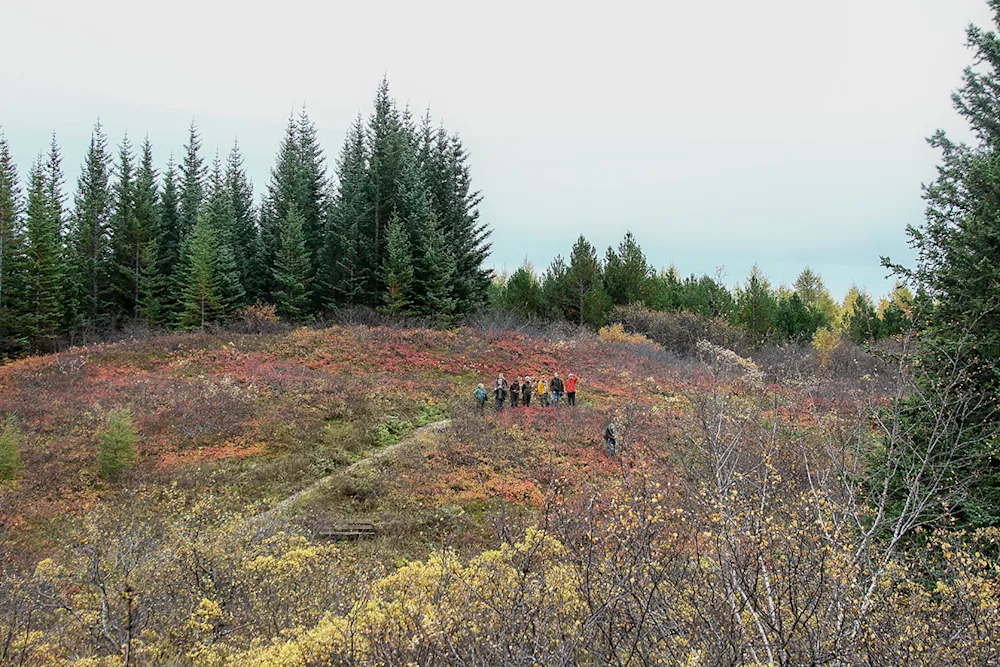
Haukadalsskógur, a major national forest in South Iceland, represents the most extensively planted forest in the region. The area serves as a significant site for ongoing forestry experiments and ecological research. Excellent recreational facilities are available, including a wheelchair-accessible trail developed in collaboration with Sjálfsbjörg in South Iceland.

Location and access
Access is via Route 35 (Biskupstungnabraut) from Selfoss to Geysir. Turn left after passing the Geysir geothermal area, following the gravel road north of the parking lot for approximately one kilometer to Haukadalur church. A portion of the cultivated forest, extending to the Haukadalsheiði highlands—one of Iceland's largest land reclamation projects—is accessible by car. A four-wheel-drive vehicle is required for the mountain road (F338) from Haukadalur to Haukadalsheiði. From there, trails branch to Kjalvegur (right) and Skjaldbreiðarvegur (left), leading towards Kaldadalsvegur south of Langjökull glacier.

Facilities and recreation
Haukadalur National Forest offers excellent facilities for outdoor recreation within a scenic and protected environment. Well-marked hiking trails cater to those seeking outdoor activities and exploration of the forest ecosystem. Interpretive signage along the trails provides educational information about the forest and its natural features. The forest includes a designated wheelchair-accessible trail. Beyond the marked trails, numerous forest roads provide open access for hiking and biking; however, motorized vehicle use on these roads is restricted to forestry vehicles only. Several picturesque rivers and streams, including Beiná, Langamelsá, and Almenningsá, traverse the forest, with the Tungufljót River forming its eastern boundary.
Restroom facilities are available for visitors.

Download the hiking map (pdf)
Haukadalur history
The Haukadalur property is owned by Land and Forest Iceland. In 1940, Danish businessman Kristian Kirk donated the land to the former Icelandic Forest Service; two years prior, he acquired the 1,600-hectare parcel and initiated soil erosion control and fencing measures. The property encompasses portions of the abandoned farms Bryggja and Torta. The former Haukadalur farmhouse, located on the hill east of the church, is no longer extant, though a flagpole marks its former site.

A church has stood in Haukadalur for centuries, situated on its original foundation on the west bank of the Beiná River. The earliest documented records of the church date back to 1121. The church served as a peasant church until approximately 1290, when it was likely integrated into the Skálholt bishopric, a status maintained until the late eighteenth century when the church lands were sold at auction in Vatnsleysa on October 1, 1794. Following the sale, the church remained under the ownership of local farmers until 1940, at which point it was acquired by the Forest Service. In 1938, Kristian Kirk oversaw the church's disassembly and subsequent reconstruction with modifications. Dating from 1842, the church is among Iceland's oldest wooden churches. The reconstruction involved the installation of a concrete foundation, lengthening of the nave, and the addition of windows. The altarpiece, depicting the crucifixion, is the work of Ásmundur Sveinsson.
The church door features a riding shield, like those historically used as protective gear for riders in ancient battles, and later as an ornamental or status symbol. Haukadalur possesses significant historical importance. Þorbrandur Þorbjarnarson and his son, Ásbrandur, cultivated the land there. Hallur Þórarinnson the Mild established a farm in Haukadalur in 1025. Ari Þorgilsson the Learned, and the patriarch of the Haukadalur family, Teitur Ísleifsson, were raised there. During Teitur Ísleifsson's tenure, Haukadalur hosted Iceland's first priestly school. In 1110, Hallur Teitsson assumed the priesthood in Haukadalur, inheriting his father's farm. His son, Gizur, became a lawyer in Skálholt. The family's residency in Haukadalur spanned six generations, or 174 years, concluding with Ormur Klængsson's death in 1284.
Forestry in Haukadalur
Forestry practices in Haukadalur encompass a diverse range of tree species and provenances, including Sitka spruce (Picea sitchensis), lodgepole pine (Pinus contorta), and black cottonwood (Populus trichocarpa) from Alaska; Siberian larch (Larix sibirica); Norway spruce (Picea abies); and Engelmann spruce (Picea engelmannii) from the United States. These constitute the primary plantings, supplemented by less prevalent species such as subalpine fir from British Columbia, hemlock from Alaska, Siberian pine from Russia, and American larch from Alaska. Furthermore, extensive research has been undertaken, encompassing various forestry techniques such as planting and tillage, alongside comparative provenance trials, comparative experiments, and cultivation of subalpine fir for Christmas tree production. Additional research initiatives include frost-lifting experiments, forest thinning density tests, surveys of root-gnawing beetles, and fertilizer trials on seedlings.

The arboretum features a diverse collection of trees, established in memory of young forester Gunnar Freysteinsson, who passed away in a 1998 automobile accident. The collection includes species from various continents, organised geographically. Notable examples include rare species for Iceland such as oak and beech.
In Haukadalur, Sitka spruce and black cottonwood have thrived exceptionally well. The average growth rate in this forest is comparable to the national average, slightly exceeding six cubic meters per hectare annually. The moist, fertile soil of Haukadalur is evidently well-suited to Sitka spruce, with the most productive areas exhibiting growth rates exceeding ten cubic meters per hectare per year. Timber harvesting is conducted sustainably, with lumber processed into wood chips, construction timber, and other products. The highest-quality lumber is crafted into planks and boards for cladding, as well as benches and picnic tables within the forest. Furthermore, Sitka spruce from Haukadalur has been utilised in constructing buildings, such as the reception house in Vallanes in Hérað near Egilsstaðir, and fire huts and service buildings in the National Forests of Laugarvatn and Vaglaskógur. Glulam beams made from Haukadalur Sitka spruce have even been used in a bridge construction over the Þjórsá River south of Mount Búrfell.

Additional points of interest within the forest
In the early years of the century, accessible forest paths were built in Haukadalur National Forest through a collaborative effort between Sjálfsbjörg in South Iceland (a division of The National Confederation of Physically Disabled People) and the Icelandic Forest Service. The Pokasjóður store's fund was the main sponsor, but the project also received support from the Icelandic Tourist Board, Sjálfsbjörg in South Iceland, the Land Reclamation Fund, the Regional Employment Agency of the South, the Icelandic Farmers' Association, and the National Power Company Landsvirkjun's summer work program. High school students from Laugarvatn and Selfoss also volunteered their time. These paths are maintained and benefit all forest visitors.
Download the hiking map (pdf)