
Icelandic Medicines Agency
Red warning triangle on medicine packaging
What does a red warning triangle on medicine packaging mean, and where can you find information about it?
Is there no need to worry about the effects of medicines if they do not carry this marking?
A red warning triangle appears on the packaging of certain medicines to indicate that they may cause sedation that affects the ability to drive and perform tasks requiring full alertness. Various types of medicines carry the red triangle, including sedatives, opioids, certain painkillers, allergy medicines and medicines for nausea.

Examples of medicines that carry a red warning triangle
Opioids
Certain painkillers
Medicines for epilepsy
Medicines for anxiety
Sedatives
Cough suppressants
Travel sickness medicines
Medicines for nausea
Allergy medicines
Migraine medicines
Certain weight-management medicines
ADHD medicines
All medicines containing more than 10% alcohol
Sleeping medicines
The Icelandic Medicines Agency (IMA) has published and maintains a list of medicines that must carry the triangle in Iceland. Marketing authorisation holders and representatives must ensure that medicines on the list carry the warning triangle. If it is not printed on the packaging, a sticker must be added.
Do medicines without the triangle have no effect on the user’s abilities?
As its name suggests, the triangle serves as a warning. However, everyone should assess their own abilities after taking medicines, even if the medicine does not carry this marking.
The effects of medicines vary from person to person. Medicines without a warning triangle may therefore affect driving ability even though there is no such marking on the packaging.
Always read the package leaflet before using a medicine, as it contains information about precautions, whether or not the medicine carries a warning triangle.
For example, bear the following in mind:
Eye drops that dilate the pupils can temporarily impair vision
Blood pressure medicines may cause dizziness, discomfort and slower reaction times
Blood glucose-lowering medicines can indirectly slow reactions and cause dizziness if blood glucose falls too quickly
Medicines for depression and other mental health conditions affect the central nervous system and may therefore cause drowsiness and slow reactions
Various herbal medicinal products cause drowsiness, particularly those containing valerian
All medicines may have unexpected effects, particularly at the start of treatment
Lyf.is – visibility online
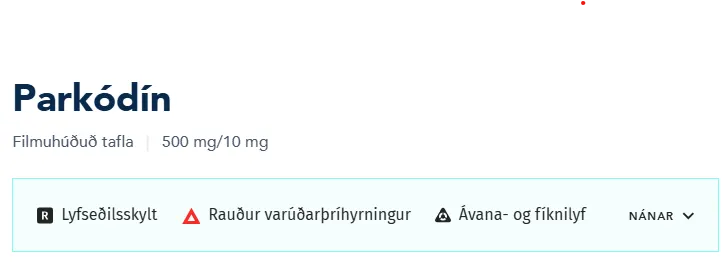
Since 8 July 2025, all marketed medicines that must carry a red warning triangle have been specifically marked on the Medicinal Product Information database website. Below the medicine’s name, strength and pharmaceutical form, you can see whether it should carry this marking. This information is also visible in the search results before opening the individual medicine’s information page.
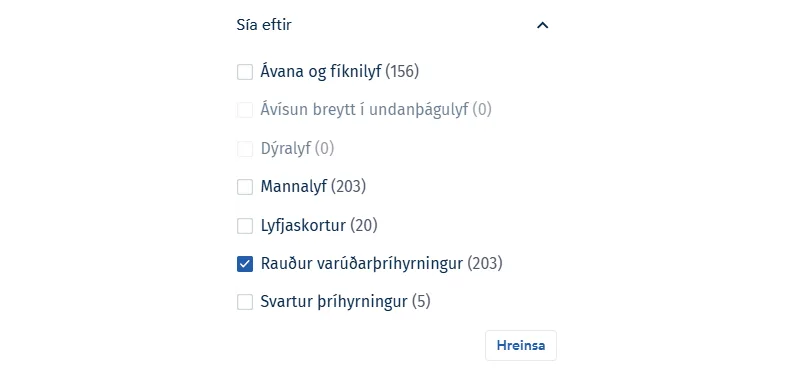
The website’s search function also includes an option to filter specifically for marketed medicines that require this marking.
What does the triangle look like, and where is it placed?
The warning triangle must be red on a white background, with one point facing upwards. Its size varies according to the space available on the packaging. Its sides are generally around 10 mm long, with a line width of 2 mm.
Where the warning triangle is not part of the printed packaging but the medicine is required to carry it, permission has been given to add a sticker bearing the triangle.
Are all medicines covered by these rules definitely marked?
A recent initiative reminded marketing authorisation holders of their obligation to label certain medicines with a red warning triangle. They were given until January 2026 to comply with these rules, so some packs that should carry the marking may not yet do so.
As unlicensed medicines are not marketed in the same way as other medicines in Iceland, it cannot be assumed that they carry instructions in Icelandic. It is therefore particularly important that patients are informed about their properties, including whether they may affect the ability to drive and use machines. Ask a doctor or pharmacist for advice if you are unsure whether a medicine may affect your driving ability.
The red triangle is used in Denmark, Norway and Finland and is therefore not an international symbol. Warnings on medicines purchased abroad may consequently differ from those on Icelandic medicine packaging.
Requirements concerning which medicines must carry a warning triangle vary between countries. Because of its small market, Iceland often shares medicine packs with one of the other Nordic countries. As a result, a medicine that may affect the ability to drive and use machines may be marketed in Iceland without a red warning triangle. However, this situation is temporary, as these medicines must be labelled with a red warning triangle sticker by January 2026 at the latest.
It is therefore always important to seek information and read about your medicines before you start using them.
See also:
This article is one of a series of educational articles published by the Icelandic Medicines Agency.
Last reviewed: 11th September 2025