22nd May 2026
22nd May 2026
Now it's the time for sun protection in Iceland
It's that time of year in Iceland when the sun is strong enough to cause sunburn. Sunburn increases the risk of skin cancer later in life, so people are encouraged to consider sunscreen. Children are more sensitive than adults to the sun's ultraviolet rays, so they need to be especially well protected. In addition to sunburn, ultraviolet rays can cause eye damage and accelerate wrinkling and skin aging.

Sun protection does not only refer to specially designed sunscreen, but also includes, for example, wearing protective clothing, sunglasses, staying in the shade and limiting outdoor exposure when the sun is strongest between 10 a.m. and 4 p.m.
The UV index is a useful way to know whether it is necessary to use sunscreen in a specific place at a specific time. If the UV index is 3 or higher, it is recommended to protect yourself from the sun. In Iceland, the UV index can reach this value from mid-April until the second half of September. The higher the UV index, the stronger the sun's ultraviolet radiation and the shorter it takes for the skin to burn in the sun.
The Icelandic Radiation Safety Authority publishes real-time measurements of the UV index in Reykjavík on its website and at the URL uv.is. When traveling abroad, for example, you can use the international UV app SunSmart (available on the App Store and Google Play) to see the UV index anywhere in the world and when you need to use sunscreen during the day.
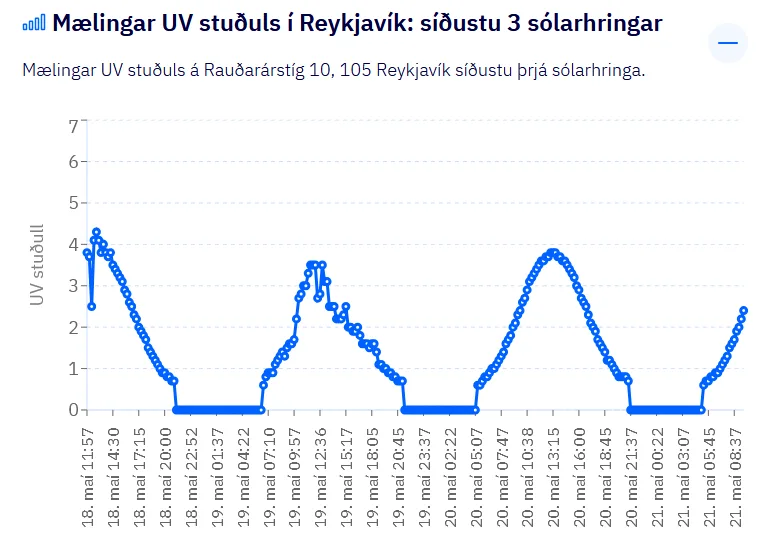
Earlier this week (May 18th – 20th), the UV index reached a maximum of 4 in Reykjavík when the sun was strongest between 10 am and 4 pm, as shown in the graph below. The strength of the sun in Iceland will increase as the summer progresses, reaching its peak in June and July when the sun is highest in the sky.
It is important to note that the UV index increases as you travel south. For example, the UV index will be 9 in Tenerife today (22 May) when the sun is at its strongest. The UV index also increases with increasing altitude and reflection of sunlight, for example from snow-covered ground and water, can cause the UV index to rise above the measured value.