11th June 2026
11th June 2026
Increased need for home nursing
A significant increase in the number of home visits by Home nursing at Heilsugæsla höfuðborgarsvæðisins last year indicates that clients have greater care needs and reduced functional ability than before.
Home nursing services are available to individuals who require healthcare in their own homes. The service supports people living in Kópavogur, Garðabær, and Hafnarfjörður. It is individualized and based on an assessment of each person’s needs. A registered nurse or occupational therapist plans the care in cooperation with the individual and their relatives.
Despite the increase in home visits and higher demand for services, waiting times for new clients are generally short. Last year, prioritization of referrals made it possible to provide services to those most in need within three days of receiving a request.
Significant growth in activity
Last year, interactions within this largest operational unit at Heilsugæsla höfuðborgarsvæðisins exceeded 200,000 for the first time, an increase of 12 per cent year over year. This growth occurred despite the “Good to Grow Old” initiative, which took effect on May 1 2025, and transferred services for clients in Mosfellsbær away from Home nursing to another service provider. On average, there were just over 560 recorded interactions per day, including nearly 460 home visits.
“This increase in service activity last year suggests that our clients have greater needs and reduced functional ability than before,” says Hildur Sigurjónsdóttir, Head of Home Nursing Services.
The goal of the service is to increase clients’ ability to live independently and enable them to remain at home under as normal conditions as possible for as long as feasible. There are many examples where, through home nursing services, clients who had already been approved for placement in a nursing home were able to postpone moving for a long period— in some cases nearly eight years.
“These examples further highlight the importance of supporting people to live at home for as long as possible. This is both better for our clients and, of course, more cost-effective for society than moving people into nursing homes,” says Hildur.
Smart solutions reduce travel burden
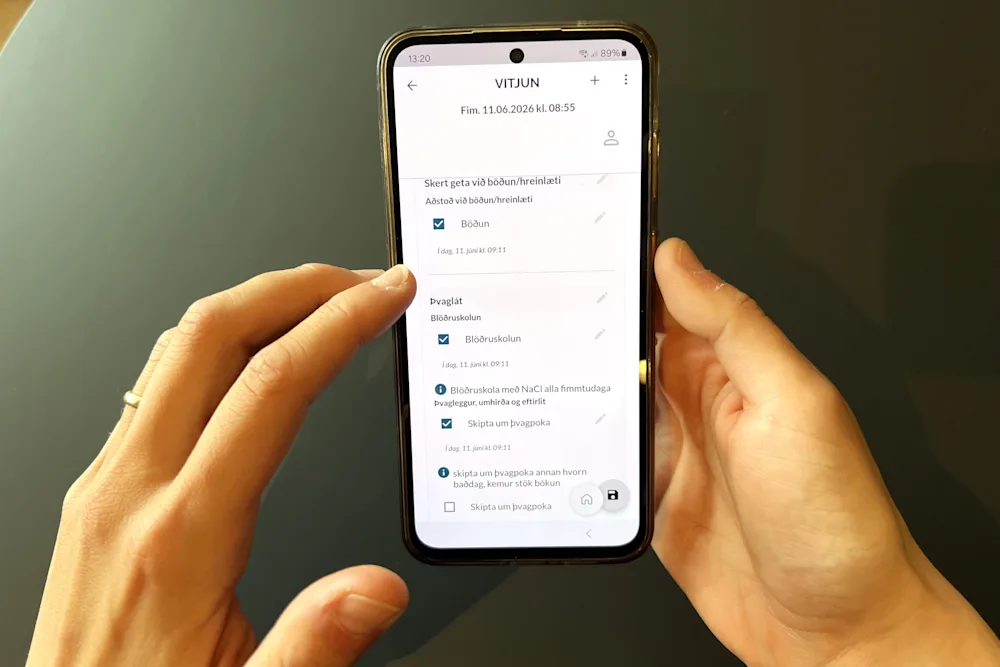
There have been major changes in home nursing operations in recent years, particularly related to technological solutions. Today, nearly all interactions with clients are recorded in real time in their homes using a smartphone app used by staff, which is directly connected to the electronic health record system. Staff also have access to the latest information on nursing needs through the app, and all information is updated in real time.
The increased use of automated medication dispensers in clients’ homes has also been successful, with high client satisfaction. These devices make it easier for people to remember and take the correct medication at the right time. With the growing use of medication dispensers, it has been possible to reduce some home visits and make people more independent and confident in managing their medication.
Around 750 service users
In total, around 750 clients receive services at any given time, and Home Nursing Services employ about 150 staff members. The focus is on multidisciplinary teamwork provided by registered nurses, nurse specialists, psychiatric nurses, nursing assistants, social care workers, occupational therapists, a geriatrician, a psychiatrist, a nutritionist, a sports scientist, a clinical pharmacist, general staff, HR officers, and reception staff.