6th July 2026
6th July 2026
Around 1,000 hectares to receive bone meal this year
Around 1,000 hectares of restoration land managed by Land and Forest Iceland will receive applications of bone meal this year. The fertiliser is used, among other things, on young birch plantations to promote growth and accelerate the natural regeneration of birch through self-seeding. This is the first year that bone meal has been applied on a significant scale in North Iceland, in addition to restoration areas in the south.
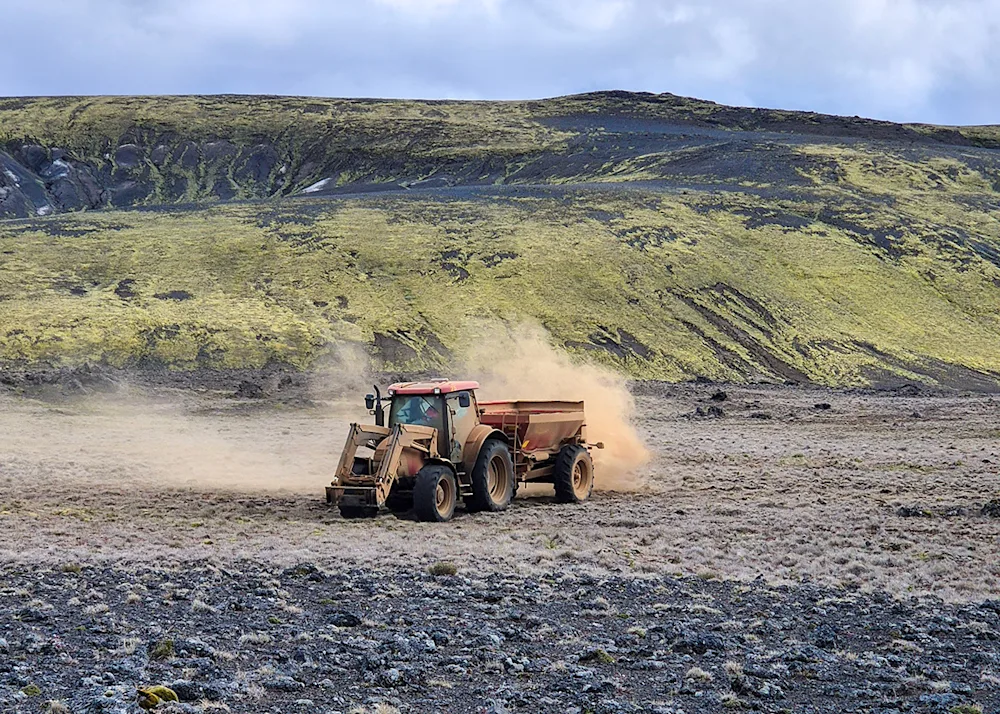
Land and Forest Iceland's new spreader enables more efficient, more even and better targeted application of bone meal. Photo: Kristján Bjarni Indriðason.
In recent years, Land and Forest Iceland has placed increasing emphasis on the use of organic fertilisers in ecosystem restoration. This year, the institution has contracted to purchase 1,500 tonnes of bone meal from Orkugerðin in Flóahreppur. The material will be applied across approximately 1,000 hectares in both North and South Iceland. It is the first time that substantial quantities of bone meal have been transported to North Iceland for this purpose.
At present, Land and Forest Iceland staff are applying bone meal in the Hekluskógar project area and on Hólasandur. The accompanying photographs were taken by Kristján Bjarni Indriðason on Thursday 2 July while work was under way in the Hekluskógar area. According to Garðar Þorfinnsson, Specialist at Land and Forest Iceland, the site treated that day lies west of Hrauneyjar, where birch was planted several years ago. The bone meal is being applied both to fertilise the young trees and to improve the surrounding land, Garðar says.
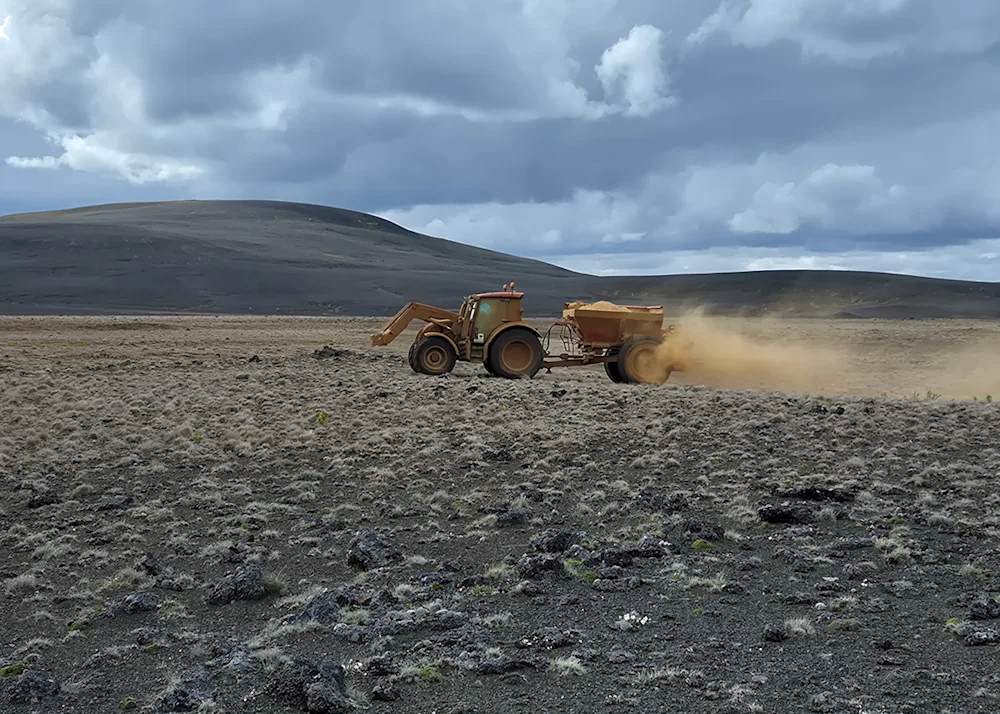
This approach offers two important benefits. Firstly, the trees become healthier and more vigorous, making them more likely to produce abundant seed at an early age and spread naturally into the surrounding landscape. Secondly, the adjacent areas become more fertile, providing better conditions for birch seed to germinate. The application of bone meal is therefore closely aligned with the guiding principle of the Hekluskógar project since its inception: planting birch in clusters, or "islands", and then encouraging the woodland to expand naturally into the surrounding areas over time, eventually forming continuous birch forest.
According to Garðar Þorfinnsson, between 500 and 600 tonnes of bone meal are expected to be applied before work pauses for the summer holidays, after which operations will resume. This spring, Land and Forest Iceland also purchased a new, larger spreader to replace the equipment previously used for bone meal application. Garðar says the new machine has exceeded expectations. It holds just over one tonne more material than the previous spreaders and automatically adjusts the application rate according to the tractor's driving speed, ensuring a more even distribution, better utilisation of the material and significantly greater operational efficiency.
Bone meal is a domestically produced organic fertiliser that has proved highly effective in ecosystem restoration projects, including in the Hekluskógar area. Its fertilising effect lasts considerably longer than that of synthetic fertilisers, while also supplying a range of trace elements in addition to the primary nutrients required for plant growth. When applied to severely degraded land, bone meal helps vegetation and a protective soil crust establish relatively quickly. This improves moisture retention and creates favourable conditions for a variety of plant species, including birch, to become established.
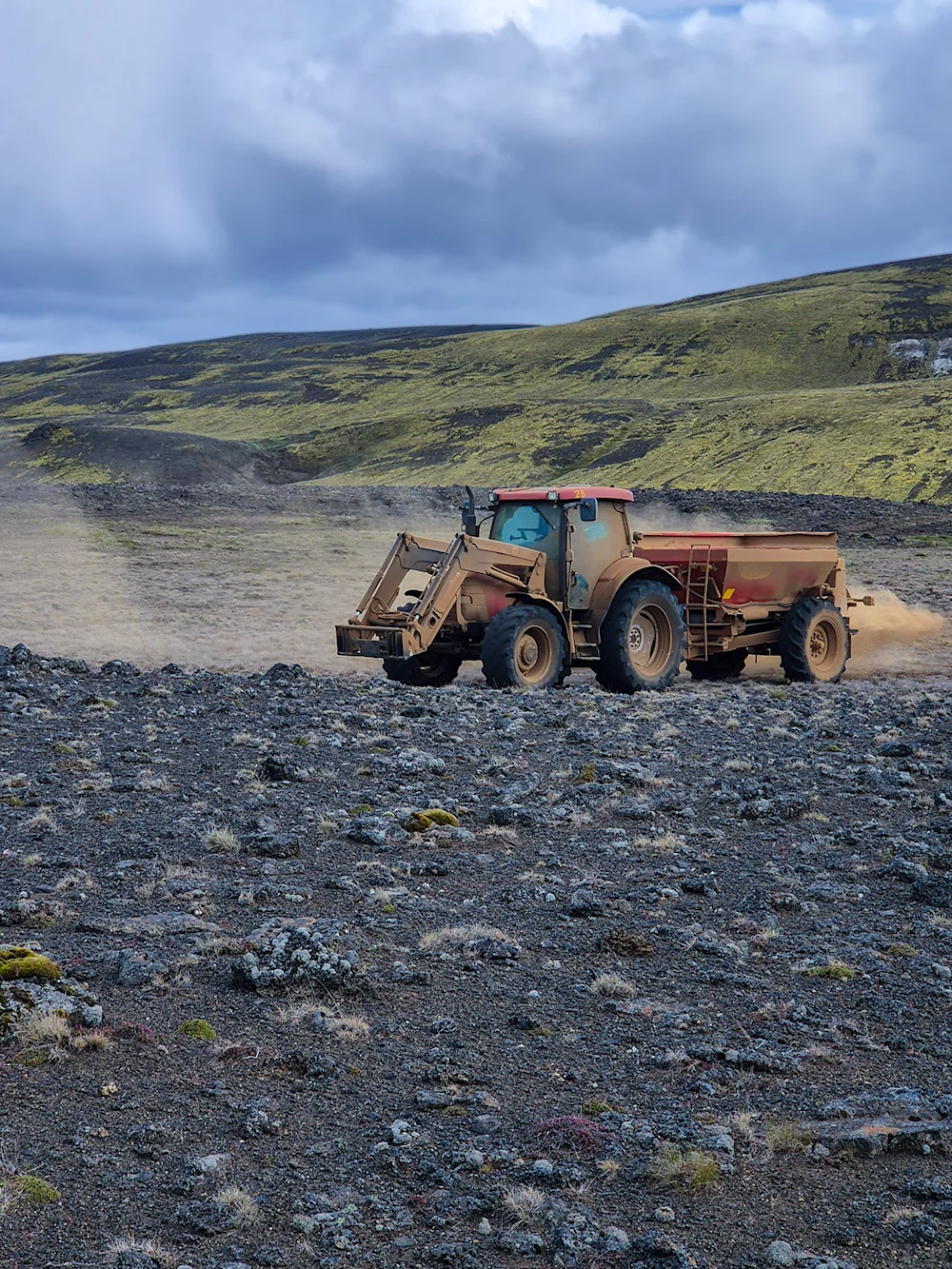
Applying bone meal to degraded land kick-starts ecosystem restoration and promotes the natural self-seeding of birch. Photo: Kristján Bjarni Indriðason.