18th May 2026
18th May 2026
50 years of Gender Equality Legislation
Today marks 50 years since the first comprehensive gender equality legislation came into force in Iceland.
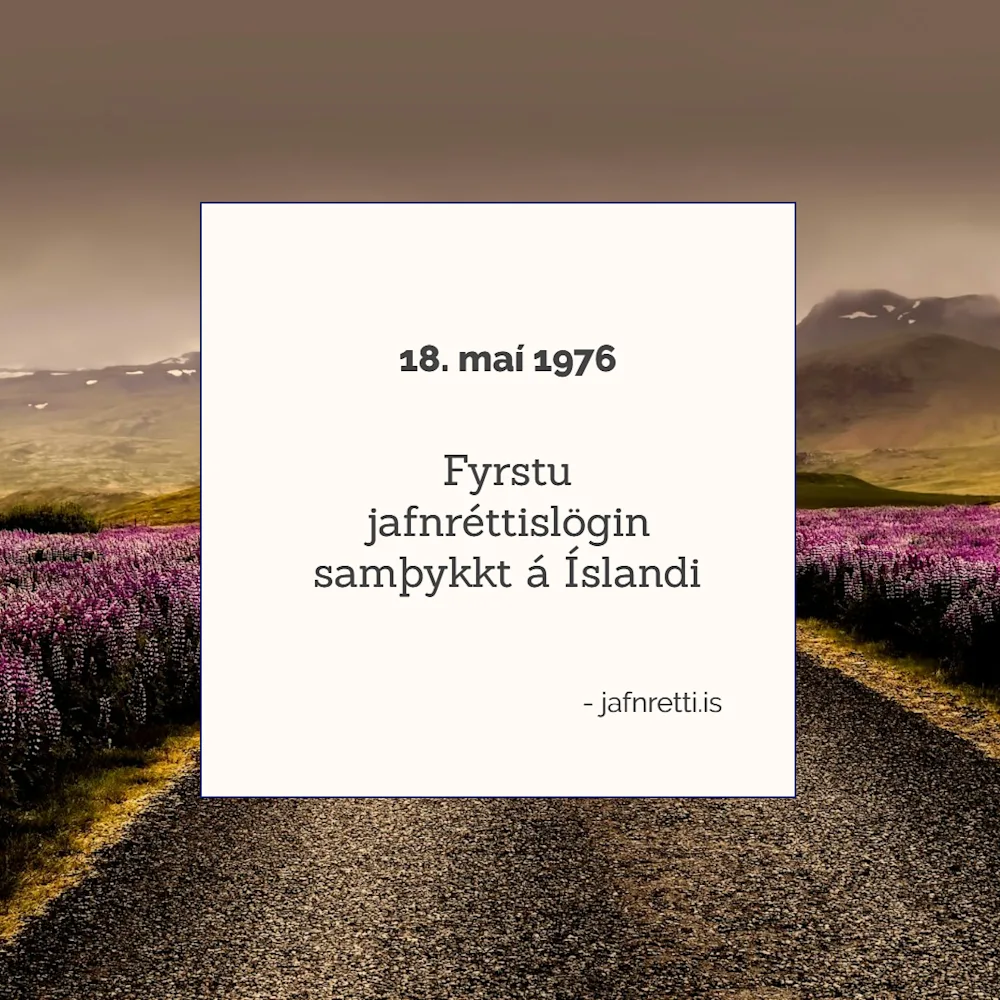
On the occasion of the day, Martha Lilja Olsen, Director of the Directorate of Equality, wrote the following article.
Today marks 50 years since the first comprehensive gender equality legislation came into force in Iceland. With the law enacted in 1976, it was for the first time clearly established in legislation that women and men should enjoy equal rights. These milestones truly marked a turning point in Icelandic society.
Iceland has often been named among the leading countries in the world in terms of gender equality, but this success did not come about on its own. Behind it lies decades of struggle by women who demanded that equality in status and rights between the sexes be enshrined in law.
During the 1960s and 1970s, discussions about the status of women became increasingly prominent in Iceland. Women were generally paid less than men and had limited access to positions of influence in society. The Women’s Day Off in 1975 became a symbol of this dissatisfaction when tens of thousands of women stopped working to demonstrate the importance of their contribution, both at home and in the workforce. The following year, the gender equality laws were passed by Parliament. The impact of the Women’s Day Off is still felt today, and this day remains a symbol of Icelandic women’s struggle for rights and equality—a struggle that continues today, albeit in different forms.
Over these 50 years, much has changed, and the legislation has evolved alongside societal developments. The proportion of women in politics has increased significantly, and women’s participation in the labor market is among the highest in the world.
Despite this progress, there is still work to be done. Criticism that women now often occupy influential positions reflects that full equality has not been achieved, and changing norms around power and opportunity remains a societal challenge. While women have recently become more visible in positions of influence in the public sector, the same cannot be said of the private market, where only 21.3% of top executives are women and only 14% of CEOs of companies listed on Nasdaq Iceland are women. The gender pay gap still exists across all sectors of society and exceeds 26% where it is highest. Women still bear greater responsibility for unpaid care work, and having children has a significant impact on women’s lifetime earnings and, consequently, their long-term pension rights. Gender segregation of the labor market remains prominent and is one of the main causes of the gender pay gap.
New challenges have also emerged, including those related to the position of marginalized groups and the influence of social media, where harmful attitudes, unrealistic expectations, and stereotypes about behavior and lifestyle are reinforced—issues to which children and young people are particularly vulnerable. Gender-based violence in its many forms remains a widespread problem and has now also moved into the digital sphere, requiring complex responses and cooperation among many actors. Women of foreign origin and women with disabilities are in a particularly vulnerable position, both in the labor market and in everyday life, highlighting the complex nature of these challenges.
The history of gender equality legislation in Iceland clearly shows that societal change does not happen by itself. It occurs when people demand change, authorities respond, and society decides that social justice matters. Gender equality is therefore—and will always be—the responsibility of each generation, and it is important that we safeguard the rights that have been achieved while continuing to strive toward full equality. No country in the world has yet achieved full gender equality, and as a global leader in this field, it is important that Iceland continues to work toward further progress. The goal should, of course, be for Iceland to become the first country in the world to achieve full legal and formal gender equality. However, equality will not necessarily become a self-evident reality even if full legal equality is achieved, because true equality requires a change in mindset and attitudes. We must remain vigilant and maintain our position, ensuring that equality becomes a given in Icelandic society.
Iceland has been a global role model in gender equality and should continue to be a leading example in this field worldwide.