Advertisements on responsible behaviour in traffic
Produced advertisements for television and web promoting responsible behaviour in traffic
The Icelandic Transport Authority (Samgöngustofa) and Sjóvá once again joined forces in this campaign against mobile phone use while driving, under the same name as last time: Don’t take the screen risk. The aim of the campaign is to reduce the number of people who take this kind of risk while driving. Following the last campaign, mobile phone use behind the wheel decreased, but we saw an increase again last year, which shows how important it is to keep talking about this. With this campaign, we are pointing out that there is no such thing as “just taking a quick look” and assuming it is harmless. Even if you’re only taking a quick look… you are still creating danger. Below you can see videos from the campaign, and more information can be found at skjahaetta.is.
The advertisement addresses seatbelt use and is intended to reach young people. Increasing number of young people aged 18–24 were choosing not to wear a seatbelt in the years before this campaign. According to the results of a survey conducted by the Icelandic Transport Authority the previous year, 10–15% of young men aged 18–24 tended to skip wearing a seatbelt, which is a much higher proportion than in the years before. The goal of this campaign is to reverse this trend.
The seatbelt is one of the most important safety features in a car, and it is so simple to use. It takes no more than 2 seconds to fasten it, so it's simply foolish not to.
In 2024, the first advertisement in the campaign Don't yawn your last breath was produced and began airing in the last days of the year. However, it was mostly aired in 2025, with more advertisements within the campaign being produced and aired that year. The campaign addresses the dangers of sleepiness and fatigue while driving and in connection with the campaign an attempt was made to provide the public with lifesaving advice, such as getting a good night's rest before driving, not having music that is too hot or too quiet in the car and much more, and if all else fails, you simply have to stop driving and lie down for 15-20 minutes.
The Icelandic Transport Authority and Sjóvá joined forces in this campaign against mobile phone use while driving. The campaign points out that the actions we perform on our phones while driving are just as distracting as similar actions with other devices, but we would not think of using those devices, either now or before the era of smartphones. As an example, it shows a person using a typewriter while driving, but of course no one would think of doing that - but using the phone to write e.g. messages distracts us just as much as using a typewriter while driving... we lend our mind, hands and eyes to the device.
The campaign also focused on letting people know about the driving mode on our phones, but today it is possible to set all phones so that they do not emit any sound while driving.
See you was a campaign on the use of reflectors, sponsored by the Icelandic Transport Authority and 66°North. Black reflectors were produced that are barely visible on black clothing except when light shines on them, and were distributed in 66°N stores and at the Icelandic Transport Authority.
In 2023, a strong emphasis was placed on electric scooters and advertisements were produced and published that were intended to curb the misuse of electric scooters, including their use under the influence of alcohol, the use of bicycles that travel faster than is permitted, the use of bicycles with passengers, and the use of mobile phones while using the bicycles. The campaign was published widely on the Internet and social media as well as on environmental media, i.e. on signs and at bus stops. The advertisements were published in collaboration with VÍS, thus achieving better distribution than would otherwise have been possible. A great deal of social discussion was achieved on the issue and very positive changes can be noted following the campaign, both in terms of accident statistics and behavior and attitudes.
In 2021, a commercial was produced that encourages the use of seat belts in a positive way. "Smellum saman" (e. Let's Click) is a song and music video where Króli and Rakel Björk sing together about love, safety and seat belts. The lyrics, video and dance contain references to the importance of fastening seat belts. The message was intentionally not entirely obvious, as the song and video were intended to stand alone. At the end of the video, it is not clear what the message is when "Smellum saman" appears with a seat belt and a belt-clicking sound. One of the most popular TikTok stars in the country at the time, Lil Curly, was hired to participate in the making of the video and post about it on TikTok, which received hundreds of thousands of views and it can be assumed that younger viewers were well reached.
A campaign by the Icelandic Transportation Authority for the purpose of getting drugs and intoxicants out of circulation. The campaign logo is the red triangle most people know of the packaging of drugs that can affect people's driving ability.
We are faced with the fact that more drivers are being arrested for driving while under the influence of narcotic drugs than for driving while intoxicated. What is more, this has been the case since 2013 and so far this year 83% more people have been arrested for driving while under the influence of narcotic drugs than alcohol, according to figures from the Metropolitan Police. The preparations for this campaign have been going on for about a year and a half but 2018 was the worst year we have seen in terms of drug and drug driving. The figures had increased year by year, but when it was clear what was going on in 2018, there was considerable social debate about this new problem. Driving under the influence of drugs and narcotics is a problem that is largely hidden from society and it is our hope that the campaign will arouse a great deal of discussion and encourage people not to drive under the influence of drugs and intoxicants and that people will talk to their family members who need to take the message to them.
In collaboration with the advertising agency Pipar-TBWA, the Icelandic Transportation Authority has launched a campaign to encourage drivers not to save 2 seconds by fastening their seat belts. The campaign is called 2 seconds and it highlights the absurdity of not using seat belts.
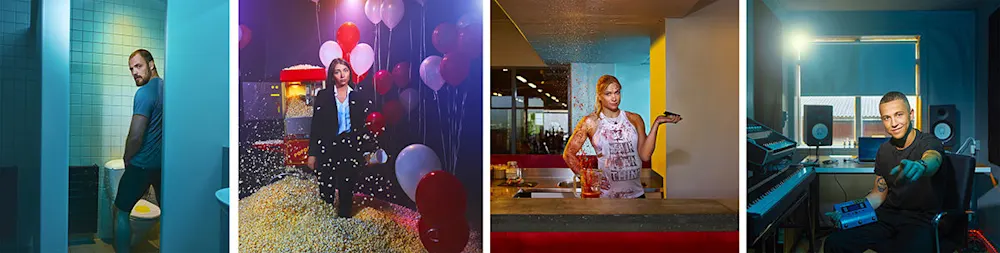
Research shows that just under 10% of Icelanders do not wear safety belts or about 35 thousand people, although they only take 2 seconds to fasten them. A driver who does not use a seat belt has about 8 times the risk of a fatal accident as a driver who uses the belt. This is shown by comparing the usage rate of belt belts with the rates of occupancy of occupants of road accidents. In research on fatal accidents where people have not worn belts, it has been found that in the majority of cases the person in question would have been saved had he/she used the belts. Compared to other European countries, Iceland ranks 17th in the general use of safety belts. It only takes 2 seconds to change it and get to 1st place.
The co-driver, i.e. the passenger in the front seat, plays an important role in the car, especially on long journeys. He has to take care of the driver's phone, adjust the music and temperature, and look after the children in the back seat. Here are two pictures about the role of the co-driver and what to consider before setting off. The drive here is likened to a flight.
The advertising campaign Car Ballet is generally about traffic culture and how mobile phone use works like sand in an otherwise well-oiled machine. Traffic normally runs smoothly, but when someone starts too late at the lights or drives out of sync with other traffic, it affects other drivers who have to adjust their driving to this one driver on the phone, which in turn causes more drivers to have to drive "out of sync".
In collaboration with Vínbúðin, three new advertisements were produced that can be said to have been an independent continuation of an older campaign, "Bara einn". The advertisements shed light on everyday situations where no one would likely agree to have alcohol on hand, and compare those situations to driving, raising the question of whether drunk driving is any worse than drunk driving in these situations.
In 2017, advertisements were produced under the slogan “Do nothing” that attacked the behavior of constantly having to respond to a beeping phone while driving. In late November, advertisements were published online with this slogan, celebrating ordinary people as heroes for simply letting their phones be when they called them while driving. Between Christmas and New Year, advertisements were published encouraging people to make a New Year’s resolution to do nothing (when their phones call you while driving), and similar advertisements were shown in early January 2018. Short advertisements were also produced encouraging people to celebrate strange holidays (e.g. Star Wars Day and the Day of Silence) by doing nothing (when their phones call you while driving). These short advertisements were shown in 2018.
The third Stay focused campaign was launched in 2017. This time it was an event in Smáralind where virtual reality and a rollover car were combined to create the experience of being in a car that rolls over because the driver was busy looking at his phone.
Since it is an experience with virtual reality and a rollover car, it is difficult to show the video that people saw inside the car. However, below is a presentation about the event. It is in 360° so if you watch on a phone, the image moves as the phone moves.
A campaign was launched on Snapchat under the banner of Stay Focused, which attempted to influence mobile phone use while driving. In that campaign, four well-known Snapchatters were pretended to get into a traffic accident while taking a snap. Of course, they didn't get into a real accident, but the person watching the snap thought they had been injured. About 15-30 minutes later, they sent a new snap stating that this had been staged, but that it was still extremely dangerous to send and view SnapChat while driving.
It is now finally known why the political leaders of the Althingi were seated in car seats around the capital surrounded by film cameras and timekeepers. This video shows the event, which was hosted by Bjarni (Independence Party), Sigmundur Davíð (Progressive Party), Katrín (Leftist Movement, Green Movement), Guðmundur (Bright Future) and Helgi Hrafn (Píratar), in the race as each of them would be fastest to buckle up. The shortest time was 1.36 and the longest 2.8 seconds, which shows that it takes no time to buckle up, but this decision can make a big difference. Everybody who buckles their seatbelt is the one and only winner. It can be worth it to be on the winning team. These seconds are well spent when they can save your life? Fasten seat belts - ALL-F.
The campaign "Just One is One Too Many" was aimed at combating drunk driving. The campaign was carried out in collaboration with Vínbúðina. The content of the advertisement was a glass of red wine that was followed to a party, out into traffic and into the emergency room where it turns into a blood bag. The message was that one in three Icelanders thinks it is okay to drive a car after having had one alcoholic drink.
With that message in mind, a wooden box was also prepared with three "used" red wine glasses, one of which was broken. Such a box was sent to the managers of the 20 largest companies in the country with the hope that the managers of the companies would have a short discussion on the issue when the companies were celebrating. They also received educational material on a USB key that looked like a car key.
Stay Focused was a campaign against mobile phone use while driving. It was so successful that in the following years three more campaigns were produced under the same name. All of them were against mobile phone use while driving, but the approach was very different each time.
Stay Focused 2013 was an interactive video, but by logging in via Facebook and registering their phone number, the viewer got an interactive experience that was unlike anything else people had experienced. The video is about a girl who goes out for a drive, but the whole time she is looking at pictures from the viewer's Facebook account and the viewer even receives messages from the girl - i.e. in the video the girl is seen sending a text message and at the same time the viewer receives the message on their phone. All this is done so that the viewer gets the impression that they know the girl. In the end, the girl then calls the viewer's number and as a result she gets into an accident. The screen goes black and the viewer's phone rings. The video doesn't start until the phone is answered, and then the phone plays the same song that's on the radio inside the car, along with screeching as the girl climbs out of the car.
It's difficult to show the video, as each display of the video is customized to the viewer each time. Instead, a video about the campaign from the Ímark Horn Festival 2013 is shown here.
An advertisement that the Icelandic Road Traffic Authority had made with the song “I think of Angels,” by KK - Kristján Kristjánsson, a musician. The ad states that in 10 years 84 people died in road accidents caused by driving too fast. The maker of ideas behind the ad is Bjarney Hinriksdóttir, a graphic designer at the White House Advertising Agency, and Sammi and Gunni at True North were responsible for the direction.
There are many who think that it is okay to not put on a seat belt if your driving speed is low and the distance is short. The "Use Car Belts - Always" advertisement provides a realistic comparison of the unsafety-belt impact and the consequences of falling to the ground from a height varying between the ground and hitting the ground at speeds of 7, 20, 30 and 55 km without safety equipment. The Icelandic Road Traffic Administration had the advertisements produced in cooperation with the insurance company VÍS. The White House Office of Advertising did concept work and design, while Filmus handled production.
In April 2009, the Icelandic Traffic Authority, together with Vínbúðin, launched an advertising campaign on online media and on the radio entitled “Spin the bottle”. The campaign aims to make drivers aware of the consequences that the decision to drive after consuming alcohol can have. A large number of people have had to experience the serious consequences of drunk driving, and the decision to drive after consuming alcohol or other drugs can affect loved ones, health, future, reputation, freedom and finances. By turning the bottle, you can see how these important factors can change for the worse simply by driving after consuming alcohol.
Do you think anyone would be OK if an instructor, air traffic controller, dentist or crane operator consumed alcohol while working with all the responsibilities that come with it? Without a doubt, it is felt by few if anybody. Despite that, approximately 50 thousand Icelanders believe that it is okay to drive after consuming one alcoholic beverage. This advertising campaign is raising awareness of the seriousness of driving under the influence of alcohol – even if only one glass was used. It is emphasized that the responsibility of the driver is less than that of the controller and drivers should keep in mind when considering whether it is okay to operate a vehicle after consumption of alcohol. The advertisement was produced in collaboration with Vínbúðin. The White House Office of Advertising handled the production, while Sagafilm handled production.
The "Sorry I Didn't See You There" advertising campaign aims to raise awareness among drivers about the importance of paying full attention when driving and checking at least twice at intersections to see if there is any risk of them running into a motorcycle. It is much more difficult to judge the distance and speed of motorcycles than larger vehicles, and one common cause of serious traffic accidents is drivers running into a motorcycle. The White House advertising agency came up with the idea for the ad, while the production company Republik was responsible for production.
The campaign is intended to make drivers think about their responsibilities in traffic so that they realise that in reality it is not possible to turn away from their wrongdoing by pressing Enter or selecting Replay to start the game again full-time and lively. Ideas were developed by the White House Press and Advertising Agency, while the animation was created by the UK-based company "I love Dust".
The ad focuses on seatbelt use and shows young people inside a car after a car accident. Only one of them is wearing a seatbelt. The others ascend to heaven one after the other, but the one wearing the seatbelt can't get up because he can't unbuckle it... eventually he wakes up and grabs the seatbelt.
The ad is a chilling reminder of the potential consequences of driving too fast where children may be playing. It reminds us of the importance of not driving over the speed limit in 30 km/h zones because none of us want to end up hitting a child.
This commercial addresses driver behavior by showing the impact our behavior has on children. Although it only addresses swearing and verbal abuse in traffic, the underlying message is that children do what we do, not what we say. This applies to many other areas, such as seatbelt use, helmet use, speeding, cell phone use while driving, etc.
The advertisement Slow Down, sometimes called Faces in the Street, appeared in 2004 and reminds us that the consequences of speeding can be extremely serious. The song Vísur Vatnsenda-Rósu, performed by Ragnheiðar Gröndal, is played under the advertisement, but the imagery speaks for itself without text or speech. Most or all people put the image in the context of the person in question having died at this location in traffic. The advertisement won a gold medal in Europe's main advertising competition, the Eurobest Award in 2004, and it was the first and only time that an Icelandic advertisement has won that award.
One of the very first campaigns that the Icelandic Traffic Agency ran. Here the consequences of traffic accidents are described in an ironic way; The readable text below describing the consequences is positive but the visuals show a negative image of what is being said (e.g. "You could get priority in traffic" but the visuals show an ambulance in an emergency). Three advertisements were made; about seatbelt use, drunk driving and speeding.

Service provider
The Icelandic Transport Authority