
Icelandic Medicines Agency
IMA is an important link in the chain of European medicines agencies
17th September 2026
Experts at the agency have taken a leading role in assessment processes for various medicines, research, and safety matters on behalf of all member states, making decisions regarding marketing authorisations across Europe every year
Recently, there has been considerable discussion about the role of the Icelandic Medicines Agency both domestically and within the collaborative network of European medicines agencies, where the pharmaceutical authorities of the European Union (EU) and the European Economic Area (EEA) work closely together. Some have wondered whether it makes any difference to the Icelandic pharmaceutical market whether Iceland is a member of the EU or not.
Committees of the European Medicines Agency
Under the EEA Agreement, the Icelandic Medicines Agency (IMA) actively participates in European cooperation in the field of medicines regulation. Although Iceland's status differs in some respects from that of EU Member States, the Agency's experts play an important role in the joint work of European medicines authorities. IMA experts actively contribute to committees and working parties and undertake leading roles in the assessment of medicines, clinical studies, and pharmacovigilance activities.
The extent of this participation is substantial. During the past year, the clinical assessment team and the quality assessment team of the Icelandic Medicines Agency completed 88 scientific advice assignments on behalf of the European Medicines Agency (EMA). This represented 11.3% of all scientific advice procedures completed, despite IMA accounting for just over 5% of the experts involved in this work.
IMA experts also serve in lead roles in assessment procedures for various medicinal products, studies, and safety-related matters on behalf of all participating countries, contributing to decisions on marketing authorisations across Europe each year.
Through this participation, IMA experts contribute to assessments and scientific advice that support regulatory decision-making on medicines throughout Europe. At the same time, this involvement strengthens expertise and specialisation within the Agency and connects Icelandic medicines regulation to the extensive collaboration taking place at the European level.
Marketing Authorisation Applications
Medicinal products may obtain marketing authorisation through several regulatory pathways within Europe. Medicinal products granted a centralised marketing authorisation are authorised throughout all EEA Member States, including Iceland.
IMA also actively participates in other European authorisation procedures, namely the Mutual Recognition Procedure (MRP) and the Decentralised Procedure (DCP). In these procedures, one country may act as the Reference Member State (RMS), leading the assessment of a marketing authorisation application on behalf of the countries concerned. IMA regularly assumes this role and is responsible for the scientific assessment of the data supporting the application. Iceland performs strongly in these procedures, as reflected in CMDh statistics on marketing authorisation procedures. During the period from January to June 2026, Iceland ranked sixth among European countries in terms of the number of completed procedures for which it acted as the Reference Member State. This is a significant achievement, particularly considering the size of the Icelandic market and the Agency compared with larger European countries.
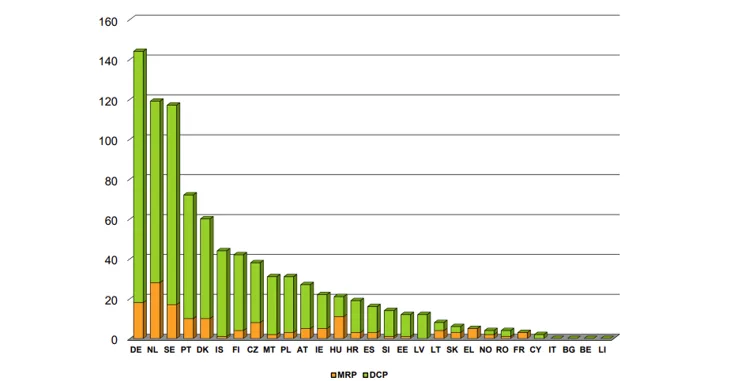
MRP and DCP procedures completed from January to June 2026, by Reference Member State (RMS). The total number of procedures was 148 MRP and 725 DCP.
The Role of IMA in the Icelandic Market
Marketed Medicinal Products and Exempt Medicines
At the end of last year, nearly 8,000 medicinal products held marketing authorisations in Iceland, of which almost 3,000 were actively marketed. The granting of a marketing authorisation does not automatically mean that a product will be placed on the Icelandic market. The marketing authorisation holder determines whether and when a product is marketed, taking into account conditions in each market. The small size of the Icelandic market can influence the availability of medicines.
IMA works in various ways to promote a broader supply of medicines and reduce the impact of medicine shortages. Similar challenges are encountered in other smaller European markets. The Agency also monitors medicine availability and works both to prevent shortages and to mitigate their impact on patients when they occur.
In recent years, numerous measures have been introduced to increase the number of marketed medicinal products and help ensure access to medicines. These include:
Simplified authorisation procedures
Fee reductions
Exemptions from labelling requirements
Zero-day procedures
These measures facilitate the rapid authorisation of medicines when a particular need arises.
Priority is also given to the expedited handling of medicine shortage cases and applications concerning exempt medicines. In addition, pharmacists may, under specified conditions, substitute a prescribed medicine with a designated exempt medicine at the time of dispensing.
Exempt medicines play an important role in ensuring access to medicines that would otherwise not be available in Iceland. Their use is relatively extensive and partly reflects the challenges associated with a small pharmaceutical market. Increased marketing of authorised medicines in Iceland could reduce the need for exempt medicines and contribute to a broader range of available treatments.
Medicine Pricing
IMA determines the maximum wholesale price of prescription medicines and veterinary medicinal products, while the pricing of over-the-counter medicines is not regulated. When setting maximum prices, IMA generally takes into account the average price of the product in the Nordic countries. If the product is not marketed there, prices in other European Economic Area countries are considered.
This approach aims to ensure fair medicine prices in Iceland while recognising the challenges posed by a small market and the importance of maintaining conditions that support the marketing of medicines.
Price incentives are also available to support the supply of certain products on the Icelandic market. These may apply to low-volume medicines, antibiotics, ophthalmic products, and medicines primarily intended for children. The objective is to increase the likelihood that essential medicines will be marketed and remain available in Iceland.
Cooperation with Neighbouring Countries
IMA actively participates in cooperation with other European medicines authorities on initiatives aimed at improving medicine safety and accessibility. These include collaboration on electronic package leaflets and joint Nordic medicine packaging.
Common Nordic packaging can facilitate the marketing of medicines in smaller markets. Marketing authorisation holders can market the same package in several countries, with labelling and package leaflets provided in more than one language.
Work has also been undertaken to develop common English-language packaging for certain hospital medicines. The transition of package leaflets for centrally authorised medicines to an electronic format (e-PIL) is also progressing well. IMA is actively involved in this development together with other European medicines authorities.