
The Directorate of Health
World Immunization Week
27th April 2026
The World Health Organization (WHO) dedicates one week each year to immunization, from April 24–30. In Europe, both WHO Europe and the European Centre for Disease Prevention and Control (ECDC) are responsible for producing materials and disseminating information in connection with European Immunization Week.
- Automatic translation
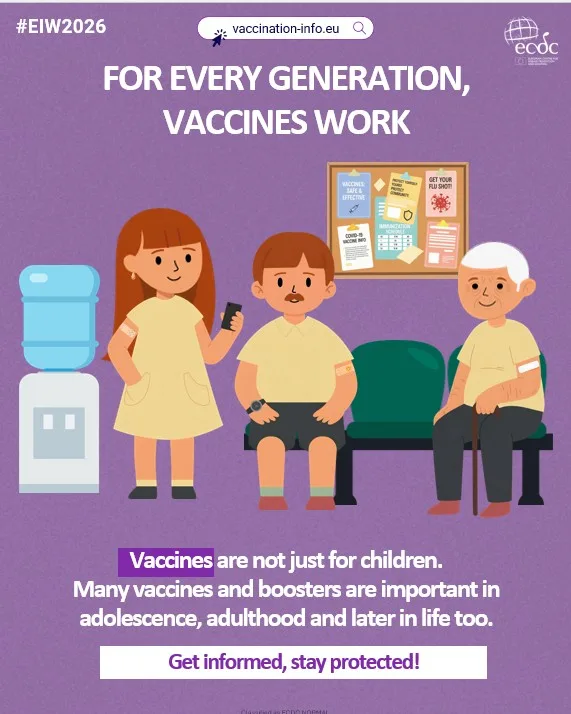
This year, the focus is on the fact that immunization works for all generations.
Routine vaccinations, which were the first step toward a childhood immunization program in Iceland, have been available in the country for over 75 years. The first legislation that made vaccinations—other than against smallpox—available to all children in Iceland was enacted in 1950. In 1974, the World Health Assembly laid the foundation for all countries to establish childhood immunization programs, meaning the idea that all children are entitled to certain vaccinations is now over 50 years old. Most people currently living in Iceland have therefore received vaccinations as children.
In recent decades, we have gained a better understanding of vaccines, the duration of the protection they provide, and new vaccines that are beneficial against diseases affecting older age groups as well—sometimes more so than children. As a result, recommendations for vaccination of adults and/or the elderly have emerged in many places, and in recent years some countries have even established vaccination programs for adults. Finland is the neighboring country that has gone the furthest in this regard, with a program that includes regular booster vaccinations against diphtheria, tetanus, and pertussis throughout life, as well as additional vaccines for older adults, such as vaccination against pneumococcal disease. Norway published a vaccination program for the elderly in 2025.
In Iceland, there is no formal vaccination program for adults, but guidelines exist regarding booster doses for diphtheria, tetanus, and pertussis, as well as recommendations for measles boosters for people born between 1975 and 1987, and guidance on vaccinating risk groups against pneumococcal disease, mumps, hepatitis viruses, and more. Participation in adult vaccination in Iceland varies widely, as these vaccinations are generally paid for by individuals, with the exception of influenza vaccinations and, in recent years, COVID-19 vaccinations. For risk groups, it has generally not been possible to assess participation rates.
With World Immunization Week, the World Health Organization (WHO) aims to highlight that vaccination is one of the most cost-effective and impactful measures available to prevent serious infectious diseases across all age groups. Adults are therefore particularly encouraged to familiarize themselves with which vaccinations require boosters or become more relevant with increasing age.
On island.is, after logging in to ‘My Pages,’ individuals can check whether a vaccination is valid, completed, expired, or not registered. Guardians of children under 16 years of age can also view their children’s vaccination status.
For more information:
WHO Regional Office for Europe (WHO Europe)
The European Centre for Disease Prevention and Control (ECDC)
Overview of vaccinations on the website of the Directorate of Health
Chief Epidemiologist