
The Directorate of Health
This news article is more than a year old
Respiratory Infections – Week 41, 2025
16th October 2025
The Chief Epidemiologist’s respiratory infections dashboard has been updated with data for week 41 of 2025 (October 6–12, 2025).
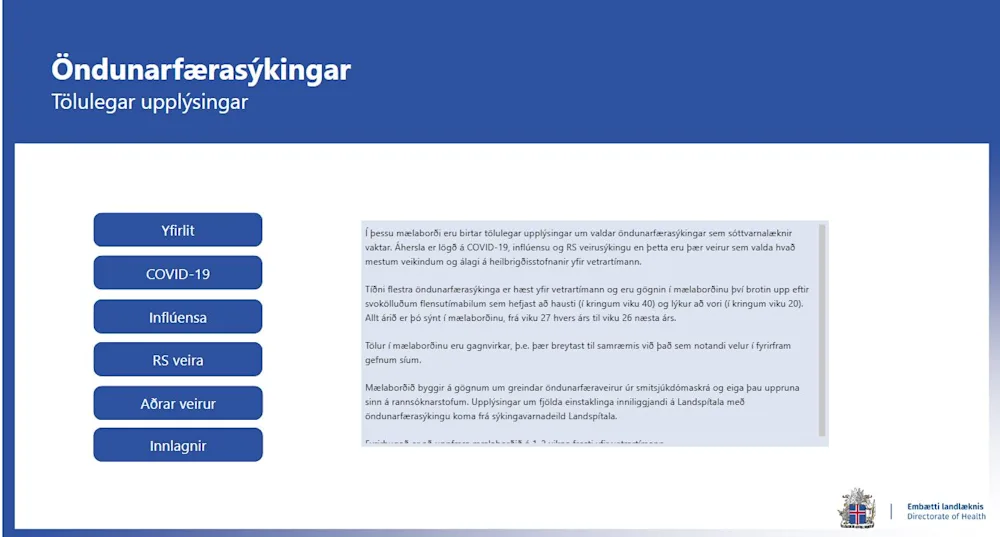
- Automatic translation
As before, the vast majority of samples for testing come from hospitals, and fewer from primary healthcare centers.
Influenza
After isolated cases of influenza during the summer, diagnoses have increased this autumn as expected. Twenty-one individuals were diagnosed with influenza in week 39 (end of September), ten in week 40, and another ten in week 41. Most were infected with influenza type A(H3), and none with influenza type B. In the past three weeks, most influenza cases have occurred among individuals aged 15 and older.
Further information about influenza can be found on the Directorate of Health website.
The annual influenza vaccination campaign has begun at primary healthcare centers. Appointments can be booked through “My Pages” on Heilsuvera or by calling your local healthcare center. See the news article on the Capital Area Health Service website.
The Chief Epidemiologist recommends that the following risk groups be given priority for influenza vaccination and strongly encourages them to be vaccinated:
All individuals aged 60 years and older.
Children under 5 years of age who are at least 6 months old at the time of vaccination.
All children and adults with chronic heart, lung, kidney, or liver diseases, diabetes, obesity, malignant diseases, or other immunosuppressive conditions.
Pregnant women.
Healthcare workers who care for individuals in the above-mentioned risk groups.
People at occupational risk due to possible co-infection with seasonal influenza and avian influenza (see news from October 2023).
RSV Infections
RSV infections have remained minimal in recent weeks, and the annual outbreak has not yet begun. One individual aged 15–64 was diagnosed in week 28 (8–14 July), and one individual aged 65 or older was diagnosed in week 41.
COVID-19
Few cases were detected weekly from the beginning of the year through spring 2025. An increase began in mid-May, continued through the summer, and peaked at 28 cases in week 28 (early July). Case numbers have since declined and remained fairly stable. In week 41 (6–12 October), 12 individuals were diagnosed with COVID-19, either through PCR testing or clinical diagnosis (doctor’s assessment without laboratory testing).
Other Respiratory Viruses
Rhinoviruses (common cold) were the most common respiratory viruses detected during the summer and early autumn.
Whooping cough (pertussis) diagnoses have been few since last winter. Two cases were reported over the summer (one in July and one in August), and one additional case was diagnosed in week 38 (15–21 September).
Hospitalizations at Landspítali
In week 41, three individuals were hospitalized at Landspítali with COVID-19 - two children under one year old and one person aged 65 or older. Six individuals were hospitalized with influenza - four aged 65 or older, one aged 15–64, and one child aged 1–2 years. No one was hospitalized with RSV infection.
Situation in Europe
In EU/EEA countries, the spread of COVID-19 (SARS-CoV-2) has decreased, and hospitalization rates remain low.
RSV and influenza infections are at minimal levels.
The number of people seeking primary healthcare for respiratory symptoms remains low but is now increasing in most countries, as expected for this time of year. The greatest increase is among children under 15 years of age.
See more information on the European Centre for Disease Prevention and Control (ECDC) website.
The Chief Epidemiologist reminds the public to:
Get the influenza vaccination if you belong to a priority or risk group.
Stay home while experiencing symptoms and until you have clearly recovered and been fever-free for 24 hours.
Take special care around vulnerable individuals if you have symptoms of infection.
Minimize contact with others who show symptoms of infection.
Cover your mouth and nose when coughing or sneezing.
Wash your hands frequently and thoroughly.
Clean shared surfaces and ventilate shared spaces as much as possible.
Consider wearing a face mask depending on the situation.
The Chief Epidemiologist