
The Directorate of Health
This news article is more than a year old
Public Health Indicators 2025 presented in Ísafjörður
29th September 2025
Public health indicators by health district in Iceland 2025 were presented for the tenth time in Ísafjörður today.
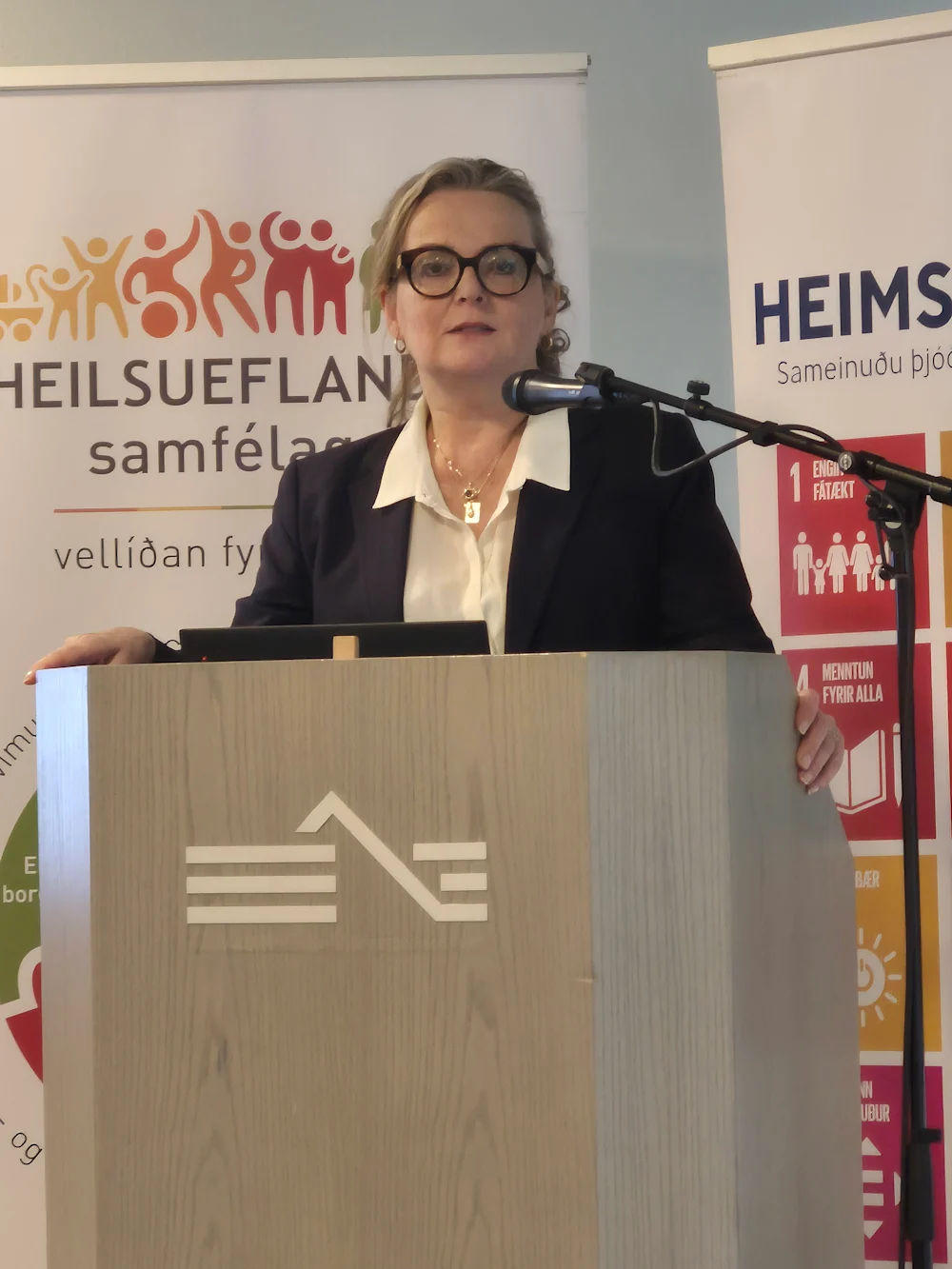
María Heimisdóttir at a meeting in Ísafjörður where the public health indicators 2025 were presented
-Automatic translation
Medical Director of Health María Heimisdóttir both opened and closed the meeting. She started by discussing the purpose of public health and finished by emphasizing that the indicators offer insight into the current situation and highlight the importance for professionals in the field to assess the data and take further action. She emphasized the value of cross-sectoral cooperation and dialogue within society and the significance of coming together, as was done today for the presentation of the Public Health Indicators.
Public health indicators concerning society, health, and diseases
Sigríður Haraldsd. Elínardóttir, head of the Health Information division, examined selected public health indicators. Among other findings, it was revealed that approximately 19% of the population faced financial difficulties in 2024, a figure that has remained relatively unchanged since 2023. Comparing healthcare districts, the highest proportion of people in financial difficulty is in the Suðurnes region, while the lowest is in East Iceland. Generally, the proportion is higher in rural areas than in the capital. Poverty has a negative impact on health and social status, underscoring the importance of providing support where needed. About a third of the population rates their mental health as fair or poor, similar to the previous year.
The Health Service Act emphasizes that healthcare services should be delivered locally and that primary healthcare typically serves as the initial point of contact within the health system. Regulations regarding primary healthcare centres stipulate that they must provide mental health services for both children and adults, encompassing assessment of problems, treatment planning, and psychological interventions. The emphasis is on addressing mild to moderate depression, anxiety, and trauma. In line with legislation and health policy objectives, health authorities have prioritized strengthening mental health services within primary care in recent years.
Judging by the number of primary care consultations where the initial diagnosis was a mental or behavioral disorder, there are clear signs that primary care has expanded its services for children and adolescents with mental health issues. These signs align with the fact that in 2017, psychological services began to be offered at primary healthcare centres, and since then, many mental health teams have started operating within primary care. The number of children's visits to primary care for cognitive and behavioral disorders has increased since 2017, particularly in rural districts.
Public health indicators concerning infectious disease prevention – vaccinations and antibiotic use
Guðrún Aspelund, Chief Epidemiologist, presented public health indicators related to infectious disease prevention and control. She highlighted that, according to regulations, all vaccinations in Iceland are recorded in a central vaccination register, and participation figures for general childhood vaccinations are published annually in June, both nationwide and by district. The aim is to monitor vaccination uptake and assess the risk of epidemics.
Participation in infant vaccinations is generally high. However, vaccination coverage is lowest for booster doses in several districts, including for diphtheria, tetanus, and pertussis (DTP), as well as for measles, mumps, and rubella (MMR).
The annual influenza vaccine is offered every autumn. The Chief Epidemiologist recommends that specific priority and risk groups receive priority for influenza vaccinations, which are provided to them free of charge. Participation in influenza vaccinations among older people increased during the COVID-19 period but has since declined. The aim is for at least 70% of older people to be vaccinated; however, participation in Iceland is currently around 40-50%.
Guðrún emphasized that prudent use of antibiotics is vital for lowering antibiotic resistance. Antibiotic prescriptions in Iceland in 2024 stayed similar to those in 2022 and 2023. Outside hospitals, approximately 94% of total antibiotic use occurred. General practitioners account for around one-third of the prescriptions, and just over 30% of the population receives an antibiotic prescription.
Icelanders use the most antibiotics in the Nordic countries, but at a rate comparable to that of EU/EEA countries. Antibiotic use in the Nordic countries has been lowest in Sweden for the past decade. Still, Iceland stands out in Europe for its low use of broad-spectrum antibiotics, which is a positive development.
Public health indicators concerning well-being and lifestyle
Dóra Guðrún Guðmundsdóttir, head of the Public Health Division, presented indicators related to well-being and lifestyle. Dóra mentioned a working group established by the Minister of Health on new public health challenges for young people, and that these challenges had been considered when selecting this year's indicators.
Smart device usage and quality time together
One of these indicators is the use of smart devices by children. It shows that the use of smart devices before sleep has increased in recent years and is now at 18% among 7th-grade students. There is some variation between healthcare districts, with the highest proportion in the Westfjords at 30%.
Spending time with parents is regarded as one of the most significant protective factors against children's risk-taking behavior. Over 87.5% of children in 4th-6th grade report that they do something enjoyable with their parents at least weekly.
Safety and violence
Violence and its prevention have been prominent concerns in society, with several indicators related to this issue. This year, questions were asked about trust and safety. Just over 30% of upper secondary school students say there is an adult at school they can trust. This figure is noticeably higher in West Iceland, at 43.3%, but it remains important to work on increasing this percentage across all districts.
Almost 96% of children in grades 7-10 feel safe at home, which is positive, but it is important to acknowledge the 4% who do not feel safe at home.
Approximately 90% of adolescents in grades 9-10 report feeling safe in their neighborhood or community, but the aim is, of course, for this figure to reach 100%. Bullying has also risen, with 11% of children in grades 6-7 saying they have been bullied, and it is crucial to systematically work towards eradicating it. One of the most notable public health indicators shows that 13% of upper secondary school students have been raped.
Drunkenness - Energy drinks – Soft drinks - Nicotine
Binge drinking among lower secondary school students has decreased, with only 3% reporting they have been drunk in the past 30 days. Energy drink consumption in upper secondary schools has increased recently, with approximately 31.2% of students in these schools saying they drink energy drinks five or more days a week. Furthermore, about a third of adults consume soft drinks daily or more often.
About a quarter of upper secondary school students have used nicotine pouches in the last 30 days, and 8.4% of adults use e-cigarettes.
Finally, women's stress levels have increased more in recent years compared to men's, with 31.6% of women now experiencing high stress, versus 22.7% of men.
The significance of public health measures for local government work
Sigríður Júlía Brynleifsdóttir, the mayor of Ísafjarðarbær, welcomed the attendees. At the end of the meeting, Margrét Geirsdóttir, Head of the Welfare Division, and Dagný Finnsbjörnsdóttir, Sports and Youth Representative and liaison for the Health Promoting Community in Ísafjarðarbær, discussed the practical use of public health indicators for the local community. Margrét mentioned the Health Promoting Municipality, the Act on the Well-being of Children, and child-friendly municipalities, which place certain obligations on municipalities to work on children's issues. She expressed serious concern about the indicator for financial difficulties and said it was crucial to take those results very seriously. She discussed new public health challenges for young people and the importance of creating a positive environment for children and youth in their local community, mentioning in this context the discussion about reopening a youth center. Dagný agreed with Margrét and spoke about the importance of updating prevention work, learning from what has been successful in tackling previous challenges, and continuing to develop a public health policy in co-operation with all sectors of society. They both discussed the significance of public health indicators and this meeting for the work ahead in promoting a health-promoting community and, consequently, well-being for all.
Lúðvík Þorgeirsson, CEO of the Westfjords Health Care Institute, chaired the meeting.
Arnar Sigbjörnsson, Project Manager
Dóra Guðrún Guðmundsdóttir, Head of Division
Gígja Gunnarsdóttir, Project Manager
Guðrún Aspelund, Chief Epidemiologist
Sigríður Elínard. Haraldsdóttir, Head of Division
Further information
Kjartan Hreinn Njálsson, Assistant to the Medical Director of Health
kjartan.h.njalsson@landlaeknir.is