
The Directorate of Health
International HPV Awareness Day
4th March 2026
The fourth of March each year is HPV Awareness Day. HPV, or the human papillomavirus, is a common virus with many different strains. Nearly everyone is considered to contract some type of HPV during their lifetime. Most people clear the infection on their own, but in some cases the infection becomes persistent.
- Automatic translation
Persistent infections with certain strains can lead to cancer at the site of infection. Cervical cancer has been by far the most common, but HPV is also linked to other cancers of the skin and mucous membranes that can occur in people of all genders.
For the past 15 years, girls in this country have been vaccinated against cervical cancer, and since 2023, the vaccine has been offered regardless of gender to help prevent the development of cancers in all genders and to reduce the spread of the HPV strains targeted by the vaccination.
In addition to the cancer-related strains of HPV, some strains cause warts. Genital warts can be prevented through vaccination.
Prevention of HPV
Only three year groups have so far received HPV vaccination regardless of gender in this country. A targeted HPV vaccination campaign for boys born in 2008–2010 aimed at ensuring equal access to the vaccine between genders began this past autumn and will continue until mid-year.
Figure 1 shows the participation rates of the 2007–2014 birth cohorts in receiving the first dose of the HPV vaccine at the end of February 2026. Vaccinations in upper secondary schools took place in January and February.
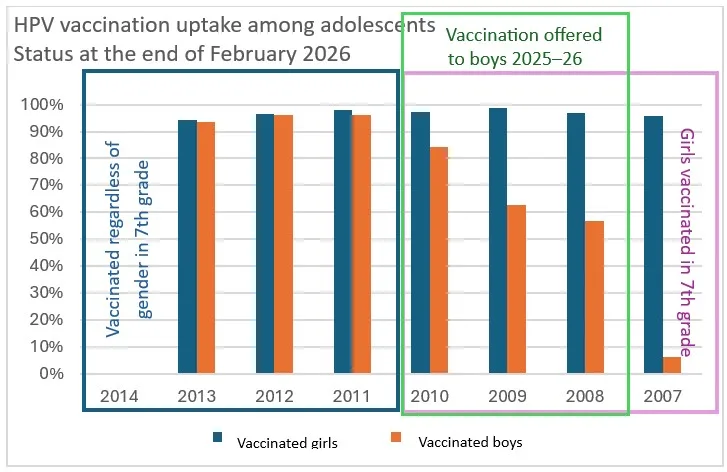
Figure 1:
The 2007 birth cohort is included to demonstrate the difference between genders when vaccination was offered free of charge only to girls – cohorts 2008–2010 began the winter of 2025–2026 with a similar participation pattern to the 2007 cohort shown in Figure 1.
The 2014 cohort is included to show the situation when no one has (yet) been offered free vaccination, as vaccinations for that cohort will begin in autumn 2026.
Cohorts 2008–2010 show participation by gender when vaccination arrangements were not the same for all genders.
Cohorts 2011–2013 show participation when vaccination is provided, regardless of gender, according to the schedule.
Vaccination can be given to adults, but the benefit after infection has already occurred is highly uncertain. Therefore, vaccination is generally not recommended after the age of 27. Vaccination for individuals with specific risk factors may be appropriate up to around age 45. In this country, adults must pay for the vaccine themselves, and since at least two doses are required, it can become quite costly.
In addition to vaccination to prevent HPV-related cancers, cervical cancer screening reduces the likelihood of cancer developing if HPV infection has occurred. Screening allows precancerous changes or early-stage cancers to be detected rather than advanced cancers. It is therefore very important that women attend screening when invited.
Unfortunately, there are no effective methods for screening HPV infections outside the cervix, and there is no specific treatment known to cure HPV infection. The consequences of infection are treated by surgical removal of lesions (warts or cancer) or through cancer therapy.
The Future of HPV Prevention Measures
The current vaccination campaign for boys focuses on delivering the first dose of the HPV vaccine to as many individuals in the target group as possible, since HPV vaccination initiated before the age of 21 is highly effective even when only a single dose is used. Some European countries have already adopted a single-dose schedule in routine immunization programs, and many more are discussing this approach.
Participation in the campaign so far is already strong enough to warrant opening that discussion here. If a single-dose schedule is systematically adopted in the national immunization program, it would be appropriate to consider whether there is room to expand the target group further, in order to improve gender equity in access to this important preventive measure.
Girls born in 1998–1999 were the first cohorts to receive HPV vaccination as part of the general program in this country. They have now already received invitations for cervical screening, and the Office of the Chief Medical Officer is currently assessing whether screening results among vaccinated women warrant changes to screening guidelines compared with those previously applied to unvaccinated women.
The Chief Epidemiologist