
The Directorate of Health
This news article is more than a year old
Respiratory Infections – Weeks 18–19 2025
15th May 2025
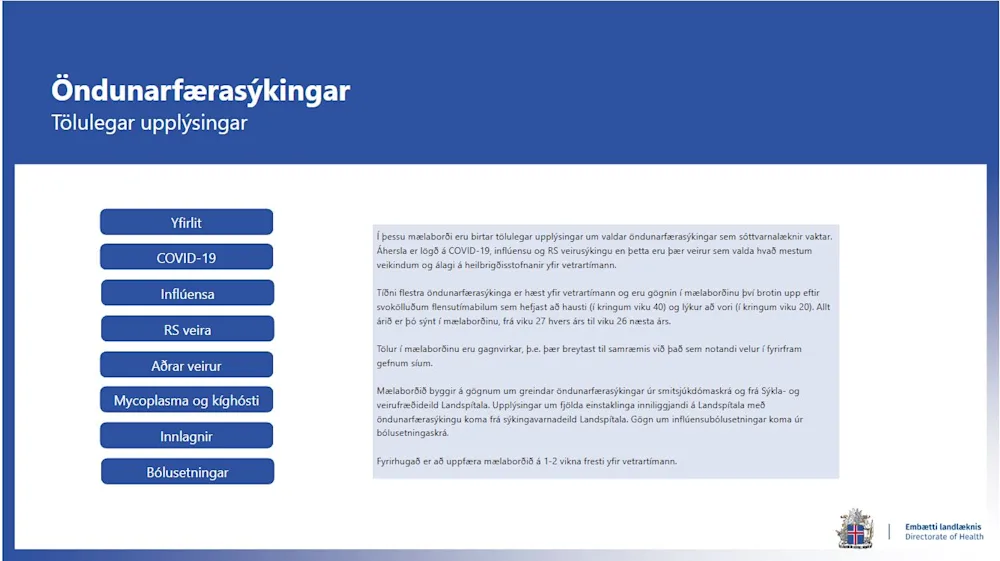
The Chief Epidemiologist’s respiratory infections dashboard has been updated with data for weeks 18 and 19 of 2025 (April 28 – May 11, 2025).
Situation in Iceland
The number of influenza and RSV diagnoses continues to decline. Only a few COVID-19 cases have been reported recently, aside from a small outbreak that occurred at Landspítali in week 17. No cases of whooping cough (pertussis) have been diagnosed in the past ten weeks, though sporadic cases of Mycoplasma infection continue to be reported.
Influenza, RSV, and COVID-19
Influenza diagnoses have been decreasing since the beginning of the year, although the weekly number has remained stable over the past four weeks. In week 18, eight individuals were diagnosed with influenza: six with type A(pdm09), one with type A(H3), and one with type B. Of those diagnosed, six were aged 65 or older and two were aged 15–64. In week 19, eight individuals were also diagnosed with influenza: six with type B and two with type A(H3). Among those cases, six were aged 15–64, one was 65 or older, and one was a child aged 0–4 years.
In weeks 18 and 19, a total of four individuals were hospitalized at Landspítali with influenza, all aged 65 and older.
A small number of RSV infections have been diagnosed in recent weeks. No cases were reported in week 18, while three individuals tested positive in week 19—one aged 15–64 and two infants under one year of age. One infant was in hospital at Landspítali with RSV in week 19.
One person was diagnosed with COVID-19 in week 18 and three in week 19. Of these four cases, two were aged 65 and older and two were aged 15–64. The previous respiratory infections summary noted an increase in COVID-19 diagnoses in week 17, when eight individuals tested positive. These cases were part of a localized outbreak in one ward of Landspítali, which also explains the rise in hospital admissions that week. This does thus not indicate increased community transmission of COVID-19.
Other Respiratory Infections
The number of respiratory virus diagnoses-excluding influenza, RSV, and SARS-CoV-2 has fluctuated in recent weeks. As in previous reports, most individuals diagnosed weekly have rhinovirus (common cold), with 14 cases in week 18 and 18 cases in week 19. Week 19 also saw an increase in enterovirus cases, with 10 individuals diagnosed.
The number of respiratory samples tested weekly has steadily declined since the beginning of 2025. A total of 143 samples were tested in week 18 and 165 in week 19. The percentage of positive samples has ranged between 35% and 50% in recent weeks.
Diagnoses of Mycoplasma bacterial infections (based on physician reports regardless of laboratory confirmation) have decreased since the beginning of the year, though weekly numbers continue to fluctuate. No cases were reported in week 18, while two cases were diagnosed in week 19. No cases of whooping cough have been reported in the past ten weeks.
Situation in Europe
The frequency of respiratory infections has decreased in EU/EEA countries, though influenza and RSV outbreaks continue in some areas.
The influenza epidemic generally peaked in week 6 of this year and is now at baseline levels in most countries.
The RSV epidemic peaked overall in week 52 of 2024, though case numbers remain notable in some areas.
The incidence of COVID-19 (SARS-CoV-2) remains low.
Further information is available on the website of the European Centre for Disease Prevention and Control (ECDC).
General Infection Control Reminders
We remind the public to:
Avoid close contact with individuals showing symptoms of infection
Stay home while symptomatic and until fully recovered and fever-free for at least 24 hours
Cover your mouth and nose when coughing or sneezing
Take extra precautions around vulnerable individuals if experiencing symptoms
Wash hands frequently and thoroughly
Clean shared surfaces and ventilate shared spaces as much as possible
Consider wearing a face mask in crowded places
Unless otherwise announced, this will be the final summary on respiratory infections for this winter season.
The Chief Epidemiologist