11th December 2025
11th December 2025
Respiratory Infections – Week 49, 2025
An annual influenza epidemic is underway and still on the rise. Many cases are being detected these days.

Figure: Number of influenza diagnoses in recent weeks (red line) compared with previous winters by week of the year (see the Chief Epidemiologist’s dashboard).
- Automatic translation
The flu has arrived earlier than in recent winters. See the chart and dashboard. Individuals in risk groups are encouraged to get vaccinated, even if they have already fallen ill with the flu (suspected or confirmed) this autumn/winter. Very little COVID-19 and RSV is being detected.
The Chief Epidemiologist’s dashboard on respiratory infections has been updated with data for week 49 (1–7 December 2025). The number of diagnoses is based on laboratory results, with most samples coming from hospitals and fewer from primary healthcare clinics.
Influenza
In week 49, 116 cases of influenza were diagnosed, all of influenza type A, most of them, or 83, of type A(H3) and 33 of type A(pdm09). The individuals diagnosed were in all age groups: 44 people were 65 years and older, 37 were 15–64 years old, nine were 5–14 years old, 11 were 1–4 years old, and 15 were under one year of age.
Influenza is a respiratory illness caused by the influenza virus. Every winter, an influenza epidemic usually occurs during the period from October to March. Influenza causes varying degrees of illness in individuals, but the illness can be severe. When infections are widespread, there is an increased risk that people in risk groups will become ill with more serious consequences, pressure on the healthcare system also increases, and there is a rise in absence from work and school in the community.
The two main strains of influenza that can infect people are type A (which causes annual epidemics) and type B (which causes regular outbreaks, mainly in children). The influenza virus changes almost continuously, and therefore the composition of the influenza vaccine is reviewed every year to maintain its effectiveness. These changes in the virus can lead to more or less severe annual influenza epidemics, and the effectiveness of the vaccine also varies from year to year. But even in years when vaccine effectiveness is lower, it reduces the risk of severe illness, hospitalization and death, especially in risk groups.
There is an antiviral drug against influenza (Tamiflu) that can be used for individuals who are at higher risk of serious illness. The medicine is prescribed by a doctor and must be given early in the course of the illness and even before test results are available.
Further information about influenza can be found on the Directorate of Health’s website.
Vaccinations
Among those for whom influenza vaccination is recommended are individuals over 60 years of age and children under 5 years old, but participation among older adults is currently only about 50%, and participation among children is low (see figure). Annual influenza vaccination reduces illness in individuals who become infected and also decreases pressure on the healthcare system, sick leave, and the spread of infection to others.

Figure: Participation in influenza vaccinations by age group during the 2025–2026 season.
Annual vaccination is still available, and the Chief Epidemiologist especially encourages the following groups to receive the vaccine as soon as possible:
All individuals aged 60 years and older.
Children under 5 years of age who are at least 6 months old at the time of vaccination.
All children and adults with chronic heart, lung, kidney, or liver diseases, diabetes, obesity, malignant diseases, or other immunosuppressive conditions.
Pregnant women.
Healthcare workers who care for individuals in the above-mentioned risk groups.
People at occupational risk due to possible co-infection with seasonal influenza and avian influenza.
Appointments can be booked through My Pages on Heilsuvera or by calling your healthcare center.
Healthcare institutions and nursing homes
The Chief Epidemiologist encourages healthcare institutions and nursing homes to take their own measures regarding general infection prevention in order to reduce the spread of infection within the institution during flu season, such as with regard to visits, the use of face masks, and hand hygiene.
Hospitalizations at Landspítali
In week 49, 27 individuals were hospitalized at Landspítali with influenza: 17 were 65 years and older, six were 15–64 years old, one was 3–4 years old, and three were 1–2 years old, see figure.

Figure: Number and age of individuals with influenza admitted to Landspítali in weeks 39–49 of 2025.
Based on the onset of epidemics in recent years and when looking at the number of diagnoses, it is evident that the number of admissions to Landspítali with or due to influenza during the first 11 weeks of the epidemic is much higher this year than in previous years (see figure).
See also media interviews with the Chief Physician at the Children’s Hospital and the Chief Physician of the Infectious Diseases Department at Landspítali regarding the significant illness burden at the hospital recently due to influenza.
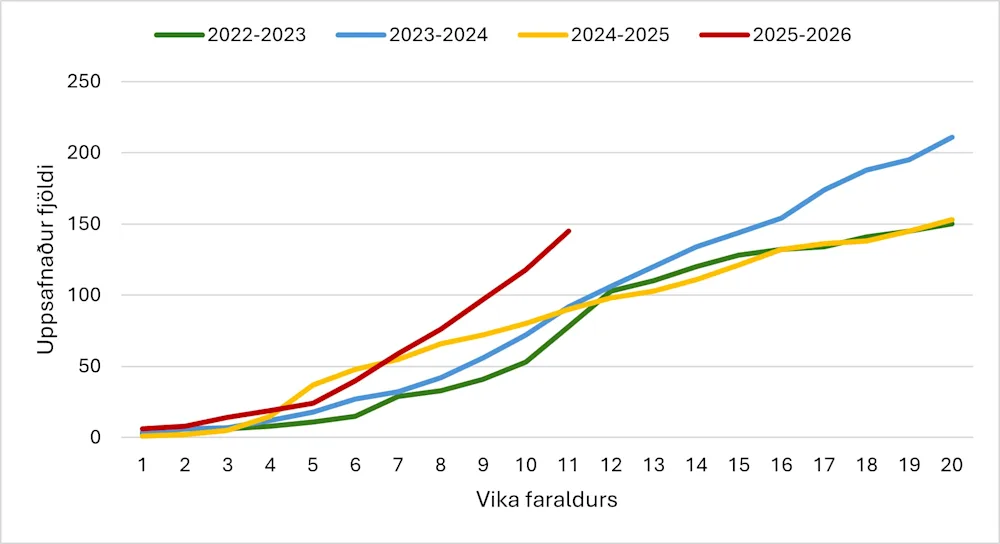
Figure: Cumulative number of admissions with/due to influenza at Landspítali during the first 11 weeks of the epidemic (year 2025 in red).
Other Respiratory Infections
RS Virus Infections
An RSV (respiratory syncytial virus) epidemic has not yet begun in Iceland, but in week 49 four cases were diagnosed: two children aged 1–2 years and two children under one year of age.
This winter, children born on 1 May 2025 or later are offered antibodies against RSV (nirsevimab), in addition to children aged 6–23 months who would otherwise have been offered palivizumab by the Children’s Hospital (Barnaspítali Hringsins) during the RSV season. Children born this winter, roughly until 31 March 2026, will be able to receive antibodies against RSV shortly after birth.
Further information on RSV infections and RSV immunization can be found on the website of the Directorate of Health.
COVID-19
The number of COVID-19 cases has remained fairly stable in recent weeks. In week 49, nine individuals were diagnosed: five in the 65+ age group, one aged 15–64 years, one aged 4–15 years, and two under 5 years old. Two individuals were hospitalized at Landspítali with COVID-19, one older than 65 years and one aged 15–64 years.
Other viruses
Of other respiratory viruses besides those mentioned above, rhinovirus (common cold) is detected the most at the Department of Microbiology and Virology at Landspítali. Over the past month, the weekly number of rhinovirus detections has ranged from 20–40, and in week 49, 28 individuals were diagnosed with rhinovirus.
Situation in Europe
In EU/EEA countries, the number of patients seeking primary care for respiratory illness symptoms is above epidemic thresholds in roughly half of the countries. This indicates substantial circulation of infections at present.
Influenza incidence continues to rise, and most countries report widespread transmission. Influenza A is dominant in all countries, with the A(H3N2) subtype being the most common. Transmission is highest among children aged 5–14 years. An increase in hospital admissions is seen in some countries across all age groups, but mainly among those aged 65 and older.
There is a slight increase in RSV circulation, but incidence remains lower than in recent winters. An increase in hospital admissions is observed in several countries, mainly among children under five years old.
The incidence of COVID-19 (SARS-CoV-2) infections is decreasing in all age groups, and hospital admissions are few.
Further information is available on the website of the European Centre for Disease Prevention and Control (ECDC).
The Chief Epidemiologist reminds people to:
Accept the influenza vaccination if you belong to a priority or risk group.
Accept the RSV monoclonal antibody for those infants where it is appropriate.
Stay at home while experiencing symptoms and until you are well on the way to recovery and fever-free for 24 hours.
Take special care around vulnerable individuals if you have symptoms of infection.
Minimize contact with others who show symptoms of infection.
Cover your mouth and nose when coughing or sneezing.
Wash your hands frequently and thoroughly.
Clean shared surfaces and ventilate shared spaces as much as possible.
Consider wearing a face mask depending on the situation.
The Chief Epidemiologist