15th April 2025
15th April 2025
This news article is more than a year old
Media report – Civil Protection level: Uncertainty level.
The short eruption has now been completed but the seismicity is still measured in the area but is decreasing.
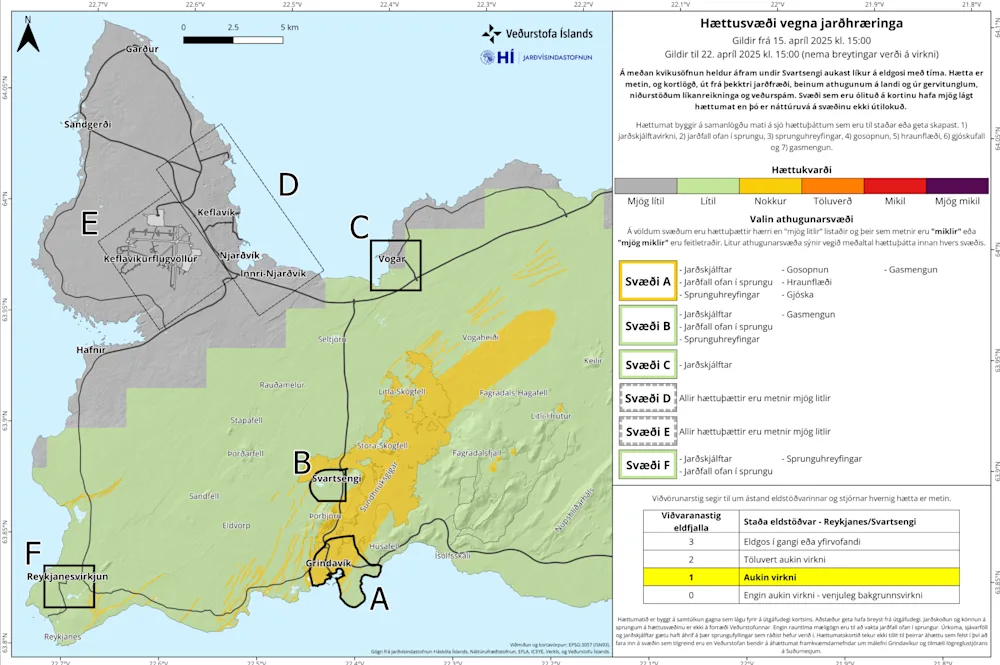
The eruption that started at 9:44 am on the morning of 1 April 2025 ended at 16:45 am on the same day and lasted for about 6 hours, making it the shortest eruption in this eruption cycle on the Sundhnúksgíga ridge. There are clear signs of a land rise in Svartsengi.
The Met Office updated the hazard assessment for the area earlier today, see hazard assessment map in the link, but its appearance has been changed in important respects. It applies until 22 April at 15:00, unchanged. See further at the link:
The National Commissioner of the Icelandic Police in consultation with the Chief of Police in Suðurnes decided on April 8th to move the Civil Protection level from a crisis level to an uncertainty level. A press release on the change in the Civil Protection level was published on the Civil Protection website at 16:37 that same day.
See the track:
The Implementation Committee for the Groundquake in Grindavík City updated the risk assessment for the urban area in Grindavík on April 9. The risk assessment was published on the website of Civil Protection on April 10th, see on the following link:
Results Based on the risk assessment of the engineering firm, which includes the Met Office’s hazard assessment and the protection measures that are in place and are constantly being worked on, the conclusion of the Executive Committee and the Department of Civil Protection is that the risk of all parties is moderate, which means that there is good protection against risks, but there is a certain uncertainty.
The risk assessment of the engineering firm Örugg is carried out for three areas, i.e. 1) eruption/explosion area, 2) Svartsengi and 3) Grindavík (urban area). The assessment is carried out for four groups, i.e. 1) responders, consultants and contractors, 2) residents, 3) companies and 4) external parties and tourists.
In Grindavík the risk is estimated to be moderate for all parties, but high at night for residents, outsiders and tourists. In the Svartsengi area the risk is estimated to be moderate for all parties. In the eruption/explosion area the risk is however very high for first responders, consultants and contractors and unacceptable for outsiders and tourists. It is recommended that non-responsive persons do not enter the eruption/explosion area.
Every morning, and during the day, there are checks to see if any defences have worked and if they have been repaired where necessary.
The risk assessment is valid until a new risk assessment is issued.
Implementation committee for the earthquake in Grindavíkurbær
Department of Civil Protection
The powers of the Chief of Police according to Article 23 of the law on civil protection no. 82/2008 do not work at the uncertainty level. At the uncertainty level the presence of the police and fire department is reduced into the urban area in Grindavík. Police do general surveillance in Grindavík town as well as in other municipalities in Suðurnes but do not have a permanent presence into Grindavík town.
The risk assessment of the Implementation Committee for the impact of the earthquake in Grindavík town includes the ability of the response team to monitor at night. The risk assessment does not include restrictions on access to the urban area in Grindavík. The Implementation Committee is responsible for the implementation of access control in Grindavík town in cooperation with the police.
Those who enter a crisis zone do so on their own responsibility. Thus, each individual is responsible for their own actions or lack of action.
All traffic to and from Grindavík is open. The Blue Lagoon is open as well as the hotel Northern Light Inn.
In the area south of Vogar and Reykjanesbraut, explosives have been searched for in the past. The area is considered to be contaminated by active and passive explosives that can cause human loss if they explode, but heat or movement can affect it. Location within 300 meters from the center of a large bomb can cause human loss.
In the area are bullets, mortars and training bombs. It is only for bomb experts to assess the condition and type of these bombs. Furthermore, no detailed information is available on the spread or size of this area but the Icelandic Coast Guard has drawn up the map below for information. In this area, first responders and others must stay at marked walking trails.
This danger is highlighted by signs that have been on the beginning of hiking trails for decades. Locals and outdoors people who have walked around the area know this. It is necessary to highlight these facts. It is recommended that the police chiefs inform tourists about this information to tourists and those who provide information to tourists. Tourists stay on marked hiking trails and trails.
There are no organized parking spaces nor any viewing facilities. Drivers do not park cars on and around Reykjanesbraut. The same applies to Grindavíkurvegur.
Conditions inside and outside of danger zones can change with little notice. In addition, dangers can be hidden outside the designated areas.
To raise awareness of the dangers, three warning whistles have been set up in Grindavík. One at the Blue Lagoon and another at HS energy in Svartsengi. They have been used with good results.
Emergency responders are working in Grindavík and police and firefighters are carrying out mandatory checks in the town as has been the case.
Useful information is on the website of the town of Grindavík on the site, then it is pointed to the website of the Icelandic Met Office on the site and the website of Civil Protection on the site.
Those who are visiting a crisis area are advised to visit the website of the Environment Agency of Iceland, at the following address: It also contains good guidelines.
Information is available on the website of the Directorate of Health, at: and the website of the Directorate of Labour, at: